I've dreamt in my life dreams that have stayed with me ever after, and changed my ideas: they've gone through and through me, like wine through water, and altered the color of my mind.
Emily Bronte
Wuthering Heights

Posts tonen met het label ANNE BRONTË. Alle posts tonen

zondag 22 mei 2022

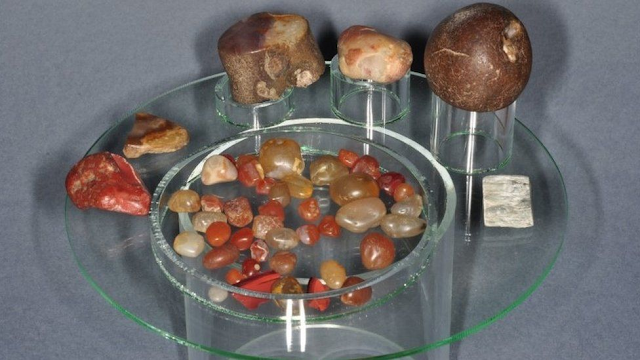
Author Anne Bronte was keen rock collector, research shows.


Anne Bronte was not only a talented writer but also a skilled rock collector interested in geology, researchers have revealed.

The youngest Bronte sister built up a collection of specimens before her death aged 29 in 1849.

It was thought she collected them for their aesthetic value, but research shared by Sally Jaspars has shown she was an informed geology fan.

Ms Jaspers is studying Bronte as part of a PhD at the University of Aberdeen.

She said: "Her interest in geology is mentioned in her literary works - indeed in The Tenant Of Wildfell Hall she references the science and a book by Sir Humphry Davy directly."


Ms Jaspers was helped by Stephen Bowden, from the university's School of Geosciences, who helped to analyse the collection housed at the Bronte Parsonage Museum in Haworth, West Yorkshire. 

Experts from the University of Leeds and a specialist spectroscopy company were also involved, and they found she had carnelians and agates which she collected in Scarborough, where she worked as a governess.

She also had flowstone and a rare kind of red obsidian, which originated outside of the UK.

vrijdag 17 januari 2020

Today we celebrate the 200th birthday of Anne Brontë.


Anne, the youngest member of the Brontë literary family, was born on 17 January 1820. Anne was born in the small Yorkshire village of Thornton on 17 January 1820, the sixth and last child of the Reverend Patrick Brontë, and his  wife Maria.

When Charlotte's friend Ellen Nussey visited Haworth in 1833, she reported that Emily and Anne were "like twins", "inseparable companions".

She described Anne: "Anne, dear gentle Anne was quite different in appearance from the others, and she was her aunt's favourite. Her hair was a very pretty light brown, and fell on her neck in graceful curls. She had lovely violet-blue eyes; fine pencilled eyebrows and a clear almost transparent complexion. 


Anne is called "gentle" Anne
  • But Anne had a 'core of steel'. She was gentle, but also brave. 
  • She published a volume of poetry with her sisters (Poems by Currer, Ellis, and Acton Bell, 1846) and two novels. Agnes Grey, based upon her experiences as a governess, was published in 1847. Her second and last novel, The Tenant of Wildfell Hall, which is considered to be one of the first sustained feminist novels, appeared in 1848. 
  • With her sister Emily she created "Gondal".

Here you can find all my posts about Anne Bronte: brontesisters/ANNE-BRONTË

donderdag 16 januari 2020

Nick Hollands "Anne Bronte 200 events" page.


My special Anne Bronte 200 website now has details on new Anne Bronte books and #AnneBronte200 events in Haworth, Bradford, Scarborough, Manchester and Brussels! 

On this page annebronte200/events we’ll be listing events celebrating Anne Brontë in 2020, and also news of publications relating to Anne Brontë and her sisters. If you have an event, or anything Anne related, you’d like me to publicise then please email me at annebronte200@hotmail.com.

With Anne’s big birthday just days away we are pleased to announce details of five Anne Brontë celebratory events – in Haworth, Scarborough, Bradford, Manchester and Brussels! Click on the individual pages to find out more!

We also have news of two very special Anne Brontë publications! There are also Anne related theatre productions coming soon in Huddersfield and Oldham – keep your eyes peeled for more details on this site soon

maandag 2 september 2019

Project Anne Brontë 200.

Project Anne Brontë 200 is an initiative run by a collective of musicians and poets, and headed by Pamela Nash*.  We are asking for your help to give the neglected Brontë sister centre stage and to further her legacy through the creation of new music for choirs as well as commemorative poetry in the run-up to 2020, the bicentenary of her birth.
"If Anne Brontë had lived ten years longer, she would have taken a place beside Jane Austen, perhaps even a higher place".... (novelist and poet George Moore, 1924).
 History has done a great disservice to Anne Brontë, and though she may now be stepping out from behind the veil, her contribution to literature still remains undervalued and unjustly overshadowed by her more celebrated siblings.  Until now, she has also been largely overlooked by composers, despite the striking musical affinities in her writing.   So we are appealing for you to join us in seizing the chance to address this under-representation of Anne and to shed new light on her through the powerful and magical medium of the choir, as we commission choral settings of her words - as well as specially-written poetry inspired by her.  crowdfunder/project-anne-bronte-200

donderdag 11 april 2019

Anne Bronte made 2 unfinished drawings of her pet spaniel Flossy.


On Anne Bronte made 2 unfinished drawings of her pet spaniel Flossy, gifted to her by her charges the Robinson girls. But there's also this sketch - it could be a Robinson girl with Flossy, but I think it's a self portrait of Anne and her beloved pet!


dinsdag 19 februari 2019

We have recently added a splendid edition of Anne Bronte’s controversial novel The Tenant of Wildfell Hall to our collection.


 The book has been donated, following a crowdfunding appeal, by Bonnets at Dawn, a social media/podcasting duo who regularly discuss the works of Jane Austen and the Bronte sisters, with occasional detours into the works of other nineteenth century female writers.  Bonnets at Dawn, otherwise known as Lauren Burke and Hannah K Chapman (based in the UK and the US),  have visited Elizabeth Gaskell’s House more than once and are now well acquainted with the stories of Charlotte’s visits to 84 Plymouth Grove and the controversies surrounding Elizabeth’s biography The Life of Charlotte Bronte.

Books by the Bronte sisters must be at the top of that list.  Elizabeth Gaskell never met Anne Bronte as she had already died before her first meeting with Charlotte, but she had heard much about her. Charlotte vividly described the life of all her family to the ever- eager listener at their meetings together. Anne is an integral character in the biography The Life of Charlotte Bronte even though Elizabeth never had the opportunity to form her own first-hand opinion. Read all: elizabethgaskellhouse

woensdag 17 januari 2018

"Like twins", "inseparable companions".


And then when Emily is 1 1/2 year old a baby sister is born in the  Bronte family
Anne Bronte
Birth on 17-01-1820


Fireplace in the dining room kleurrijkbrontesisters

As was the customary in those days, it’s likely that a local midwife would have helped with the birth and it would have taken place in front of the large fireplace that still forms the centre point of the building today annebronte

When Charlotte's friend Ellen Nussey visited Haworth in 1833, she reported that Emily and Anne were "like twins", "inseparable companions".

She described Anne: "Anne, dear gentle Anne was quite different in appearance from the others, and she was her aunt's favourite. Her hair was a very pretty light brown, and fell on her neck in graceful curls. She had lovely violet-blue eyes; fine pencilled eyebrows and a clear almost transparent complexion.

If we could travel back to the January day in 1820 and take a look at the baby Anne at Thornton Parsonage or the Brontë children at Kipping House just what would we see? We would see children just like any others, for when we look upon any infant in its cradle who can say what they will turn out to be or do? Baby Anne would grow up to be a very special woman indeed, one whose achievements are only now starting to be recognised. Wherever you are, stop to raise a glass of something cold or warm and say ‘Happy 198th birthday, Anne Brontë!’
annebronte/happy-198th-birthday-to-anne-bronte/

zondag 3 december 2017

A Brontë Advent – Haworth Christmas Events


What a beautiful photograph
I found it on the weblog from Nick Holland 

Anne Brontë was undoubtedly the most devout of the Brontë siblings, so she in particular would have loved the Advent celebrations advancing week by week in her father’s church a short walk from the parsonage she called home – such as the lighting of advent carols and the singing of hymns. Christmas music was a particular delight to Anne – so much so that she wrote a poem called ‘Music on Christmas Morning’, which begins:

‘Music I love – but never strain
Could kindle raptures so divine,
So grief assuage, so conquer pain,
And rouse this pensive heart of mine –
As that we hear on Christmas morn,
Upon the wintry breezes born.’

We can imagine this warming sight as Christmas day dawned at the Haworth Parsonage: Emily Brontë, a highly accomplished pianist, playing a carol while Anne, who Ellen Nussey said liked to sing in a quiet yet sweet voice, sang to her family.

The village of Haworth also loves music at Christmas – and indeed the Advent Christmas period as a whole is one of particular joy in this beautiful moorside village. In recent decades the modern tradition of ‘scroggling the holly’ has drawn the crowds, but there is no scroggling this year – fear not, for there are lots of other exciting activities coming that are great for Brontë lovers and families alike.

This weekend is ‘choral weekend’ – one the whole Brontë family would surely have enjoyed. The 9th of December is the night of the torchlight procession, a moving spectacle as folks in Victorian attire process up the steep and picturesque Main Street. Sunday the 10th is even more spectacular, as a there is a candelit carol procession from 4.30 which culminates in a traditional carol service at St. Michael and All Angels’ Church.

The Brontë Parsonage Museum is also particularly magical throughout December – particularly on Thursday 8th December – as there’s a chance to experience the parsonage by candlelight and then look at some of the Brontë treasures including manuscripts by Charlotte, Emily and Anne. It’s a tour I’ve done myself, and it truly is thrilling. Places are limited but you can find out more at the Brontë Society website here – where you’ll also find details of other events including Christmas wreath making workshops.

It’s certainly beginning to feel a lot like Christmas here in Yorkshire, by which I mean that it’s absolutely freezing of course, but life feels good when you wrap up warm and read a Brontë book with a warm drink near to hand!

woensdag 29 november 2017

Coming Soon Without the Veil Between Anne Brontë A Fine And Subtle Spirit Book Trailer


This book gives us Anne. Not Anne, the ‘less gifted’ sister of Charlotte and Emily (although we meet them too as convincingly drawn individuals); nor the Anne who ‘also wrote two novels’, but Anne herself, courageous, committed, daring and fiercely individual: a writer of remarkable insight, prescience and moral courage whose work can still astonish us today. ~ Deborah Bennison, Bennison Books https://booklaunch.io/dmdenton/withou... Thank you to Deborah Bennison of Bennison Books, author Thomas Davis, and author Mary Clark for words used in the text of this video. The music is Song Without Words, No 46 in C minor, OP 102 by Mendelssohn, Public Domain, Royalty Free music from Musopen

woensdag 8 maart 2017

International Women's Day: an apt passage form Anne's 'The Tenant of the Wildfell Hall'

“I am satisfied that if a book is a good one, it is so whatever the sex of the author may be. All novels are or should be written for both men and women to read, and I am at a loss to conceive how a man should permit himself to write anything that would be really disgraceful to a woman, or why a woman should be censured for writing anything that would be proper and becoming for a man.”

zondag 22 januari 2017

‘Take courage, Charlotte, take courage’.


Anne Brontë’s final words to her sister Charlotte were ‘Take courage, Charlotte, take courage’, and they have proved to be inspirational not only to her sister, but to people across the world over a century and a half later. Read all on this beautiful article of Nick Holland: annebronte/take-courage-the-final-words-of-anne-bronte/

dinsdag 17 januari 2017

Flowers for Anne's birthday.


Flowers for Anne's birthday
Thank you very much to the person who sends them every year -
they are much loved

donderdag 5 januari 2017

Take Courage: Anne Brontë and the Art of Life.

If you’ve read Samantha Ellis’s charming bibliomemoir How to be a Heroine – a heartwarming trip down memory lane as she looks back over the literary ladies that have shaped her life – you might be surprised to discover it’s Anne Brontë, the oft-overlooked 'third Beatle' of England’s most famous literary siblings, who’s the subject of her second book, Take Courage: Anne Brontë and the Art of Life.

Better known Charlotte and Emily were both integral to the journey recounted in How to be a Heroine, Ellis’s entire enterprise inspired by an argument with her best friend regarding the respective allure of passionate headstrong Cathy Earnshaw versus dependable independent Jane Eyre. The stories told in both Wuthering Heights and Jane Eyre are held aloft as grand romances, inspiring a host of adaptations, sequels and prequels from fan fiction through to Jean Rhys’s revisionist masterpiece, Wide Sargasso Sea. Similar approbation for Anne’s novel The Tenant of Wildfell Hall (1848), would be tricky since it lays bare the underbelly of the romance fantasy, taking a leading lady “who starts out like other Brontë heroines, charmed by a sexy dangerous man,” Ellis explains, “but she sees the light and leaves him.” As Ellis points out, this depiction of female agency was radical for its time. While readers today will no doubt find the story hugely "refreshing," it wasn’t exactly what people either expected or wanted in the mid 1800s.

This novel (Anne’s second and final work) is central to Ellis’s project though, her modus operandi being to “see Anne through the stories she told, not the stories told about her,” especially since when it comes to the latter, there are two significant stumbling blocks. Firstly, nowhere near as much is known about the baby Brontë as compared to her more famous sisters; and secondly, what is available has been filtered through Charlotte, who suppressed the publication of The Tenant of Wildfell Hall after Anne’s death (by then she was the only surviving sibling). Hence the image of the “virginal Victorian spinster, sweet and stoic, selfless and sexless, achieving very little before wasting away at twenty-nine” has held sway. Not least over Ellis herself. Until, that is, the day she was shown Anne’s last letter, written only five weeks before her death. Despite the writer’s failing health, Ellis is captivated by the “hope and spirit” she sees on the page.

As such, Take Courage is as much an account of Ellis’s own discovery of Anne's work as it is that of her subject’s life, and herein lies the book's unique appeal. Ellis – who is, it should be noted, as intelligent and perceptive a reader as she is an evocative storyteller – truly writes from the heart, which isn’t to say she hasn’t done her research. She has. But if you’re looking for a run-of-the-mill scholarly biography heavy with footnotes, this isn’t what Take Courage is. Instead it’s a deeply sympathetic and interesting re-evaluation of a woman ahead of her time who has much to teach us all about living courageously. independent/books/reviews/take-courage-anne-bronte

The Parlour

The Parlour

Parsonage

Parsonage

Charlotte Bronte

Presently the door opened, and in came a superannuated mastiff, followed by an old gentleman very like Miss Bronte, who shook hands with us, and then went to call his daughter. A long interval, during which we coaxed the old dog, and looked at a picture of Miss Bronte, by Richmond, the solitary ornament of the room, looking strangely out of place on the bare walls, and at the books on the little shelves, most of them evidently the gift of the authors since Miss Bronte's celebrity. Presently she came in, and welcomed us very kindly, and took me upstairs to take off my bonnet, and herself brought me water and towels. The uncarpeted stone stairs and floors, the old drawers propped on wood, were all scrupulously clean and neat. When we went into the parlour again, we began talking very comfortably, when the door opened and Mr. Bronte looked in; seeing his daughter there, I suppose he thought it was all right, and he retreated to his study on the opposite side of the passage; presently emerging again to bring W---- a country newspaper. This was his last appearance till we went. Miss Bronte spoke with the greatest warmth of Miss Martineau, and of the good she had gained from her. Well! we talked about various things; the character of the people, - about her solitude, etc., till she left the room to help about dinner, I suppose, for she did not return for an age. The old dog had vanished; a fat curly-haired dog honoured us with his company for some time, but finally manifested a wish to get out, so we were left alone. At last she returned, followed by the maid and dinner, which made us all more comfortable; and we had some very pleasant conversation, in the midst of which time passed quicker than we supposed, for at last W---- found that it was half-past three, and we had fourteen or fifteen miles before us. So we hurried off, having obtained from her a promise to pay us a visit in the spring... ------------------- "She cannot see well, and does little beside knitting. The way she weakened her eyesight was this: When she was sixteen or seventeen, she wanted much to draw; and she copied nimini-pimini copper-plate engravings out of annuals, ('stippling,' don't the artists call it?) every little point put in, till at the end of six months she had produced an exquisitely faithful copy of the engraving. She wanted to learn to express her ideas by drawing. After she had tried to draw stories, and not succeeded, she took the better mode of writing; but in so small a hand, that it is almost impossible to decipher what she wrote at this time.

I asked her whether she had ever taken opium, as the description given of its effects in Villette was so exactly like what I had experienced, - vivid and exaggerated presence of objects, of which the outlines were indistinct, or lost in golden mist, etc. She replied, that she had never, to her knowledge, taken a grain of it in any shape, but that she had followed the process she always adopted when she had to describe anything which had not fallen within her own experience; she had thought intently on it for many and many a night before falling to sleep, - wondering what it was like, or how it would be, - till at length, sometimes after the progress of her story had been arrested at this one point for weeks, she wakened up in the morning with all clear before her, as if she had in reality gone through the experience, and then could describe it, word for word, as it had happened. I cannot account for this psychologically; I only am sure that it was so, because she said it. ----------------------She thought much of her duty, and had loftier and clearer notions of it than most people, and held fast to them with more success. It was done, it seems to me, with much more difficulty than people have of stronger nerves, and better fortunes. All her life was but labour and pain; and she never threw down the burden for the sake of present pleasure. I don't know what use you can make of all I have said. I have written it with the strong desire to obtain appreciation for her. Yet, what does it matter? She herself appealed to the world's judgement for her use of some of the faculties she had, - not the best, - but still the only ones she could turn to strangers' benefit. They heartily, greedily enjoyed the fruits of her labours, and then found out she was much to be blamed for possessing such faculties. Why ask for a judgement on her from such a world?" elizabeth gaskell/charlotte bronte


Poem: No coward soul is mine

No coward soul is mine,
No trembler in the worlds storm-troubled sphere:
I see Heavens glories shine,
And faith shines equal, arming me from fear.


O God within my breast.
Almighty, ever-present Deity!
Life -- that in me has rest,
As I -- Undying Life -- have power in Thee!


Vain are the thousand creeds
That move mens hearts: unutterably vain;
Worthless as withered weeds,
Or idlest froth amid the boundless main,


To waken doubt in one
Holding so fast by Thine infinity;
So surely anchored on
The steadfast Rock of immortality.


With wide-embracing love
Thy Spirit animates eternal years,
Pervades and broods above,
Changes, sustains, dissolves, creates, and rears.


Though earth and man were gone,
And suns and universes ceased to be,
And Thou wert left alone,
Every existence would exist in Thee.


There is not room for Death,
Nor atom that his might could render void:
Thou -- Thou art Being and Breath,
And what Thou art may never be destroyed.


--
Emily Bronte

Family tree

The Bronte Family

Grandparents - paternal
Hugh Brunty was born 1755 and died circa 1808. He married Eleanor McClory, known as Alice in 1776.

Grandparents - maternal
Thomas Branwell (born 1746 died 5th April 1808) was married in 1768 to Anne Carne (baptised 27th April 1744 and died 19th December 1809).

Parents
Father was Patrick Bronte, the eldest of 10 children born to Hugh Brunty and Eleanor (Alice) McClory. He was born 17th March 1777 and died on 7th June 1861. Mother was Maria Branwell, who was born on 15th April 1783 and died on 15th September 1821.

Maria had a sister, Elizabeth who was known as Aunt Branwell. She was born in 1776 and died on 29th October 1842.

Patrick Bronte married Maria Branwell on 29th December 1812.

The Bronte Children
Patrick and Maria Bronte had six children.
The first child was Maria, who was born in 1814 and died on 6th June 1825.
The second daughter, Elizabeth was born on 8th February 1815 and died shortly after Maria on 15th June 1825. Charlotte was the third daughter, born on 21st April 1816.

Charlotte married Arthur Bell Nicholls (born 1818) on 29th June 1854. Charlotte died on 31st March 1855. Arthur lived until 2nd December 1906.

The first and only son born to Patrick and Maria was Patrick Branwell, who was born on 26th June 1817 and died on 24th September 1848.

Emily Jane, the fourth daughter was born on 30th July 1818 and died on 19th December 1848.

The sixth and last child was Anne, born on 17th January 1820 who died on 28th May 1849.

Top Withens in the snow.

Top Withens in the snow.

Blogarchief

LinkWithin

Related Posts with Thumbnails