I've dreamt in my life dreams that have stayed with me ever after, and changed my ideas: they've gone through and through me, like wine through water, and altered the color of my mind.
Emily Bronte
Wuthering Heights

Posts tonen met het label Hathersage in Derbyshire. Alle posts tonen

zondag 16 augustus 2020

Hathersage on the Charlotte Bronte, Jane Eyre trail.

Nick Holland: I'm in beautiful Hathersage on the Charlotte Bronte, Jane Eyre trail. Here's a short video:


twitter/Nick_Holland

The reason for Charlotte’s visit to Hathersage was that Ellen Nussey’s brother had been made vicar of the parish. Whilst Charlotte was there, Henry was on honeymoon with his new bride Emily Prescott (he had previously had a proposal rejected by Charlotte of course). Charlotte and Ellen were overseeing some renovations that Henry had ordered, and the beautiful parsonage building they stayed in was recreated as the home of the Rivers family in Morton:
‘I could not bear to return to the sordid village, where, besides, no prospect of aid was visible. I should have longed rather to deviate to a wood I saw not far off, which appeared in its thick shade to offer inviting shelter; but I was so sick, so weak, so gnawed with nature’s cravings, instinct kept me roaming round abodes where there was a chance of food. Solitude would be no solitude—rest no rest—while the vulture, hunger, thus sank beak and talons in my side.

dinsdag 9 april 2013

Henry Nussey finally married

In 1839 Henry Nussey proposed marriage to several young women of his acquaintance, including Charlotte Brontë. “I have no personal repugnance to the idea of a union with you,” she wrote in her unenthusiastic reply, but she claimed to refuse him for altruistic reasons: “mine is not the sort of disposition calculated to form the happiness of a man like you” (to HN, 5 Mar 1839). When he was – or thought he was – engaged later in the same year, she wrote honoring him for “not hunting after wealth” (to HN, 28 Oct 1839), but when he actually got engaged she told Ellen “I am glad . . . to hear that Henry is really going to be married, and still more so to learn that his wife elect has a handsome fortune” (to EN, 14 Nov 1844). blackwellreference

Emily Prescott was the daughter of a gentleman of Hampshire origins, and a citizen of Everton, whence she was married, with Ellen as bridesmaid. The latter’s first impressions were favorable: “She is very pious but very agreeably so and quite free from all affectation” (EN to Mary Gorham, 6 Aug 1845). These impressions proved false. “I could not live with one so cold and narrow,” Charlotte was soon writing, though she adds, unflatteringly for Ellen’s brother, “still I think she is just the person for Henry – she will obtain influence over him and keep it” (to EN, 8 Sep 1845).

Ellen Nussey was at Hathersage to prepare a home for her  brother, Henry Nussey, who had been appointed Vicar of  Hathersage, and had married Emily Prescott. His sister stayed at the Vicarage whilst he was on his honeymoon; she even had to select some of the furniture,  and engage the servants, and have everything in readiness for  the return of the bride and bridegroom. So anxious was she to persuade Charlotte Bronte to be with her at this time that she got her brother to write to Charlotte whilst he was on his honeymoon, " for which you deserve smothering," wrote Charlotte to Ellen Nussey in reply.

In Jane Eyre we can read a discription about this happening :

The three days were, as she had foretold, busy enough. I had thought all the rooms at Thornfield beautifully clean and well arranged; but it appears I was mistaken. Three women were got to help; and such scrubbing, such brushing, such washing of paint and beating of carpets, such taking down and putting up of pictures, such polishing of mirrors and lustres, such lighting of fires in bedrooms, such airing of sheets and feather-beds on hearths, I never beheld, either before or since. Mrs. Fairfax had pressed me into her service, and I was all day in the storeroom, helping (or hindering) her and the cook; learning to make custards and cheese-cakes and French pastry, to truss game and garnish desert-dishes.

Emily Prescott seems to have tried to make Ellen pay for her own washing while she remained with them at Hathersage after their return from their honeymoon, suggesting she was the sort of rich person who is bent on holding on to what she has. She and Henry did not remain long at Hathersage. He seems to have got on the wrong side of people in his new parish, including the Duke of Devonshire. Henry ceased to be a practicing clergyman (like many others in the Brontë story), and he and his wife lived for a time in the South of France. She died in Nice in 1907. The notion that they were unhappy in their marriage and separated seems to be untrue. ... blackwellreference

jane-eyre-hathersage-and-the-apostles-cupboard
---------------------------


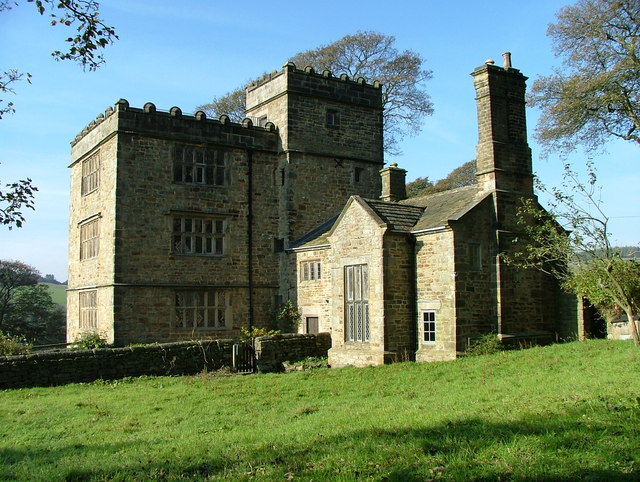
Charlotte Bronte visited Hathersage in 1845 and used it as the 'Norton' of the story 'Jane Eyre' - taking the heroine's surname from the local family. She also used North Lees Hall, an Elizabethan manor house 2km north of Hathersage as the house where Mrs Rochester jumped from the roof to her death. North Lees is one seven halls built by Robert Eyre of Highlow (there were many local Robert Eyres) for his seven sons and is one of the finest Elizabethan buildings in the region - a tall square tower with a long wing adjoining.
 

dinsdag 4 december 2012

Remembering Charlotte's visit

 
BBC News reports that 'Sixty holly trees will be planted in the Peak District National Park to celebrate the Queen's Diamond Jubilee' and includes an interesting piece of lore:
The trees will be planted at the Hollin Bank site near Stanage Edge, above the town of Hathersage, on 8 December.
Estate ranger Bill Gordon said Hollin Bank was a "fitting site" as Hollin is a traditional dialect word for holly.
Stanage Cottage used to stand on the site and had links back to the times of Queen Victoria, who also celebrated her Diamond Jubilee, Mr Gordon added.
"The cottage was built for the gamekeeper on the original shooting estate... and then became known as Hugh Thorp's cottage after the people who lived there in the 1800s.
"Hugh's wife lived to her 90s and remembered being at North Lees when Charlotte Brontë visited. So it is a historic site," said Mr Gordon.Remembering Charlotte's visit

zaterdag 11 augustus 2012

Hathersage Hall


NOT many people can boast their home has connections with such iconic and legendary figures as Little John and Charlotte Bronte. 
In 1845, Charlotte Brontë stayed at the Hathersage vicarage, visiting her friend Ellen Nussey, whose brother was the vicar, while she was writing Jane Eyre. Many of the locations mentioned in her novel match locations in Hathersage, the name Eyre being that of a local gentry family. Her "Thornfield Hall" for example is widely accepted to be North Lees Hall situated on the outskirts of Hathersage.

Today, Hathersage Hall is a superb combination of the best of both worlds – a house of immense historic character possessing every modern amenity.
The reception hall alone is 17ft by 13ft with a stone-flagged floor and stone archway leading to an inner hall with a cast-iron fireplace set on a stone hearth and access to a wine cellar. The spacious drawing room has another gritstone fireplace as the focal point plus shuttered sash windows that look out over the grounds. The elegant dining room has a spectacular original Tudor ceiling, exposed floor boards and could seat a small army at the dining table.
The hothouse has raised borders with specimen botanical plants and climbers plus a central water feature with lilies and an original gritstone fireplace at one end.
The hall also has a second conservatory at the front housing more unusual specimens, including a fig tree, and has double doors opening on to the front terrace.
One of most used rooms in the house is the enormous breakfast kitchen which is a typical fusion of the old and the new. Features include a superb custom-made and hand-painted range of yew wall and base units, a granite central breakfasting island, a classic twin Belfast sink, a four-oven Aga and a range of upmarket appliances, while mullioned windows, built-in window seats, oak beams, stone flagged floor and a massive stone fireplace with the original gritstone surround all add character.
On the first floor, the master bedroom, with its original 17th-century Tudor ceiling, has sash windows and window seat with amazing views across to Stanage Edge. Its accompanying en suite has a double-ended bath as well as a shower cubicle.
Five other bedrooms and a games room are served by two luxurious bathrooms while on the second floor there are another four bedrooms, one with an en suite. 
Read more:thisisderbyshire

maandag 6 februari 2012

North Lees Hall

North Lees Hall is one of seven houses built by Sir Robert Eyre for his seven sons in and around the village of Hathersage.  It is said to have been the inspiration for Thornfield Hall in Jane Eyre after Charlotte Bronte visited it while staying at the vicarage.  


The road to North Lees Hall is described in Charlotte Bronte’s book :
 “the road ( to Thornfield Hall ) is a soft mantle of greens in spring and a blaze of gold in the Autumn, being gently sheltered by the thicket of foliage of the English summer days. Peace walks with he, who treads this way.


stubbs family history/the-eyres-north-lees-and-jane-eyre-also-little-john-buried-hathersage-church/

cathy-smith.suite101

-------------
Charlotte Bronte visited Hathersage in 1845 to stay with her old school friend Ellen Nussey at Hathersage Rectory, whose brother was the vicar of the village and it was while he was away on his honeymoon that Charlotte arrived to keep her friend company for a few weeks during the summer.  On Irish rovers  you see pictures how a Derbyshire  summer looks.

Distance Haworth/ Hathersage. It was three stories high . . . a gentleman’s manor-house . . . battlements around the top gave it a picturesque look’


Grotere kaart weergeven
peakdistrictinformation/towns/villages


In 1845 Charlotte Brontë stayed at Hathersage vicarage with her friend Ellen Nussey and regularly visited the locally important Eyre family at North Lees Hall.  Charlotte’s letters reveal Hathersage as the village Morton in Jane Eyre (published 1847). The landlord of the George Inn was a Mr Morton at the time Brontë stayed here and she borrowed the Eyre family name for her heroine.  There’s a reference in the novel to ‘Mr Oliver’s needle factory’ in Morton, and there were several needle mills in Hathersage then.

The novel’s crenellated Thornfield is clearly based on North Lees Hall. Robert Eyre is said to have built seven houses for seven sons and you can still see North Lees, an impressive Tudor manor just a short pleasant walk from the village.  It is rumoured there was indeed a ‘mad woman in the attic’ in its early history, just like Bertha Mason in Brontë’s novel. Agnes Ashurst was ‘reputed to have become demented and was confined to a room on the second floor where the walls were padded for her safety’. She later died in a fire.

‘Ladies, keep off, or I shall wax dangerous.’
And dangerous he looked:  his black eyes darted sparks.

the squeee/in-charlotte-brontes-footsteps
diane-heartshaped/hathersage-walk

zondag 5 februari 2012

Charlotte Bronte visiting Hathersage in Derbyshire.


Charlotte Bronte is usually associated with the village of Haworth in Yorkshire as this is where most of her novels are set. But possibly her most famous novel, Jane Eyre, seems to be set in the small village of  Hathersage in Derbyshire. In the summer of 1845 Charlotte visited this village in the heart of the Peak District. She was 29 and had come to stay with her old school friend Ellen Nussey at the Rectory. 
Charlotte arrived by stage coach which stopped at the George Inn. Local historians are keen to point out how she used her visit to great effect in collecting impressions for her famously passionate novel, published a couple of years later. In Chapter 11 we find Jane newly arrived and waiting nervously in The George to meet her new employer; the dashing Mr. R. 
" A new chapter in a novel is something like a new scene in a play; and when I draw up the curtain this time, reader, you must fancy you see a room in the George Inn at Millcote, with such large figured papering on the walls as inn rooms have; such a carpet, such furniture, such ornaments on the mantelpiece, such prints, including a portrait of George the Third, and another of the Prince of Wales, and a representation of the death of Wolfe. All this is visible to you by the light of an oil lamp hanging from the ceiling, and by that of an excellent fire, near which I sit in my cloak and bonnet; my muff and umbrella lie on the table, and I am warming away the numbness and chill contracted by sixteen hours’ exposure to the rawness of an October day… ": 
It was on one of the tombstones in the graveyard of St. Michael’s Church that Charlotte saw the local family name ’Eyre’ which she chose to adopt for her heroine. During her stay she took the opportunity to explore, walking on the moors and visiting many of the houses scattered around the area. One of these houses, the crenellated North Lees, is said to be the model for Thorn Field Hall, home of Mr. Rochester and the place where he and Jane fell in love. The George Inn which still stands on the main street has been welcoming travellers for over 500 years, first as an alehouse, and, since 1770, as an inn. homesteadbb.free-online.co.uk/derbys

www.george-hotel


The Parlour

The Parlour

Parsonage

Parsonage

Charlotte Bronte

Presently the door opened, and in came a superannuated mastiff, followed by an old gentleman very like Miss Bronte, who shook hands with us, and then went to call his daughter. A long interval, during which we coaxed the old dog, and looked at a picture of Miss Bronte, by Richmond, the solitary ornament of the room, looking strangely out of place on the bare walls, and at the books on the little shelves, most of them evidently the gift of the authors since Miss Bronte's celebrity. Presently she came in, and welcomed us very kindly, and took me upstairs to take off my bonnet, and herself brought me water and towels. The uncarpeted stone stairs and floors, the old drawers propped on wood, were all scrupulously clean and neat. When we went into the parlour again, we began talking very comfortably, when the door opened and Mr. Bronte looked in; seeing his daughter there, I suppose he thought it was all right, and he retreated to his study on the opposite side of the passage; presently emerging again to bring W---- a country newspaper. This was his last appearance till we went. Miss Bronte spoke with the greatest warmth of Miss Martineau, and of the good she had gained from her. Well! we talked about various things; the character of the people, - about her solitude, etc., till she left the room to help about dinner, I suppose, for she did not return for an age. The old dog had vanished; a fat curly-haired dog honoured us with his company for some time, but finally manifested a wish to get out, so we were left alone. At last she returned, followed by the maid and dinner, which made us all more comfortable; and we had some very pleasant conversation, in the midst of which time passed quicker than we supposed, for at last W---- found that it was half-past three, and we had fourteen or fifteen miles before us. So we hurried off, having obtained from her a promise to pay us a visit in the spring... ------------------- "She cannot see well, and does little beside knitting. The way she weakened her eyesight was this: When she was sixteen or seventeen, she wanted much to draw; and she copied nimini-pimini copper-plate engravings out of annuals, ('stippling,' don't the artists call it?) every little point put in, till at the end of six months she had produced an exquisitely faithful copy of the engraving. She wanted to learn to express her ideas by drawing. After she had tried to draw stories, and not succeeded, she took the better mode of writing; but in so small a hand, that it is almost impossible to decipher what she wrote at this time.

I asked her whether she had ever taken opium, as the description given of its effects in Villette was so exactly like what I had experienced, - vivid and exaggerated presence of objects, of which the outlines were indistinct, or lost in golden mist, etc. She replied, that she had never, to her knowledge, taken a grain of it in any shape, but that she had followed the process she always adopted when she had to describe anything which had not fallen within her own experience; she had thought intently on it for many and many a night before falling to sleep, - wondering what it was like, or how it would be, - till at length, sometimes after the progress of her story had been arrested at this one point for weeks, she wakened up in the morning with all clear before her, as if she had in reality gone through the experience, and then could describe it, word for word, as it had happened. I cannot account for this psychologically; I only am sure that it was so, because she said it. ----------------------She thought much of her duty, and had loftier and clearer notions of it than most people, and held fast to them with more success. It was done, it seems to me, with much more difficulty than people have of stronger nerves, and better fortunes. All her life was but labour and pain; and she never threw down the burden for the sake of present pleasure. I don't know what use you can make of all I have said. I have written it with the strong desire to obtain appreciation for her. Yet, what does it matter? She herself appealed to the world's judgement for her use of some of the faculties she had, - not the best, - but still the only ones she could turn to strangers' benefit. They heartily, greedily enjoyed the fruits of her labours, and then found out she was much to be blamed for possessing such faculties. Why ask for a judgement on her from such a world?" elizabeth gaskell/charlotte bronte


Poem: No coward soul is mine

No coward soul is mine,
No trembler in the worlds storm-troubled sphere:
I see Heavens glories shine,
And faith shines equal, arming me from fear.


O God within my breast.
Almighty, ever-present Deity!
Life -- that in me has rest,
As I -- Undying Life -- have power in Thee!


Vain are the thousand creeds
That move mens hearts: unutterably vain;
Worthless as withered weeds,
Or idlest froth amid the boundless main,


To waken doubt in one
Holding so fast by Thine infinity;
So surely anchored on
The steadfast Rock of immortality.


With wide-embracing love
Thy Spirit animates eternal years,
Pervades and broods above,
Changes, sustains, dissolves, creates, and rears.


Though earth and man were gone,
And suns and universes ceased to be,
And Thou wert left alone,
Every existence would exist in Thee.


There is not room for Death,
Nor atom that his might could render void:
Thou -- Thou art Being and Breath,
And what Thou art may never be destroyed.


--
Emily Bronte

Family tree

The Bronte Family

Grandparents - paternal
Hugh Brunty was born 1755 and died circa 1808. He married Eleanor McClory, known as Alice in 1776.

Grandparents - maternal
Thomas Branwell (born 1746 died 5th April 1808) was married in 1768 to Anne Carne (baptised 27th April 1744 and died 19th December 1809).

Parents
Father was Patrick Bronte, the eldest of 10 children born to Hugh Brunty and Eleanor (Alice) McClory. He was born 17th March 1777 and died on 7th June 1861. Mother was Maria Branwell, who was born on 15th April 1783 and died on 15th September 1821.

Maria had a sister, Elizabeth who was known as Aunt Branwell. She was born in 1776 and died on 29th October 1842.

Patrick Bronte married Maria Branwell on 29th December 1812.

The Bronte Children
Patrick and Maria Bronte had six children.
The first child was Maria, who was born in 1814 and died on 6th June 1825.
The second daughter, Elizabeth was born on 8th February 1815 and died shortly after Maria on 15th June 1825. Charlotte was the third daughter, born on 21st April 1816.

Charlotte married Arthur Bell Nicholls (born 1818) on 29th June 1854. Charlotte died on 31st March 1855. Arthur lived until 2nd December 1906.

The first and only son born to Patrick and Maria was Patrick Branwell, who was born on 26th June 1817 and died on 24th September 1848.

Emily Jane, the fourth daughter was born on 30th July 1818 and died on 19th December 1848.

The sixth and last child was Anne, born on 17th January 1820 who died on 28th May 1849.

Top Withens in the snow.

Top Withens in the snow.

Blogarchief

LinkWithin

Related Posts with Thumbnails