I've dreamt in my life dreams that have stayed with me ever after, and changed my ideas: they've gone through and through me, like wine through water, and altered the color of my mind.
Emily Bronte
Wuthering Heights

Posts tonen met het label Housekeeping in the Victorian period. Alle posts tonen

woensdag 15 januari 2014

The fireplace was considered the heart of the home.

 
The old Parsonage at Thornton. Pictured above is the fireplace at the old Parsonage where Charlotte, Branwell, Emily and Anne were born
 
Until quite recently, coal fires were the only form of heating for most homes and would have been lit every day.


Each morning the grates had to be cleaned out, and the fire ‘laid’, usually with pieces of rolled up newspaper which had small pieces of wood known as kindling laid on top with the coal going on top of that. The wood had to be chopped small and the coal had to be fetched from the coal house outside. The fire would be lit and then more small pieces of coal added until the fire was burning brightly, when larger pieces of coal could be added.
Sometimes the paper or wood was damp, or the wind blew down the chimney, and the fire would not burn properly. This was when the bellows came in useful.  Most Victorian homes kept a small ornamental but working pair of bellows on the hearth. The metal end would be placed at the bottom of the grate and the bellows opened and closed to create a current of air under the fire, which would help it to burn up more quickly. Even the kitchen had a fire. madeintheblackcountry

Generally most fireplaces of the 18th and 19th c. kept you roasting on one side and freezing on the other. A gadget from those days was the fire screen, a device meant to shield a lady’s face from the heat of the fire, while the rest of her person stayed cozily warmed. victoriandecorating

maandag 9 december 2013

Queen Victoria's Book of Spells and more about gaslight in Victorian times.

I always love it very much when I have a reaction.  Roses and Vellum tells me:

Gaslamps are so beautiful. It is funny to think something so beautiful and nostalgic to us now was strange and futuristic back then. I have been reading recently, and there was a story (Smithfield by James P Blaylock) about the lighting of the gaslamps for the first time, it was quite fascinating to think about.

Thank you for your reaction. Yes, It is fascinating to think about the days that gaslight was new.  Your reaction also made me curious. I never heard about Queen Victoria's Book of Spells. So I was searching for it.  I found this nice weblog:  suzanne-johnson/drive-by-review-and-cntest-queen
 
ABOUT QUEEN VICTORIA’S BOOK OF SPELLS: “Gaslamp Fantasy,” or historical fantasy set in a magical version of the nineteenth century, has long been popular with readers and writers alike. A number of wonderful fantasy novels, including Stardust by Neil Gaiman, Jonathan Strange and Mr Norrell by Susanna Clarke, and The Prestige by Christopher Priest, owe their inspiration to works by nineteenth-century writers ranging from Jane Austen, the Brontës, and George Meredith to Charles Dickens, Anthony Trollope, and William Morris. And, of course, the entire steampunk genre and subculture owes more than a little to literature inspired by this period….Queen Victoria’s Book of Spells is an anthology for everyone who loves these works of neo-Victorian fiction, and wishes to explore the wide variety of ways that modern fantasists are using nineteenth-century settings, characters, and themes. These approaches stretch from steampunk fiction to the Austen-and-Trollope inspired works that some critics call Fantasy of Manners, all of which fit under the larger umbrella of Gaslamp Fantasy. The result is eighteen stories by experts from the fantasy, horror, mainstream, and young adult fields, including both bestselling writers and exciting new talents such as Elizabeth Bear, James Blaylock, Jeffrey Ford, Ellen Kushner, Tanith Lee, Gregory Maguire, Delia Sherman, and Catherynne M. Valente, who present a bewitching vision of a nineteenth century invested (or cursed!) with magic.
 
Wow, there really is a lot to read, I never heard from before.
 
On another website I found more about gaslight buildingconservation/lighting
 
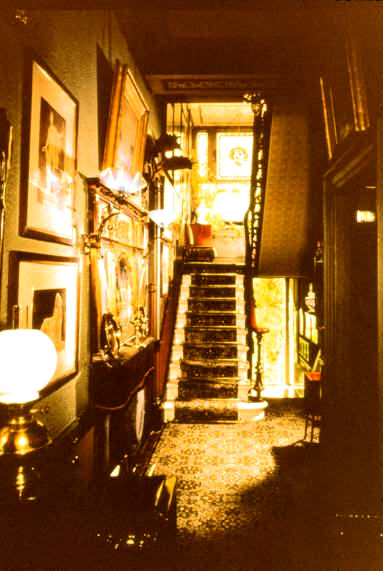
At the start of the Victorian period most houses were lit by candles and oil lamps. Interior fittings included chandeliers (suspended from the ceiling) and sconces (fixed to the wall). However these were mainly used on special occasions, and most ordinary events after sunset took place using portable light sources such as candlesticks, candelabra (bracketed candlesticks) and oil lamps, and by the light of the fire. By the end of the period gas lighting was common in urban homes and electricity was being introduced in many. Gas lighting of buildings and streets began early in the 19th century, with most streets in London lit by gas as early as 1816. But for the first 50 years it was generally distrusted and few homes were lit. After gas fittings were introduced in the new Houses of Parliament in 1859 the tide turned. Fasionable town houses constructed in the 1860s often had a central pendant gas light (that is to say a gas light attached to the ceiling) in each of the principal rooms with a ventilation grille above, cunningly disguised in the deep recesses of the ceiling rose. Gas 'wall brackets' were used in place of the sconce, and some staircases were lit by newel lights attached to the newel post. The largest pendant fittings had several burners and were known as gasoliers.

 
Late 19th century paraffin lamp and gas wall brackets in the entrance hall of the Linley Sambourne House, London. (Victorian Society, Linley Sambourne House, London/Bridgeman Art Library)

Before the advent of the incandescent mantle, gas lighting relied on a simple open flame. By the mid 19th century the most common burners produced fan-shaped flames like the Batswing and Fish Tail burners. The Argand burner, which was successfully adapted for gas, was the principal exception with its circular flame.

All these gas light fittings and the early incandescent mantles had to point upwards directing the light towards the ceiling and away from where the light was needed most, and it was not until 1897 that the gas mantle was adapted to burn downwards - a useful event to remember when dating gas fittings.

 
Simple gas lights incorporated a plain brass, copper or iron gas supply tube with a tap for switching the gas on and off, terminating in a burner shielded from direct view by a shade or globe to diffuse the light. Some burners such as the Argand also incorporated a glass tube or chimney, and around which could be placed a larger shade of glass or silk. Pendant lights could consist of little more than a vertical rod turned at right angles at the end to support the up-turned burner, but they were rarely that simple in the Victorian period. Every element of the gas light offered an opportunity for embellishment. Early pendant fittings often incorporated two or more arms forming a loop, gracefully curving down around the glass lamp shade, with the lamp cradled below. In another design scrolling arms radiated from a central baluster, a design echoed by the scrolling arms of the wall brackets.

The shades provided another opportunity for embellishment. Most glass shades were translucent, either frosted or coloured and were often extremely ornate, with cut glass decoration or etched patterns. The most elaborate shapes appeared at the end of the 19th century when designs reached their most opulent in the Louis XV revival. As well as ornate silk shades on lamps with chimneys, a variety of other more delicate devices were introduced at different times, such as shades of glass beads.

By 1890 main stream taste had begun to change dramatically. Although William Morris, the father of the Arts and Crafts Movement, had established Morris and Co almost 40 years earlier, it was the second generation of craftsmen who started to manufacture products on a larger scale, often adopting the industrial processes reviled by Morris. One of the greatest and most prolific designers of the new style was W A S Benson who, with the encouragement of William Morris, had set up his own workshop making light fittings and other metalwork. His fittings, like those of many of his contemporaries, were mass-produced, selling through Liberty's in London in particular.

The Arts and Crafts style swept out the clutter from the Victorian interior, leaving them lighter and brighter in every sense. Richly decorated surfaces were replaced by plain ones relying on the warmth of natural materials
and simple craftsmanship for their interest. Those elements like the fireplaces and light fittings which remained as richly ornamented as ever before took on a new importance, focussing attention. Often the decoration of fittings can be described as 'Art Nouveau' for their graceful, flowing lines and lack of any clear historical influence, but revivalism remained common, and most homes at the turn of the 19th century borrowed heavily from the Tudor and Elizabethan periods in particular.

zondag 17 februari 2013

On this day in 1855 Tabitha Aykroyd "Tabby" faithful servant of the Bronte family died aged 85.


Almost nothing is known of Tabitha's life before she entered the Parsonage in 1824 aged 53. She was almost certainly a native of Haworth, and we know of two sisters; Rose, who married a Bingley man called Bower, and Susannah, who married a Haworth man called Wood. Tabitha never married, and while there is no record of her life before she entered the Parsonage, it is thought that she had worked in domestic service and on farms.

Living at the Parsonage 'Tabby' was the Cook/Housekeeper and for the first 15 of her 31 years at the Parsonage, she was the only servant living in, although the Brontë sisters themselves also cooked, cleaned and washed clothes. In December 1836 Tabby slipped on ice in Haworth's main street, badly breaking her leg. Aunt Branwell suggested that she leave the Parsonage to be nursed by her sister Susannah, but the Brontë children objected, even going on hunger strike, and Tabby stayed in the Parsonage nursed by the children. The leg never fully healed however, and over the next 3 years many of Tabby's duties were taken up by Emily.

In 1839 Tabby seems to have retired temporarily, moving into a house in Newell Hill that she had bought with her now-widowed sister Susannah. Mr. Brontë engaged Martha Brown, the 11 year old daughter of his Sexton, John Brown, but the greater part of the skilled and the heavy work fell upon the Brontë girls, with Emily becoming Housekeeper. In 1842, Tabby moved back into the Parsonage where she stayed, sharing the little servants' bedroom with young Martha, for the next 13 years. Tabby died in February 1855 and she is buried with her sister Susannah, and a George Aykroyd who may be a brother, just over the wall from the Parsonage garden.

Personality; Influence
According to Mrs. Gaskell, Tabby "abounded in strong practical sense and shrewdness. Her words were far from flattery; but she would spare no deeds in the cause of those whom she kindly regarded"(The Life of Charlotte Brontë 1857). Mrs. Brontë had been dead for 3 years when Tabby came to the Parsonage and the children were looked after by their mother's sister, Elizabeth Branwell. A year after Tabby's arrival, the two eldest children, Maria and Elizabeth, died of consumption. Charlotte and Emily were only nine and seven years old at the time, and as they at least had only a formal relationship with their Aunt Branwell, they found physical and emotional warmth in the kitchen. Tabby was fond of her "childers" and they were fond of her. As Charlotte later wrote, "she was like one of our own family". Tabby took the girls for their walks on the moors, and, with her old-fashioned ways and broad Haworth accent, she was sometimes the butt of their boisterous games.


Tabby was a great storyteller. She knew all the local families, all their complex inter-relationships and disputes, and, despite her belief in the Christian teachings of divine reward and retribution, she held also to the ancient anthropomorphic traditions of the countryside, claiming (according to Mrs. Gaskell) to have known people who had seen the fairies. Emily, who spent more time working in the kitchen than either of her sisters, was particularly close to Tabby, and Tabby's influence permeates the landscape of Wuthering Heights. Tabby has also been identified as the model for Nelly Dean in Wuthering Heights, and for the housekeeper Martha in Charlotte's novel Shirley.
bronteparsonage/tabitha-aykroyd

Ellen “Nelly” Dean

Ellen, or Nelly Dean, is the housekeeper of Thrushcross Grange as the novel begins and is the servant of both Catherines. Intelligent and compassionate, she is often more of a friend or relative to the characters in the book than a servant. Consequently, she knows more of the story than anyone else so is able to fill Mr Lockwood in on events.
wuthering-heights.

Quotes
(Childhood) … I was almost always at Wuthering Heights; because my mother had nursed Mr. Hindley Earnshaw … and I got used to playing with the children: I ran errands too, and helped to make hay, and hung about the farm ready for anything that anybody would set me to.
(1801, aged 43) At this diabolical violence I [Ellen] rushed on him furiously. 'You villain!' I began to cry, 'you villain!' A touch on the chest silenced me: I am stout, and soon put out of breath; and, what with that and the rage, I staggered dizzily back and felt ready to suffocate, or to burst a blood-vessel.
(1801, aged 44) ' … you [Ellen], my good friend, are a striking evidence against that assertion. Excepting a few provincialisms of slight consequence, you have no marks of the manners which I am habituated to consider as peculiar to your class. I am sure you have thought a great deal more than the generality of servants think. You have been compelled to cultivate your reflective faculties for want of occasions for frittering your life away in silly trifles.'
' … but I [said Ellen] have undergone sharp discipline, which has taught me wisdom; and then, I have read more than you would fancy, Mr. Lockwood. You could not open a book in this library that I have not looked into, and got something out of also … '’

 
Sarah Lancashire who plays Nelly Dean

Sarah, 44, describes Nelly as the go-between for Cathy and Heathcliff. “She feels terribly protective of them. What we don’t see in our adaptation, but is written in the book, is that Nelly grew up with Cathy. It was Nelly’s mother who was in service at Wuthering Heights, so the two of them almost have a sibling relationship separated by their status.
“Nelly also raised Heathcliff so she has maternal feelings towards them both. Nelly’s life is undoubtedly Cathy, because she herself has never married or had children of her own. She’s very much a woman in service bound to the family.”
Despite her role as carer, Sarah says Nelly is helpless when it comes to Cathy and Heathcliff’s relationship.
“I don’t think Nelly has any influence or control over how they feel for each other,” she says. “Brutally bound by her status in life, Nelly is incapable of intervening to prevent their relationship. All she can do is stand back from it all.”
Wuthering Heights was filmed last year in areas of West Yorkshire, on vast areas of moorland and stone-built manor houses including East Riddlesden Hall, near Keighley, and Oakwell Hall at Birstall. Did the rugged Yorkshire landscape help Sarah identify with the story?
bronteblog/wuthering-heights


vrijdag 3 augustus 2012

A reader asked me: Is er ook iets bekend over breiwerk in die tijd ( Victoriaanse lace ? In the Victorian age, what kind of knitting did women do?)


If the end of the 18th Century heralded the decline of the handknitting industry
The 19th century heralded the beginning of the craft of home-knitting for pleasure rather than profit. 

This was the time of white cotton work, doilies, chair backs, curtains, shelf edgings etc.
If an article could be knitted, then the Victorian lady knitted it.

  • By 1835 knitting had become a very fashionable hobby for middle class drawing rooms of England and Scotland
  • Between 1835-40, English knitting books appeared in large numbers, these were very popular
  • New imported yarns, fine wools and improved quality needles now became available
  • 1836 is the date of first known pattern publication, this was by Jane Gaugain.
  • In 1837, Jane produced a small slim book on family knitting
  • In 1840, she published a bookThe Ladies Assistant which included crochet as well as knitting
  • between 1852-3, she produced lots of books, they contained patterns for
    caps, counterpanes, purses, baby clothes, shawls, bags, pin cushions, doyleys, cuffs, spencers, blankets,
    muffs, scarfs, mittens, and stockings
  • It was in about 1837, in Gaitloch, Scotland that the first Argyle or Tartan stockings were produced Mini knitting stuff
Lacy and lush, with delightful flower patterns and lovely colors – that is what the Victorian look is all about; it is what Victorian knitting and crochet were all about, too. From delightfully flattering clothes to wonderfully luxurious bed coverings, Victorian women loved to stitch gorgeous items in dainty patterns. Nowadays, it’s easy to make the same kinds of wonderful pieces yourself. Sources abound for yarns and patterns with that unmistakable Victorian appeal.

Coverlets were one of the most exquisite knitted items in any Victorian home. They were a lavish mix of many floral lace patterns, creating a look of opulence. According to legendary knitting expert Mary Thomas’s Book of Knitting Patterns, “lace knitting” is “the height of the knitter’s art,” and to achieve the best results “knitters used the finest of knitting needles and the doilyfinest of knitting yarns.” Delicate designs such as bluebell, laburnum, and beech-leaf captured the beauty of the garden with leaf and flower motifs. 
Another essential for any Victorian knitter was the doily. Ladies of the era pulled out all the stops when they crafted these delightful accents, using often a dozen lace designs in a single piece. Crochet was also a popular method for crafting doilies, as well as similar items such as vase mats – thicker and smaller doilies meant to keep furniture free of water spots. Three-dimensional flowers graced the edges of many crocheted doilies, with the same styles of leaf motifs found in knitting – adding to it flowered charm.
 
Knit and Crochet Fashions: Stepping Out in Lace and Luxury
 
knitted shawl
Clothes were another way for a Victorian lady to enjoy hand-knit lace.  Shawls were a favorite accessory. Some were simple one-stitch designs, while others were lavish, with ornate patterns, scalloped edges, and long fringe. For more warmth, shawls were often crafted from non-lacy patterns, such as garter stitch or double crochet, and then enhanced with a lacy edge. Whether they were lacy or cozy, shawls were often trimmed with ribbon and made in fashionable hues of red, mauve, and blue. Victoriana/VictorianCrafts/knitting

Charlotte Bronte in Jane Eyre:
Women are supposed to be very calm generally; but women feel just as men feel; they need exercise for their faculties and a field for their efforts as much as their brothers do; they suffer from too rigid a restraint, too absolute a stagnation, precisely as men would suffer; and it is narrow-minded in their more privileged fellow-creatures to say that they ought to confine themselves to making puddings and knitting stockings, to playing on the piano and embroidering bags. It is thoughtless to condemn them, or laugh at them, if they seek to do more or learn more than custom has pronounced necessary for their sex.  

The Professor: Next day was appropriated to the first class; on my arrival, I found the directress seated, as usual, in a chair between the two estrades, and before her was standing Mdlle. Henri, in an attitude (as it seemed to me) of somewhat reluctant attention. The directress was knitting and talking at the same time.

vrijdag 8 april 2011

Housekeeping in the Victorian period.


Mr. Brontë had intended that his second daughter, Elizabeth, should be a housekeeper, and the other four, governesses. The only paid employment that Emily ever undertook was teaching at the Law Hill School near Halifax in 1838, and she lasted only six months. Emily Brontë was only ever happy at home; she enjoyed housekeeping, and she enjoyed the company of the family's elderly servant, Tabitha Aykroyd.


Nancy and Sarah Garr had accompanied the Bronte family in Thornton in 1820. Nancy had joined the family as a nurse-maid, but was later promoted to cook and assistant housekeeper. In 1824 Nancy married. Sarah emigrated to America.

In 1821, Elizabeth Branwell travelled up to Yorkshire and moved into the Parsonage to nurse her dying sister and help run the household. She subsequently spent the rest of her life there raising the Brontë children - to whom she was known as 'Aunt Branwell'. She provided much of the children's education, including needlework and embroidery for the girls. After Aunt Branwell died in 1842 Emily took on the role of housekeeper helping out in the kitchen.

Since 1826, 'Tabby' was the cook/housekeeper and for the first 15 of her 31 years at the Parsonage, she was the only servant living in, although the Brontë sisters themselves also cooked, cleaned and washed clothes.

In December 1836 Tabby slipped on ice in Haworth's main street, badly breaking her leg. Aunt Branwell suggested that she leave the Parsonage to be nursed by her sister Susannah, but the Brontë children objected, even going on hunger strike, and Tabby stayed in the Parsonage nursed by the children. The leg never fully healed however, and over the next 3 years many of Tabby's duties were taken up by Emily. Emily cooked and ironed.

In 1839 Tabby seems to have retired temporarily, moving into a house in Newell Hill that she had bought with her now-widowed sister Susannah. Mr. Brontë engaged Martha Brown, the 11 year old daughter of his Sexton, John Brown, but the greater part of the skilled and the heavy work fell upon the Brontë girls, with Emily becoming Housekeeper. In 1842, Tabby moved back into the Parsonage where she stayed, sharing the little servants' bedroom with young Martha, for the next 13 years.

Martha's duties ranged from basic washing, cleaning and laying fires, to running errands and, after Tabby's death, preparing food. She was also called upon to help nurse the sick of the household, and for all this she was paid £6 a year when she started, rising to £10 a year by 1858.


The Servant's Room. Tabby Ackroyd lived local, as did Martha Brown. To the left of the fireplace is a section of a staircase which would have gone outside.

1) Charlotte in a letter to Ellen Nussey: (after Tabby had been ill)
"" I discovered a most unladylike talent for cleaning, sweeping up hearths, dusting rooms, making beds etc., so if everything else fails- I can turn my hand to that- if anybody will give me good wages, for little labour. I won't be a cook, I hate cooking, I won't be a nurserymaid, nor a lady's maid, far less a lady's companion, or a straw-bonnet maker, or a mantua-maker, I will be nothing but a house-maid.""

2 ) Emily and Anne Brontë's Diary Paper, November 24, 1834.
I fed Rainbow, Diamond Snowflake Jasper pheasant (alias) this morning Branwell went down to Mr. Driver's and brought news that Sir Robert Peel was going to be invited to stand for Leeds Anne and I have been peeling apples for Charlotte to make us an apple pudding and for Aunt nuts and apples Charlotte said she made puddings perfectly and she was of a quick but limited intellect. Taby said just now Come Anne pilloputate (i.e. pill a potato) Aunt has come into the kitchen just now and said where are your feet Anne Anne answered On the floor Aunt papa opened the parlour door and gave Branwell a letter saying here Branwell read this and show it to your Aunt and Charlotte–The Gondals are discovering the interior of Gaaldine Sally Mosley is washing in the back kitchen.

It is past Twelve o'clock Anne and I have not tidied ourselves, done our bedwork or done our lessons and we want to go out to play we are going to have for Dinner Boiled Beef, Turnips, potatoes and applepudding. The Kitchin is in a very untidy state Anne and I have not done our music exercise which consists of b major Taby said on my putting a pen in her face Ya pitter pottering there instead of pilling a potate I answered O Dear, O Dear, O dear I will directly with that I get up, take a knife and begin pilling (finished) pilling the potatoes papa going to walk Mr. Sunderland expected.
Emily and Anne


3) Anne Brontë's Diary Paper, Thursday July 31, 1845
Charlotte has lately been to Hathersage in Derbyshire on a visit of three weeks to Ellen Nussy–she is now sitting sewing in the Dining-Room Emily is ironing upstairs I am sitting in the Dining Room in the Rocking chair before the fire with my feet on the fender Papa is in the parlour Tabby and Martha are I think in the Kitchen Keeper and Flossy are I do not know where little Dick is hopping in his cage


4) Emily Brontë's Diary Paper, Thursday, July 30, 1845
Tabby has just been teasing me to turn as formerly to-'pilloputate'. Anne and I should have picked the black currants if it had been fine and sunshiny. I must hurry off now to my taming and ironing I have plenty of work on hands and writing and am altogether full of buisness;

http://academic.brooklyn.cuny.edu/english/melani/novel_19c/wuthering/diary_papers

The back yard of the Parsonage contained a peat store and the two-seater privy, with seats for children and adults. A large wash kitchen, built on the back of the house.
A mixture of  coal and peat would have been burnt for heat, Mrs Gaskell recalled how fires burning in the grates ""made a pretty warm dancing light all over the house"".


A visitor to the Parsonage recalles how ""everything was exquisitely neat, and the copper pans shone like gold. it was a snug, warm crooning place.


Emily studied German, with her book propped up before her, when she kneaded dough"".

HOUSEKEEPING IN THE GEORGIAN AND VICTORIAN PERIOD.

A Homekeeping Schedule One of the things most stressed for the woman of the past was to keep a regular homekeeping schedule. A schedule meant all things were done in a timely manner.

"FOR convenience as well as efficient work in housekeeping, a schedule of regular daily, weekly, monthly, and yearly processes should be made out. Time can then be well planned, and a routine established that simplifies the machinery of housekeeping. " ~ A Manual of Home-Making
"A very good order of work is :
Monday, washing.
Tuesday, ironing.
Wednesday, mending.
Thursday, cleaning silver, preserving, etc.
Friday, sweeping, and window cleaning.
Saturday, thorough cleaning of kitchen closets,
cellar, etc., baking, etc.

a woman's work in the victorian age
victorian laundry
Life-in-victorians.
victorian servants
.kitchens-from-late-1800s-to-early-1900


Behind Closed Doors is a fascinating look at Georgian domestic life. The period covered is the long 18th century, from the Glorious Revolution of 1688 to the end of the 1820s.
Behind Closed Doors is published by Yale University Press & it’s gorgeously produced with lots of plates & illustrations in the text & heavy, creamy paper. A beautiful object worthy of its contents.
I also have the DVD of the TV series Amanda Vickery made based on the book, At Home with the Georgians. I’ve watched the first episode & enjoyed it very much. I loved seeing the people in the book brought to life in their own words & seeing their houses & portraits was fascinating. I was also intrigued to see Amanda Vickery whip out her iPad at every opportunity to show us a print (which she enlarged with a touch to the screen to show details) or a document as well as lots of more traditional documentary scenes of her lovingly unwrapping diaries in various libraries & archives. Seeing poor, frustrated Gertrude Savile’s diaries with their crossings-out & miserable scribble was very poignant. I’ll be watching the other episodes over the weekend.

zaterdag 19 februari 2011

What would the Brontë sisters sew?


They stitched samplers long before Charlotte grew up to write “Jane Eyre,” before Emily wrote “Wuthering Heights” and before Anne wrote “The Tenant of Wildfell Hall.” [...]

Charlotte completed her sampler at age 13 in April 1829. Emily was done with hers at age 11 on March 1, 1829. Anne finished hers at age 10 on Jan. 23, 1830. They stitched their samplers at their home, Haworth Parsonage in Yorkshire, after the girls had returned from school where their older sisters, Maria and Elizabeth, had died from privation and illness suffered at the boarding school.

It is easy to imagine the sisters sitting together, hoops and needles in hand, making row after row of cross-stitches to fashion each word. Perhaps the sewing was an occasion to sit together and talk about life in the village or to remember their sisters. Or perhaps the sewing was drudgery, an onerous task to be got through until they could go out to the moors where they let their imaginations run wild.

As might be expected of the daughters of Patrick Brontë, a clergyman, the Brontë sisters’ samplers consist of lengthy passages from the Bible, from Proverbs and Psalms.


Photographs of the Brontës’ samplers are included in “Samplers and Tapestry Embroideries” by Marcus Huish, first published in 1900 in London. Huish describes the samplers: “They show a strange lack of ornament, and a monotony of colour (they are worked in black silk on rough canvas) which deprive them of all attractiveness in themselves.” Judging from the photographs, it’s easy to see how Huish might arrive at that conclusion, but the samplers, to my eye, have an almost architectural beauty of composition.


Huish says in his book that the owner of the samplers at that time was Clement Shorter, a journalist who collected manuscripts, books and materials related to his favorite authors, including the Brontë sisters.

Each sampler differs somewhat from the others. The top verse in Charlotte’s sampler reads: “A house divided against itself can’t stand.” But horizontal bars of stitching separate the seven verses in the sampler. Did she intend that as a bit of drollery? It can be argued that “Jane Eyre” has the “house divided” idea as one of its themes. Rochester was certainly a “house divided against itself,” given the fact that he had a madwoman, his wife, living in the attic, while falling in love and persuading Jane, the governess, who didn’t know about the wife, to marry him.

A line in Emily’s sampler says: “Surely I am more brutish than any man, and have not the understanding of a man.” Was this line from a verse from Proverbs a foreshadowing of her character Heathcliff, whose callous behavior transgressed social and moral codes, in “Wuthering Heights”?

Anne’s sampler, also with verses from Proverbs, bears this line: “She is more precious than rubies and all the things thou canst desire are not to be compared unto her.” It was Anne who created the character Helen, the wife of Arthur, the unfaithful, drunken husband who did not value his wife. Helen fled from him in “The Tenant of Wildfell Hall.”

The three samplers are stitched with the same zigzag border, similar to a Greek key pattern.

I searched a long time on the Internet for images of the samplers so I could direct readers to them, but I was not successful. The only images I found are in Huish’s book.

I came across references stating that the samplers are housed at Haworth Parsonage, now a museum, but at websites pertaining to Haworth I did not find information to confirm that the samplers are, indeed, housed at the museum. I e-mailed a query but have not yet received a reply. (Ardeana Hamlin)

Well, we are not the Brontë Parsonage Museum but we can confirm that the samplers do indeed belong to their collection.
 
http://bronteblog.blogspot.com/

The children learned how to sew from Aunt Branwell.


Miss Branwell was a very small, antiquated little lady. She wore caps large enough for half-a-dozen of the present fashion, and a front of light auburn curls over her forehead. She always dressed in silk. She had a horror of the climate so far north, and of the stone floors in the Parsonage. She talked a great deal of her younger days — the gaiety's of her dear native town Penzance, the soft, warm climate, &c. She gave one the idea that she had been a belle among her own home acquaintance. She took snuff out of a very pretty gold snuff-box, which she sometimes presented to you with a little laugh, as if she enjoyed the slight shock of astonishment visible in your countenance. She would be very lively and intelligent, and tilt arguments against Mr. Bronte without fear."

So Miss Ellen Nussey recalls the elderly, prim Miss Branwell about ten years later than her first arrival in Yorkshire. But it is always said of her that she changed very little. Miss Nussey's striking picture will pretty accurately represent the maiden lady of forty, who, from a stringent and noble sense of duty, left her southern, pleasant home to take care of the little orphans running wild at Haworth Parsonage. Henceforth their time was no longer free for their own disposal. They said lessons to their father, they did sewing with their aunt, and learned from her all housewifely duties. Patrick Branwell was the favourite with his aunt, the naughty, clever, brilliant, rebellious, affectionate Patrick. Next to him she always preferred the pretty, gentle baby Anne, with her sweet, clinging ways, her ready submission, her large blue eyes and clear pink-and-white complexion. Charlotte, impulsive, obstinate and plain, the rugged, dogged Emily, were not framed to be favourites with her. Many a fierce tussle of wills, many a grim listening to over-frivolous reminiscence, must have shown the aunt and her nieces the difference of their natures. Maria, too, the whilom head of the nursery, must have found submission hard ; but hers was a singularly sweet and modest nature. Of Elizabeth but little is remembered. Meanwhile the regular outer life went oh — the early rising, the dusting and pudding-making, the lessons said to their father, the daily portion of sewing accomplished in Miss Branwell's bedroom, because that lady grew more and more to dislike the flagged flooring of the sitting-room.

Every day, some hour snatched for a ramble on the moors ; peaceful times in summer when the little girls took their sewing under, the stunted thorns and currants in the garden, the clicking sound of Miss Branwell's pattens indistinctly heard within. Happy times when six children, all in all to each other, told wonderful stories in low voices for their own entrancement.
Miss Branwell took care that the girls should not lack more homely knowledge.


Each took her share in the day's work, and learned all details of it as accurately as any German maiden at her cookery school. Emily took very kindly to even the hardest housework ; there she felt able and necessary ; and, doubtless, upstairs, grimly listening to prim Miss Branwell's stories of bygone gaiety's, this awkward growing girl was glad to remember that she too was of importance to the household, despite her tongue-tied brooding.
Read more about Aunt Branwell:
http://brontefamilyblog.blogspot.com/2010/03/aunt-elizabeth-branwell.html

donderdag 18 juni 2009

The Haworth Parsonage

The Haworth Parsonage was built in 1779. It became the Brontë family home in 1820 and remained so until Patrick Brontë's death in 1861. Between 1872-78, Patrick's successor, the Reverend John Wade, added a gable wing (seen on the right-hand side in the picture on the left). In 1928, the building was purchased, at a cost of £3,000, from the Church Trustees by Sir James Roberts, who then presented it to the Brontë Society to provide a home for their museum. The 'Brontë Parsonage Museum' was officially opened on 4 August of that year. This photograph


is suspected of being taken shortly after this time.

In this diagram of the Parsonage grounds,


drawn in 1850, the house is marked in grey - and the 'back kitchen' (or scullery) can be clearly seen. Adjacent to the corner of this is the well (indicated) - source of all the household water. The (almost) rectangular patch marked directly above this well (on the map) was probably the 'small grass enclosure for the drying of clothes' described by Mrs. Gaskell. The map also clearly indicates that the entrance to the Parsonage from Church Lane was not adjacent to the front door, as it is today, but directly opposite the 'back door'.
There are three contemporary descriptions of the front garden. Firstly, Ellen Nussey wrote of '. . . the garden which was nearly all grass and possessed only a few stunted thorns and shrubs, and a few currant bushes which Emily and Anne treasured as their own bit of fruit garden'. In Anne and Emily's 1845 diary paper, Emily wrote 'Anne and I should have picked the blackcurrants if it had been fine and sunshiny'. Mrs. Gaskell gave a slightly more detailed description of the front garden: 'Underneath the windows is a narrow flower border, only the most hardy plants could be made to grow there. Within the stone wall, which keeps out the surrounding churchyard, are bushes of elder and lilac; the rest of the ground is occupied by a square grass plot and a gravel walk'. Mr. Brontë once declared 'I will never flag the garden walks . . . it would cost £5, look worse, be more slippery in frost, require washing, and produce weeds between the joinings'.

An American visitor in 1850 noted 'the garden on either side (of a flagged walk [is this an inaccurate statement, or did Mr. Brontë change his mind?] ) was filled with various common country plants and shrubs, but bore no trace of any care or attention'. A visitor after Charlotte's death was taken by Mr. Nicholls 'through a high walled yard at the back of the house around to the front through a small flower garden'. Reports from other visitors indicate 'that the Parsonage was well screened at both front and rear by a high wall and that little could be seen except the kitchen window. Emily was the "head gardener" and was much obliged for the flower seeds sent by Ellen Nussey of Sicilian pea and crimson cornflowers'. The high wall 'protected the privacy of the inhabitants' and it is noted that 'neither Charlotte nor Mr. Brontë liked "gazers"'.41

A small pocket book of Patrick's records that in 1847: 'I got the well cleaned by pump-sucker - and two men - for five shillings [25 pence]. The water was tinged yellow - by eight tin cans in a state of decomposition. It had not been cleaned for twenty years, before.' 42


--------------------------------------------------------------------------------

Aykroyd, Tabitha (Tabby), née Wood (ca 1770–1855):

The Brontës’ cook and general servant from 1824. She soon became a center of warmth, story-telling and fun (often as their butt) for the Brontë children, supplying qualities that Aunt Branwell, for all her good intentions, lacked. Her place in the household, and the young Brontës’ affections, is evidenced in the early juvenilia, and in the Diary Papers of Emily and Anne, which also bear witness to the inspiration her broad Yorkshire dialect was to them. It is clear that in those early years she nagged them, nourished their imaginations, and treated them (as they treated her) as equals. They repaid her in 1836 by going on hunger strike when, she having broken a leg, Aunt Branwell wanted her out of the Parsonage. They won on that occasion, but Tabby did leave in 1839 to live with her sister, Susannah Wood. She returned to the Parsonage, probably in 1843 (though references in Charlotte’s letters of 29 May and 2 June 1843? suggest she had been living there for some time). She may have come back in part as company for Emily, but her lameness did allow her to do some of her old duties (probably including boiling the potatoes “to a sort of vegetable glue!”, CB to EJB, 1 Oct 1843); these she clung to tenaciously, and vigorously supervised Martha Brown in the work she herself could no longer manage. Her strong, simple mind, nourished on Methodism, meant she fulfilled her responsibilities.

According to Mrs. Gaskell, Tabby "abounded in strong practical sense and shrewdness. Her words were far from flattery; but she would spare no deeds in the cause of those whom she kindly regarded"(The Life of Charlotte Brontë 1857). Mrs. Brontë had been dead for 3 years when Tabby came to the Parsonage and the children were looked after by their mother's sister, Elizabeth Branwell. A year after Tabby's arrival, the two eldest children, Maria and Elizabeth, died of consumption. Charlotte and Emily were only nine and seven years old at the time, and as they at least had only a formal relationship with their Aunt Branwell, they found physical and emotional warmth in the kitchen.

Tabby was fond of her "childers" and they were fond of her. As Charlotte later wrote, "she was like one of our own family". Tabby took the girls for their walks on the moors, and, with her old-fashioned ways and broad Haworth accent, she was sometimes the butt of their boisterous games. Tabby was a great storyteller. She knew all the local families, all their complex inter-relationships and disputes, and, despite her belief in the Christian teachings of divine reward and retribution, she held also to the ancient anthropomorphic traditions of the countryside, claiming (according to Mrs. Gaskell) to have known people who had seen the fairies. Emily, who spent more time working in the kitchen than either of her sisters, was particularly close to Tabby, and Tabby's influence permeates the landscape of Wuthering Heights. Tabby has also been identified as the model for Nelly Dean in Wuthering Heights, and for the housekeeper Martha in Charlotte's novel Shirley.
-

The Parlour

The Parlour

Parsonage

Parsonage

Charlotte Bronte

Presently the door opened, and in came a superannuated mastiff, followed by an old gentleman very like Miss Bronte, who shook hands with us, and then went to call his daughter. A long interval, during which we coaxed the old dog, and looked at a picture of Miss Bronte, by Richmond, the solitary ornament of the room, looking strangely out of place on the bare walls, and at the books on the little shelves, most of them evidently the gift of the authors since Miss Bronte's celebrity. Presently she came in, and welcomed us very kindly, and took me upstairs to take off my bonnet, and herself brought me water and towels. The uncarpeted stone stairs and floors, the old drawers propped on wood, were all scrupulously clean and neat. When we went into the parlour again, we began talking very comfortably, when the door opened and Mr. Bronte looked in; seeing his daughter there, I suppose he thought it was all right, and he retreated to his study on the opposite side of the passage; presently emerging again to bring W---- a country newspaper. This was his last appearance till we went. Miss Bronte spoke with the greatest warmth of Miss Martineau, and of the good she had gained from her. Well! we talked about various things; the character of the people, - about her solitude, etc., till she left the room to help about dinner, I suppose, for she did not return for an age. The old dog had vanished; a fat curly-haired dog honoured us with his company for some time, but finally manifested a wish to get out, so we were left alone. At last she returned, followed by the maid and dinner, which made us all more comfortable; and we had some very pleasant conversation, in the midst of which time passed quicker than we supposed, for at last W---- found that it was half-past three, and we had fourteen or fifteen miles before us. So we hurried off, having obtained from her a promise to pay us a visit in the spring... ------------------- "She cannot see well, and does little beside knitting. The way she weakened her eyesight was this: When she was sixteen or seventeen, she wanted much to draw; and she copied nimini-pimini copper-plate engravings out of annuals, ('stippling,' don't the artists call it?) every little point put in, till at the end of six months she had produced an exquisitely faithful copy of the engraving. She wanted to learn to express her ideas by drawing. After she had tried to draw stories, and not succeeded, she took the better mode of writing; but in so small a hand, that it is almost impossible to decipher what she wrote at this time.

I asked her whether she had ever taken opium, as the description given of its effects in Villette was so exactly like what I had experienced, - vivid and exaggerated presence of objects, of which the outlines were indistinct, or lost in golden mist, etc. She replied, that she had never, to her knowledge, taken a grain of it in any shape, but that she had followed the process she always adopted when she had to describe anything which had not fallen within her own experience; she had thought intently on it for many and many a night before falling to sleep, - wondering what it was like, or how it would be, - till at length, sometimes after the progress of her story had been arrested at this one point for weeks, she wakened up in the morning with all clear before her, as if she had in reality gone through the experience, and then could describe it, word for word, as it had happened. I cannot account for this psychologically; I only am sure that it was so, because she said it. ----------------------She thought much of her duty, and had loftier and clearer notions of it than most people, and held fast to them with more success. It was done, it seems to me, with much more difficulty than people have of stronger nerves, and better fortunes. All her life was but labour and pain; and she never threw down the burden for the sake of present pleasure. I don't know what use you can make of all I have said. I have written it with the strong desire to obtain appreciation for her. Yet, what does it matter? She herself appealed to the world's judgement for her use of some of the faculties she had, - not the best, - but still the only ones she could turn to strangers' benefit. They heartily, greedily enjoyed the fruits of her labours, and then found out she was much to be blamed for possessing such faculties. Why ask for a judgement on her from such a world?" elizabeth gaskell/charlotte bronte


Poem: No coward soul is mine

No coward soul is mine,
No trembler in the worlds storm-troubled sphere:
I see Heavens glories shine,
And faith shines equal, arming me from fear.


O God within my breast.
Almighty, ever-present Deity!
Life -- that in me has rest,
As I -- Undying Life -- have power in Thee!


Vain are the thousand creeds
That move mens hearts: unutterably vain;
Worthless as withered weeds,
Or idlest froth amid the boundless main,


To waken doubt in one
Holding so fast by Thine infinity;
So surely anchored on
The steadfast Rock of immortality.


With wide-embracing love
Thy Spirit animates eternal years,
Pervades and broods above,
Changes, sustains, dissolves, creates, and rears.


Though earth and man were gone,
And suns and universes ceased to be,
And Thou wert left alone,
Every existence would exist in Thee.


There is not room for Death,
Nor atom that his might could render void:
Thou -- Thou art Being and Breath,
And what Thou art may never be destroyed.


--
Emily Bronte

Family tree

The Bronte Family

Grandparents - paternal
Hugh Brunty was born 1755 and died circa 1808. He married Eleanor McClory, known as Alice in 1776.

Grandparents - maternal
Thomas Branwell (born 1746 died 5th April 1808) was married in 1768 to Anne Carne (baptised 27th April 1744 and died 19th December 1809).

Parents
Father was Patrick Bronte, the eldest of 10 children born to Hugh Brunty and Eleanor (Alice) McClory. He was born 17th March 1777 and died on 7th June 1861. Mother was Maria Branwell, who was born on 15th April 1783 and died on 15th September 1821.

Maria had a sister, Elizabeth who was known as Aunt Branwell. She was born in 1776 and died on 29th October 1842.

Patrick Bronte married Maria Branwell on 29th December 1812.

The Bronte Children
Patrick and Maria Bronte had six children.
The first child was Maria, who was born in 1814 and died on 6th June 1825.
The second daughter, Elizabeth was born on 8th February 1815 and died shortly after Maria on 15th June 1825. Charlotte was the third daughter, born on 21st April 1816.

Charlotte married Arthur Bell Nicholls (born 1818) on 29th June 1854. Charlotte died on 31st March 1855. Arthur lived until 2nd December 1906.

The first and only son born to Patrick and Maria was Patrick Branwell, who was born on 26th June 1817 and died on 24th September 1848.

Emily Jane, the fourth daughter was born on 30th July 1818 and died on 19th December 1848.

The sixth and last child was Anne, born on 17th January 1820 who died on 28th May 1849.

Top Withens in the snow.

Top Withens in the snow.

Blogarchief

LinkWithin

Related Posts with Thumbnails