I've dreamt in my life dreams that have stayed with me ever after, and changed my ideas: they've gone through and through me, like wine through water, and altered the color of my mind.
Emily Bronte
Wuthering Heights

Posts tonen met het label What did the Bronte Sisters look like?. Alle posts tonen

dinsdag 25 juli 2023

Challenges posed by AI by Nick Holland.


Nick Holland
My latest blog post looked at the Brontes and technology, and at the challenges posed by AI today. I've just asked an AI server to create a picture of the Bronte sisters using a computer, and this is what it's come up with!

zondag 12 juni 2022

Defying Expectations: 5 Treasures Of The Exhibition.

 Nick Holland from the Anne Bronte Blog paid his first visit of 2022 to the Brontë Parsonage Museum in Haworth. Their latest exhibition is entitled ‘Defying Expectations’ and it takes a particular look at clothing and accessories used by the Brontë sisters, as well as showcasing some old favourite items from the museum’s extensive collections, and some items which are less frequently seen. Despite it’s title this exhibition very much lived up to my high expectations, so in today’s post I bring you five treasures from this year’s parsonage collection! Read all the story here: Anne Bronte
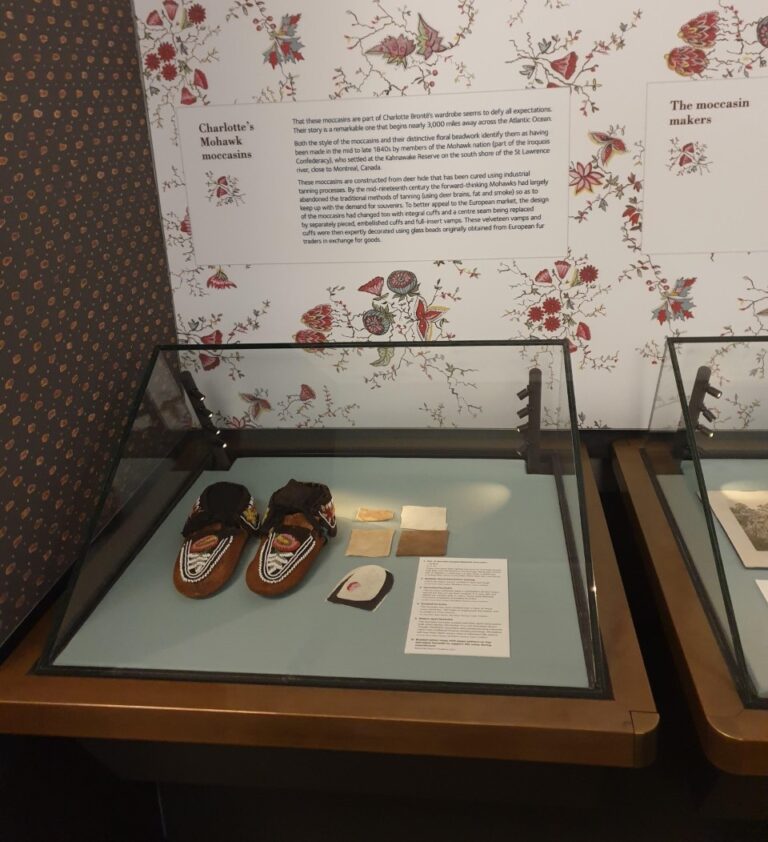
                                              Mohawk Moccasin Slippers


                                                      Berlin Work Bag

                                                                  Shawls

Nick Holland: The one on the right with the shiny silk inserts, is  the very shawl that Charlotte Brontë wore on her wedding day in 1854.


Luxurious Dress

Nick Holland: Perhaps the greatest item of all, among many great items, in this year’s exhibition is this dress. Charlotte’s Room, as the museum hails it, always contains a Brontë dress within a carefully sealed glass case. They are always very moving, but this year the dress is particularly spectacular – and it really does defy general expectations around Charlotte Brontë’s apparel.

We often think of Charlotte Brontë as rather dowdy, and she may have been so by necessity throughout much of her life. The Brontës were not wealthy, and had to repair, improvise and recycle much of their clothing. By the end of Charlotte’s life, however, things had changed dramatically for her. The royalties she earned from her writing were far greater than anything she could have hoped to earn from careers as a teacher or governess, and the legacy she left in 1855 was worth more than a million pounds in today’s money.

This dress dates from this period of Charlotte’s life. It was one where she often had to mix in high society, difficult as that must have been for someone as shy as she was, and she dressed accordingly. This striped silk dress was one of three found holed up behind a wall during renovations at the parsonage in 1936. It has been a cause of speculation for some time, but the museum has finally proven that it did belong to Charlotte meaning that it can finally go on display. With floral adornments it’s an item of real beauty, and evidence of the elevation in status and wealth that Charlotte’s literary genius finally brought her. Also displayed her are an ornate fan, and a pair of black stockings worn by Charlotte Brontë.


                                    Hair Brooch and Bracelet

zaterdag 19 februari 2022

Lace collar from Charlotte Bronte.


 Nick Holland @Nick_Holland_

Another Saturday treasure from the wonderful Bronte Parsonage Museum. This lace collar was worn by Charlotte Bronte and was made for her by her little sister Anne Bronte:

dinsdag 15 februari 2022

Unravelling the Mystery: Charlotte Brontë’s 1850 ‘Thackeray Dress’, by Eleanor Houghton.


In the summer of 1850, there was a frisson of excitement in London society. Charlotte Brontë, the recently revealed writer of the best-selling novel Jane Eyre, was in the capital, staying with her publisher, George Smith. The highlight of Charlotte’s trip was a large, formal dinner hosted by her literary hero, William Makepeace Thackeray. To this august event it has long been assumed that she wore a floral print, white and blue delaine skirt and bodice. Read all: tandfonline/Thackeray Dress

 euppublishing/Unravelling the Mystery: Charlotte Brontë’s 1850 ‘Thackeray Dress’

maandag 29 oktober 2018

Looking for Emily Brontë in the “Wild Workshop” of “Wuthering Heights”.

The image of Emily Brontë on the cover of Robert Barnard’s contribution to The British Library Writers’ Lives series is a retouched detail from the portrait of the three Brontë sisters, Anne, Emily, and Charlotte, painted by their brother Branwell. Two years ago at the Morgan Library’s Charlotte Brontë bicentennial, I stood in front of the original painting (circa 1834), with its folds, creases, and marks of wear. The contrast between the spectral Emily I saw then and this radiant girl is eerie. There’s color in the cheeks and brow and lips and the light of thought in the eyes. What had seemed a neutral expression now appears appealingly impertinent. It’s incredible to think this fresh-faced human being aglow with attitude was born 200 years ago, July 30, 1818, and died at 30 in 1848, a year after the publication of her only novel, which came into the world with its author concealed behind the pen name Ellis Bell. Wuthering Heights has been synonymous with mystery ever since.
Read all: towntopics/looking-for-emily-brontë-in-the-wild-workshop-of-wuthering-heights/

zaterdag 12 november 2016

dinsdag 11 oktober 2016

Visit the Manuscript of 'Jane Eyre' in New York.


How did Charlotte Brontë go from scribbling in secret to one of England’s (and literature’s) most famous names? Look for the answer in a passage in Jane Eyre, in which her famously plain heroine tells her husband-to-be that she is a “free human with an independent will.” That bold declaration is at the center of a new exhibition at the Morgan Library & Museum in New York—one that celebrates the author’s 200th birthday with a look at the forces that turned her into a writer.
Brontë has been at the center of literary legend since her first published novel, Jane Eyre, appeared under a pseudonym in 1847. The book was immediately loved and loathed for emotions that flew in the face of convention and courtesy, and the identity of its author became a much-contested question. But even after Brontë was discovered to be the person behind the pen name Currer Bell, myths about her childhood, her family members and the atmosphere in which she became an author have persisted. Read all the article; smithsonianmag


dinsdag 24 november 2015

George Richmond' s portrait de Charlotte Brontë et ""le-vrai-visage-de-Charlotte".

Louise Sanfaçon made the portrait in the right.
 
Lorsque le portrait de Charlotte Brontë, réalisé par l’artiste George Richmond, fut publié en frontispice de sa biographie en 1857, soit deux ans après sa mort à l’âge de trente-huit ans, il a attiré quelques commentaires acrimonieux de son ancienne amie Mary Taylor : «Je ne suis pas du tout favorable à l’idée de publier un portrait qui embellisse ses traits.» a-t-elle répliqué à la biographe Elizabeth Gaskell.  «J’aurais de loin préféré voir le vrai visage de Charlotte, avec les yeux et la bouche plus rapprochés, de même que son menton carré et son grand nez disproportionné.» soeursbronte/le-vrai-visage-de-charlotte/

When the portrait of Charlotte Brontë, directed by George Richmond, was published as the frontispiece of his biography in 1857, two years after his death at the age of thirty-eight years, he drew some of his former acrimonious comments friend Mary Taylor: "I am not at all favorable to the idea of publishing a portrait that embellish his features." she replied to the biographer Elizabeth Gaskell.
I had rather the mouth and eyes had been nearer together
and shown the veritable square face and large disproportionate nose'
 
Gaskell herself had written of her subject’s “plain, large and ill-set features”, “crooked mouth and large nose”, and in private had been even more specific about “a reddish face; large mouth & many teeth gone; altogether plain; the forehead square, broad and rather overhanging”.
 
George Smith was so impressed by the prominence of Miss Brontë’s brow that he took her to a phrenologist in 1851 to have it analysed, but thought little of her personal charms, recalling that her head “seemed too large for her body” and that “her face was marred by the shape of the mouth and by the complexion”.  

zondag 22 november 2015

The Brontë Death Jewellery


Take a look at the beautiful bracelet at the top of our latest Brontë blog; it’s one that was especially precious to Charlotte Brontë, and she wore it wherever she went, but what is it made of? At the centre is a sparkling amethyst but the strap around it is made of the intertwined hair of her dead sisters, Emily and Anne Brontë.

Read all of it: annebronte Nick Holland is talking about the color of the hair of the Brontes, about hairworkers, the people who crafted these objects and more very interesting things.

vrijdag 20 november 2015

Charlotte Bronte and a case of mistaken identity

Chalk drawing by George Richmond, 1850, left; photograph, right, date unknown
CLAIRE HARMAN

Published: 30 September 2015
Chalk drawing by George Richmond, 1850, left © National Portrait Gallery, London; photograph, right, date unknown, © Brontë Society
A s the bicentenary of Charlotte Brontë’s birth approaches (April 21, 2016), many picture editors, exhibition organizers and publishers will be looking round for a suitable image of the author and perhaps feeling a little disappointed with the available choices. Only two pictures of Brontë survive that were made from life: the first, crudely painted by her brother Branwell when she was a teenager (in the group portrait known as “The Brontë Sisters”), makes the subject look doughy and dull; the second, a chalk drawing commissioned by the publisher George Smith in 1850 and executed by the fashionable artist George Richmond, veers the other way towards flattery. When Richmond’s portrait was published as the frontispiece to Elizabeth Gaskell’s Life of Charlotte Brontë in 1857, two years after Brontë’s death at the age of thirty-eight, it drew some blunt comments from the subject’s old friend Mary Taylor. “I do not altogether like the idea of publishing a flattered likeness”, she told the biographer; “I had rather the mouth and eyes had been nearer together, and shown the veritable square face and large disproportionate nose.”

Taylor was by no means the only person to remark on Brontë’s un-beautiful appearance. Gaskell herself had written of her subject’s “plain, large and ill-set features”, “crooked mouth and large nose”, and in private had been even more specific about “a reddish face; large mouth & many teeth gone; altogether plain; the forehead square, broad and rather overhanging”. George Smith was so impressed by the prominence of Miss Brontë’s brow that he took her to a phrenologist in 1851 to have it analysed, but thought little of her personal charms, recalling that her head “seemed too large for her body” and that “her face was marred by the shape of the mouth and by the complexion”. William Thackeray described Brontë as “homely-faced”, “without a pennyworth of good looks”, while his daughter Anne recalled their famous visitor’s defensive and unpleasant demeanour: “I remember how she frowned at me whenever I looked at her, but perhaps it was specially at me – at least so I imagined. There was a general impression of chin about her face”. These plain-speaking judges did all grant Brontë one outstanding feature; large, shining eyes “of extraordinary brilliance and penetration”. From their descriptions, it seems safe to conclude that Charlotte Brontë had an unusually large brow, large expressive eyes, a wide mouth collapsing over missing teeth and a big nose (like her father, whom she was said to resemble). Richmond’s portrait, for all its prettification, does actually indicate those characteristics in a veiled form. Read all: http://www.the-tls/The Times Literary Supplement


dinsdag 27 oktober 2015

Charlotte Brontë sketch identified as self-portrait


Pencil sketch by Charlotte Brontë, which new research reveals is a self-portrait alongside George Richmond’s portrait. Composite: Pierpont Morgan Library/Getty Images

Experts say author made drawing, sketched on her school atlas, years before writing Jane Eyre in which protagonist draws herself in similar fashion.

A sketch of a woman’s head by Charlotte Brontë, previously thought to be of another pupil drawn while the author was at boarding school in Brussels, has been identified as a self-portrait.

The literary biographer Claire Harman said the drawing, which she suggests shows Brontë looking into a mirror, preceded the novel Jane Eyre, in which the protagonist also draws herself in a similar fashion.

The sketch dates from 1843, four years before Brontë published Jane Eyre, one of English literature’s great masterpieces, and when the young writer was suffering the agonies and insecurities of unrequited love.

The drawing was known to be by Brontë, not least because it was sketched on her school atlas.

Harman’s discovery is “massively significant” as there are only two other known lifetime portraits of Brontë.

Despite the sketch’s small size – barely 1.5 inches high – its facial details resemble those in an 1850 image by George Richmond, now in the National Portrait Gallery, although the artist was known to flatter his sitters. Read more: theguardian/charlotte-bronte-sketch-identified-self-portrait

Ann Dinsdale, collections manager of the Brontë Parsonage Museum, Haworth, says that it is hard to prove the identity conclusively, but the sketch 'does certainly resemble the sitter in the Richmond portrait' dailymail./New-self-portrait-Charlotte-Bronte-discovered-drew-looking-mirror-just-like-great-heroine-Jane-Eyre

zondag 19 juli 2015

The owner has contacted the Daily Mail and the Brontë Parsonage and several experts give their opinion:
It is clearly a photo with a story to tell – and collector Seamus Molloy hopes it will earn a place in the history of literature. For he believes the subjects in the grainy antique picture, which cost him only £15 on eBay, are Charlotte, Emily and Anne Brontë. If so, it would be the only known photo of the sisters. Mr Molloy, 47, bought the 4½in by 3¼in image because he thought its subjects resembled the Brontës in the only known surviving portrait of them, painted by their brother Branwell. (...) Yesterday Catherine Rayner, of the Brontë Society, said: ‘It would be wonderful if it is. It is worth investigating. 'We have discussed it and there is a possibility it might go forward for some sort of forensic examination. 'Most of me is saying I don’t think it can be them. But we are not dismissing it.’ Ann Dinsdale, of the Brontë Museum in Haworth, West Yorkshire, said: ‘It seems unlikely that the Brontës would have been photographed. 'Photography was in its infancy. The family was quite reclusive and Emily and Anne were unknown at that time. 'Naturally there is a huge interest in what they looked like. However, provenance of images is hard to establish and sadly we may never really know.’ (...) Mr Molloy has also contacted the National Portrait Gallery, where photographs cataloguer Constantia Nicolaides said there were ‘notable differences’ in the brow lines and lip shape of the subjects in the photograph from those of the sisters as painted by Branwell. Two historical costume experts, contacted by the Mail without being told it was believed to be a photograph of the Brontës, dated the clothing worn by the women to around 1850 - tantalisingly close to the latest date it could have been taken, 1848 when Emily died. The National Media Museum in Bradford told Mr Molloy the image is a ‘collodian positive’, a process that was commercially available after 1852, and doubted a photographer would have used that to copy an even earlier form of photograph as it would have been ‘practically difficult’. (David Wilkes)
If this is a real picture of the Brontës, then I'm Heathcliff! (...)
Emily, after years of withering away, died of TB in 1848, Anne a year later. All, in this photograph, look as healthy as three Yorkshire puds. This photograph would have had to be taken in the 1840s, when photographic portraiture was in its infancy. This trio have left, the eye suggests, their infancy some way behind them. The one on the left (with a prayer book in her hand) looks middle-aged. Exposures, for the earliest photographs, took many minutes (trees were, for that reason, favourite objects: it can get boring). (John Sutherland)
You’ve got to think, why would there be a picture of them? There’s certainly no record of them ever having had a photograph taken. Everybody wants to know what the Brontës looked like – I regularly get sent images, either portraits or photographs, of either one woman or three women, and people think that they’re the Brontës. We do what we can, but if the image has got no provenance and it’s not documented anywhere, it’s really difficult. Even if you can look at it and say, ‘well the hairstyles are absolutely right, the costume is right,’ it’s still difficult to know for sure. (Ann Disndale) 
bronteblog

woensdag 13 november 2013

Bonnets in the museum collection


There is at least two possibly three bonnets in the museum collection and the sisters mention buying bonnets but never mention buying hats.(The only hat in the collection is a quite pretty  petite straw one worn by Ellen Nussey ) hathawaysofhaworth

donderdag 5 september 2013

Honeymoon dress from Charlotte


From the Treasure Trove: Charlotte’s honeymoon dress. This dress was worn by Charlotte when she set out on her honeymoon in 1854. The dress is made from silk and is actually a separate skirt and top. Originally it was patterned with stripes of lavender and silver, which have gradually faded to a uniform silvery brown colour.
facebook/Bronte-Parsonage-Museum

 The last part (Stripes and so on....) is new to me.

donderdag 2 mei 2013

“Do you know that I was in Leeds......


“Do you know that I was in Leeds on the very same day with you last Wednesday? I had thought of telling you where I was going, and having your help and company in buying a bonnet, &c., but then I
reflected this would merely be making a selfish use of you, so I determined to manage or mismanage the matter alone. I went to Hurst and Hall’s for the bonnet, and got one which seemed grave and
quiet there amongst all the splendours; but now it looks infinitely too gay with its pink lining. I saw some beautiful silks of pale sweet colours, but had not the spirit nor the means to launch out at the rate of five shillings per yard, and went and bought a black silk at three shillings after all. I rather regret this, because papa says he would have lent me a sovereign if he had known. I believe, if you had been there, you would have forced me to get into debt....
arthursbookshelf 

The Illustrated London News of September 11, 1858 stated that Leeds was the "largest and most flourishing" city in Yorkshire, the fifth in England "in point of population and commercial activity. The population in 1851 was 172,270. The number of inhabited houses in 1851 was 36,165
 Leeds


zaterdag 27 oktober 2012

The brown gown

I am not sure which sister this gown belonged to. I think it’s attributed to Charlotte but most gowns are, I had thought before I viewed it that it belonged to Emily as it’s quite narrow skirted and Emily is known to have worn narrow skirted gowns  but it seems a bit too small on the bodice to have been Emilys, its just  possible its Charlotte’s as she did wear brown but it just seems so unlike all the other gowns known to be Charlotte’s or described by those who knew her that I cant quite bring myself to belive it hers. I cant help but feel it might have belonged to  another of the sisters perhaps Anne, she was a similar build to Charlotte  and not that much taller. Hathaways of Haworth

vrijdag 26 oktober 2012

Charlotte Brontes Paisley Gown

This gown looks quite pretty when displayed in a glass case on a mannequin but up close it  is  utterly exquisite. I had expected it to be a  simple fine cotton lawn, very like liberty’s  Lawns,In reality the fabric is crisp and fresh but gossamer fine and as light as spiders silk,If you look carefully at the photo below you can just see the tape measure showing through the fabric. The whole dress weights barely anything. It’s also beautifully sewn and constructed and  in beautiful condition with no hemlines scuffing or pin marks etc. 


I think its possible it was professionally made but if not it speaks well for Charlotte’s sewing skills. I find it hard to belive it’s ever been worn and wonder if it was an unworn part of Charlotte’s trousseau or perhaps worn as an afternoon gown  briefly on one of Charlotte’s stays at the homes of rich friends or in London. I think it must have been bought after Charlotte’s income improved. There is a lot of fabric and that  fabric does not seem to be a cheap one as  besides being printed with a wide range of coloured dyes it also has a woven pattern of almost invisible stripes. Read on: Hathaways of Haworth

donderdag 25 oktober 2012

Charlotte Bronte' s dress which she used during her honeymoon tour.


Its a strange and moving item, the stiffness of the fabric and the gowns construction  almost creates an impression of an occupant and its strange to imagine what is now laid out with such care  on a table was once hung neatly upstairs with similar care waiting Charlotte’s arrival from her wedding at the nearby church and just a few hours later would have been clothing Charlotte as she walked happily out of the Parsonage door to start her Honeymoon tour .I suspect it arrived at its destination hours later rather less crisp and pristine than it now looks but  such is the case with all natural fabrics  and the gown was an eminently sensible choice for traveling.  Read more on: Hathaways of Haworth

The Parlour

The Parlour

Parsonage

Parsonage

Charlotte Bronte

Presently the door opened, and in came a superannuated mastiff, followed by an old gentleman very like Miss Bronte, who shook hands with us, and then went to call his daughter. A long interval, during which we coaxed the old dog, and looked at a picture of Miss Bronte, by Richmond, the solitary ornament of the room, looking strangely out of place on the bare walls, and at the books on the little shelves, most of them evidently the gift of the authors since Miss Bronte's celebrity. Presently she came in, and welcomed us very kindly, and took me upstairs to take off my bonnet, and herself brought me water and towels. The uncarpeted stone stairs and floors, the old drawers propped on wood, were all scrupulously clean and neat. When we went into the parlour again, we began talking very comfortably, when the door opened and Mr. Bronte looked in; seeing his daughter there, I suppose he thought it was all right, and he retreated to his study on the opposite side of the passage; presently emerging again to bring W---- a country newspaper. This was his last appearance till we went. Miss Bronte spoke with the greatest warmth of Miss Martineau, and of the good she had gained from her. Well! we talked about various things; the character of the people, - about her solitude, etc., till she left the room to help about dinner, I suppose, for she did not return for an age. The old dog had vanished; a fat curly-haired dog honoured us with his company for some time, but finally manifested a wish to get out, so we were left alone. At last she returned, followed by the maid and dinner, which made us all more comfortable; and we had some very pleasant conversation, in the midst of which time passed quicker than we supposed, for at last W---- found that it was half-past three, and we had fourteen or fifteen miles before us. So we hurried off, having obtained from her a promise to pay us a visit in the spring... ------------------- "She cannot see well, and does little beside knitting. The way she weakened her eyesight was this: When she was sixteen or seventeen, she wanted much to draw; and she copied nimini-pimini copper-plate engravings out of annuals, ('stippling,' don't the artists call it?) every little point put in, till at the end of six months she had produced an exquisitely faithful copy of the engraving. She wanted to learn to express her ideas by drawing. After she had tried to draw stories, and not succeeded, she took the better mode of writing; but in so small a hand, that it is almost impossible to decipher what she wrote at this time.

I asked her whether she had ever taken opium, as the description given of its effects in Villette was so exactly like what I had experienced, - vivid and exaggerated presence of objects, of which the outlines were indistinct, or lost in golden mist, etc. She replied, that she had never, to her knowledge, taken a grain of it in any shape, but that she had followed the process she always adopted when she had to describe anything which had not fallen within her own experience; she had thought intently on it for many and many a night before falling to sleep, - wondering what it was like, or how it would be, - till at length, sometimes after the progress of her story had been arrested at this one point for weeks, she wakened up in the morning with all clear before her, as if she had in reality gone through the experience, and then could describe it, word for word, as it had happened. I cannot account for this psychologically; I only am sure that it was so, because she said it. ----------------------She thought much of her duty, and had loftier and clearer notions of it than most people, and held fast to them with more success. It was done, it seems to me, with much more difficulty than people have of stronger nerves, and better fortunes. All her life was but labour and pain; and she never threw down the burden for the sake of present pleasure. I don't know what use you can make of all I have said. I have written it with the strong desire to obtain appreciation for her. Yet, what does it matter? She herself appealed to the world's judgement for her use of some of the faculties she had, - not the best, - but still the only ones she could turn to strangers' benefit. They heartily, greedily enjoyed the fruits of her labours, and then found out she was much to be blamed for possessing such faculties. Why ask for a judgement on her from such a world?" elizabeth gaskell/charlotte bronte


Poem: No coward soul is mine

No coward soul is mine,
No trembler in the worlds storm-troubled sphere:
I see Heavens glories shine,
And faith shines equal, arming me from fear.


O God within my breast.
Almighty, ever-present Deity!
Life -- that in me has rest,
As I -- Undying Life -- have power in Thee!


Vain are the thousand creeds
That move mens hearts: unutterably vain;
Worthless as withered weeds,
Or idlest froth amid the boundless main,


To waken doubt in one
Holding so fast by Thine infinity;
So surely anchored on
The steadfast Rock of immortality.


With wide-embracing love
Thy Spirit animates eternal years,
Pervades and broods above,
Changes, sustains, dissolves, creates, and rears.


Though earth and man were gone,
And suns and universes ceased to be,
And Thou wert left alone,
Every existence would exist in Thee.


There is not room for Death,
Nor atom that his might could render void:
Thou -- Thou art Being and Breath,
And what Thou art may never be destroyed.


--
Emily Bronte

Family tree

The Bronte Family

Grandparents - paternal
Hugh Brunty was born 1755 and died circa 1808. He married Eleanor McClory, known as Alice in 1776.

Grandparents - maternal
Thomas Branwell (born 1746 died 5th April 1808) was married in 1768 to Anne Carne (baptised 27th April 1744 and died 19th December 1809).

Parents
Father was Patrick Bronte, the eldest of 10 children born to Hugh Brunty and Eleanor (Alice) McClory. He was born 17th March 1777 and died on 7th June 1861. Mother was Maria Branwell, who was born on 15th April 1783 and died on 15th September 1821.

Maria had a sister, Elizabeth who was known as Aunt Branwell. She was born in 1776 and died on 29th October 1842.

Patrick Bronte married Maria Branwell on 29th December 1812.

The Bronte Children
Patrick and Maria Bronte had six children.
The first child was Maria, who was born in 1814 and died on 6th June 1825.
The second daughter, Elizabeth was born on 8th February 1815 and died shortly after Maria on 15th June 1825. Charlotte was the third daughter, born on 21st April 1816.

Charlotte married Arthur Bell Nicholls (born 1818) on 29th June 1854. Charlotte died on 31st March 1855. Arthur lived until 2nd December 1906.

The first and only son born to Patrick and Maria was Patrick Branwell, who was born on 26th June 1817 and died on 24th September 1848.

Emily Jane, the fourth daughter was born on 30th July 1818 and died on 19th December 1848.

The sixth and last child was Anne, born on 17th January 1820 who died on 28th May 1849.

Top Withens in the snow.

Top Withens in the snow.

Blogarchief

LinkWithin

Related Posts with Thumbnails