I've dreamt in my life dreams that have stayed with me ever after, and changed my ideas: they've gone through and through me, like wine through water, and altered the color of my mind.
Emily Bronte
Wuthering Heights

Posts tonen met het label honeymoon. Alle posts tonen

zaterdag 26 februari 2022

Charlotte's Irish honeymoon with a different approach.

A book on Charlotte Brontë’s Irish honeymoon, “Charlotte Brontë – An Irish Odyssey”, read all: brusselsbronte/charlottes-irish-honeymoon-continued

For his recreation of the honeymoon, Michael O’Dowd also uses writings of literary friends and acquaintances who had visited the same places before Charlotte and Arthur’s honeymoon, including Harriet Martineau and William Makepeace Thackera, as well as well-known guidebooks on Ireland of the time (e.g. by Anna Maria and Samuel Hall).

Moreover, “An Irish Odyssey” is interspersed with extracts from poems and verse by well-known British and Irish poets (such as Thomas Moore, Sir Aubrey de Vere, Percy Bysshe Shelley, Sir Walter Scott and many more), which creates a very poetic atmosphere.

In all of these chapters, the author gives us a lot of information on the scenery that Charlotte and Arthur may have seen on their visits (based on travel and tourist guides of the time). He explores possible ways of travelling (by boat, train, coach, jaunting car, …) that Charlotte and Arthur may have used, as this is not always clear from the letters. He provides scientific facts on fauna and flora. He explores the historical and spiritual heritage of Banagher (where Arthur’s family lived) and its surroundings in great detail, but also historical facts about Ireland in general are shared with the reader. 

I once was searching for information about the honeymoon of Charlotte and Arthur. I found a lot of information Brontesisters.blog/honeymoon

donderdag 5 september 2013

Honeymoon dress from Charlotte


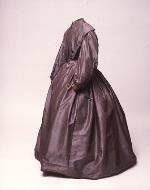
From the Treasure Trove: Charlotte’s honeymoon dress. This dress was worn by Charlotte when she set out on her honeymoon in 1854. The dress is made from silk and is actually a separate skirt and top. Originally it was patterned with stripes of lavender and silver, which have gradually faded to a uniform silvery brown colour.
facebook/Bronte-Parsonage-Museum

 The last part (Stripes and so on....) is new to me.

vrijdag 26 oktober 2012

Charlotte Brontes Paisley Gown

This gown looks quite pretty when displayed in a glass case on a mannequin but up close it  is  utterly exquisite. I had expected it to be a  simple fine cotton lawn, very like liberty’s  Lawns,In reality the fabric is crisp and fresh but gossamer fine and as light as spiders silk,If you look carefully at the photo below you can just see the tape measure showing through the fabric. The whole dress weights barely anything. It’s also beautifully sewn and constructed and  in beautiful condition with no hemlines scuffing or pin marks etc. 


I think its possible it was professionally made but if not it speaks well for Charlotte’s sewing skills. I find it hard to belive it’s ever been worn and wonder if it was an unworn part of Charlotte’s trousseau or perhaps worn as an afternoon gown  briefly on one of Charlotte’s stays at the homes of rich friends or in London. I think it must have been bought after Charlotte’s income improved. There is a lot of fabric and that  fabric does not seem to be a cheap one as  besides being printed with a wide range of coloured dyes it also has a woven pattern of almost invisible stripes. Read on: Hathaways of Haworth

donderdag 25 oktober 2012

Charlotte Bronte' s dress which she used during her honeymoon tour.


Its a strange and moving item, the stiffness of the fabric and the gowns construction  almost creates an impression of an occupant and its strange to imagine what is now laid out with such care  on a table was once hung neatly upstairs with similar care waiting Charlotte’s arrival from her wedding at the nearby church and just a few hours later would have been clothing Charlotte as she walked happily out of the Parsonage door to start her Honeymoon tour .I suspect it arrived at its destination hours later rather less crisp and pristine than it now looks but  such is the case with all natural fabrics  and the gown was an eminently sensible choice for traveling.  Read more on: Hathaways of Haworth

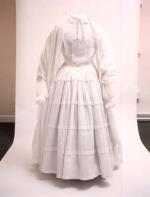
Charlotte Bronte' s white wedding bonnet and veil as well as a replica of her wedding dress.


And for the record here are her white wedding bonnet and veil as well as a replica of her wedding dress. 

 
Of the third--the wedding-dress--I wholly decline the responsibility  It must be charged upon a sort of friendly compulsion or over-persuasion. Nothing would satisfy some of my friends but white which I told you I would not wear. Accordingly they dressed me in white by way of trial--vowed away their consciences that nothing had ever suited me so well--and white I had to buy and did buy to my own amazement--but I took care to get it in cheap material--there were some insinuations about silk, tulle and I don't know what--but I stuck convulsively to muslin--plain book muslin with a tuck or two. Also the white veil--I took care should be a matter of 5s being simply of tulle with little tucks. If I must make a fool of myself--it shall be on an economical plan.
~ Charlotte Brontë to Elizabeth Gaskell (?), early June 1854
 
What the journalist may be mistaking for her wedding dress is her going-away dress, which wasn't 'almost mauve' but which does now look dark mauve and is thought to have been lavender when new, not pink.
 
Read more: To her own amazement

vrijdag 15 juli 2011

Haworth and the newly-married couple


The people of Haworth welcomed in a loyal manner the  return of the newly-married couple, and in return Mr. Nicholls and his wife gave a tea and supper to five hundred of the day and Sunday scholars, teachers, bell-ringers, and choristers, etc. This gathering was a great success, and the votes of thanks touched Charlotte Bronte very deeply " One of the villagers, in proposing my husband's health, described him as a ' consistent Christian, and a kind gentleman.' I own the words touched me deeply, and I thought . . . that to merit and win such a character was better than to earn either wealth, or fame, or power."

The curate's wife had to drop the mantle of a novelist, as she was kept very busy in various ways. Visitors called at the old vicarage, and return calls had to be made. All the clergy in the neighbourhood and their wives made a point of calling and offering their congratulations, and the parsonage put
on a new life, for it had been a lonely and desolate place for a long time. http://www.archive.

http://www.sippingtea.com/victorian.html

donderdag 14 juli 2011

Back home


Charlotte and Arthur returned to Haworth  in the early evening of 1 august 1854. Her father was unwell when they arrived but under Charlotte's care he soon recovered.

Charlotte wrote to Ellen:

TO MISS ELLEN NUSSEY.                        ‘Haworth, August 9th, 1854.

Dear Ellen,
I earnestly hope you are by yourself now, and relieved from the fag of entertaining guests. You do not complain, but I am afraid you have had too much of it.

‘Since I came home I have not had an unemployed moment. My life is changed indeed: to be wanted continually, to be constantly called for and occupied seems so strange; yet it is a marvellously good thing. As yet I don’t quite understand how some wives grow so selfish. As far as my experience of matrimony goes, I think it tends to draw you out of, and away from yourself. ‘We have had sundry callers this week. Yesterday Mr. Sowden and another gentleman dined here, and Mr. and Mrs. Grant joined them at tea. ‘I do not think we shall go to Brookroyd soon, on papa’s account. I do not wish again to leave home for a time, but I trust you will ere long come here.
‘I really like Mr. Sowden very well. He asked after you. Mr. Nicholls told him we expected you would be coming to stay with us in the course of three or four weeks, and that he should then invite him over again as he wished us to take sundry rather long walks, and as he should have his wife to look after, and she was trouble enough, it would be quite necessary to have a guardian for the other lady. Mr. Sowden seemed perfectly acquiescent.

During the last six weeks, the colour of my thoughts is a good deal changed: I know more of the realities of life than I once did. I think many false ideas are propagated, perhaps unintentionally. I think those married women who indiscriminately urge their acquaintance to marry, much to blame. For my part, I can only say with deeper sincerity and fuller significance what I always said in theory, “Wait God’s will.” Indeed, indeed, Nell, it is a solemn and strange and perilous thing for a woman to become a wife. Man’s lot is far, far different. Tell me when you think you can come. Papa is better, but not well. How is your mother? give my love to her.—Yours faithfully,

‘C. B. Nicholls.

maandag 11 juli 2011

Honeymoon


I found this interesting story on: charlotte bronte's kilkee. On this website you can also find pictures of the West End Hotel, Charlotte and Arthur stayed in during their honeymoon.

Charlotte wrote of the hotel:
Here at our Inn - splendidly designated 'the West End Hotel' - there is a good deal to carp at, were in a carping humour - but we laugh instead of grumbling -for out of doors there is much indeed to compensate for any indoor shortcomings, so magnificent an ocean - so bold and grand a coast - I never yet saw.
Limerick Chronicle, 5 July 1854
WEST END HOTEL,
Kilkee
MRS. SHANNON begs leave to acquaint her friends and the Public, that she has fitted up her Hotel, in very
Superior Style for the accommodation of Tourists and Visitors to that beautifu watering place. From the long Patronage Mrs. S. has received fiom her Friends, she expects a continuance of their support. Families
requiring private apartments can be accommodated by application at Cruise's Royal Hotel, Limerick; or at 
West End Hotel, Kilkee. This hotel commands a magnificent view of the Cliffs, Bay, and surrounding
scenery.

Mrs. Shannon and her daughters had moved to Francis Street (modern Grattan St.) Kilkee. Here she
opened her 'Kilkee Boarding House. She was also the post-mistress of Kilkee. This 'Boarding House' changed its name to the 'Kilkee Board and Lodging House' by June 1831, which changed again to 'Kilkee
Hotel' in 1832, and like the two other hotels in the resort charged 25 shillings per week for full board in 1830.  A letter headed 'Bubbles From Bathing Places' in a Limerick newspaper in 1840 stated:
'Katty Fitzgerald and the widdy Shannon have commodious an' cleanly accommodation, no doubt. Moderate charges an' great civility ...

This hotel in Francis St. was later taken over by a Michael McNamara of Limerick as a public house.  By May 1841 Mrs. Shannon had moved to the West End. By May 1841 Mrs. Shannon had moved to the West End, Kilkee, where she had built a large house (now occupied by Mr. Gubbins of Limerick and Mrs. Jim Frawley of Kilkee). Here, with her daughters, she ran the 'West End Boarding House' which name she later, in 1844, changed to the 'West End - not to be confused with the later and larger building of the same name nearby. She  continued as post-mistress until September 1854. This post-office stood on the Dunlickey Road adjoining the hotel. The drawing-rooms of her hotel were  described as 'large and comfortable' and the bedrooms were 'spacious and airy. The Limerick Chronicle was able to state:
'Mrs. Shannon's new Hotel, or West End Boarding House, as well from its accommodation as its beautiful situation on the cliffs over the enchanting bay, and commanding a view of the village promise
every comfort to be desired at this delightful resort.

By the summer of 1843 she had 'made great and extensive improvements'" and in 1844, 1845, 1847,1848 built several additional rooms 'which with the entire Establishment are fitted up with the greatest elegance and comfort. These new additions later formed the nucleus of her private residence after 1870, and is now called 'West End House' (now owned by Mrs. Maureen McMahon of Limerick). In Charlotte Bronte's time it was part of the West End Hotel. Here Mrs Shannon supplied her guests with brandy, genuine malt whiskey, ale and Guinness's porter,  'all of the purest and best quality' and her terms were 'extremely moderate.

photos of Kilkee

zondag 10 juli 2011

Honeymoon


The Lakes of Killarney naturally proved to be the place of greatest interest to them in this part of Ireland. Charlotte had described it in imagination, and her father, too, had a story connected with this district, entitled " The Maid of Killarney," which was his most ambitious effort in prose.
Beautiful Glengariff, Tralee, Cork, and probably Blarney Castle, were visited, and Charlotte Bronte says, " The scenery in some parts of Ireland exceeded all I had ever imagined."

Cork City


The Rose of Tralee


Accident with a horse
Gap of Dunloe

It was whilst visiting Killarney that she had a narrow escape of losing her life an incident not mentioned by Mrs. Gaskell in the Life, either because she decided not to pierce the " sacred doors " after the marriage, or else that Mr. Nicholls did not wish an account of his honeymoon to appear.

    Charlotte Bronte tells, in a letter to Miss Winkworth, how they went through the gap of Dunloe, she on horseback. Finding that the horse was nervous and trembled when it came to a dangerous part, her husband asked her to alight, but as she did not feel afraid she declined. Mr. Nicholls was at the horse's head when suddenly it reared and Charlotte Bronte was thrown beneath it. Mr. Nicholls did not see that his wife had fallen off, and the horse kicked and trampled around her. In the few seconds that she was
on the ground she says she thought of the consequences to her husband and father if anything should happen to her. When her plight was seen, the horse was let loose and sprang over her. She was neither bruised by the fall, nor touched by the horse's hoofs, and she was grateful for more reasons than one.

zaterdag 9 juli 2011

Honeymoon


After spending about a week at Banagher, the newly-weds travelled along the banks of the Shannon and Lough Derg to Limerick, where they took a boat – either the Erin-go-Brath or the Garryowen – to Kilkee. The Koh-i-noor steamer was then out of commission, having met with an accident near Foune.

the West End Hotel

From Kilkee on Tuesday, July 18th, 1854, Charlotte wrote to Catherine Wooler, her former teacher:

'My Dear Miss Catherine, - Your kind letter reached me in a wild and remote spot - a little watering-place on the South West Coast of Ireland' and she gave her a synopsis of her honeymoon tour in Wales and Ireland, adding: I had heard a great deal about Irish negligence & I own that till I came to Kilkee - I saw little of it. Here at our Inn - splendidly designated 'the West End Hotel' - there is a good deal to carp at, were in a carping humour - but we laugh instead of grumbling -for out of doors there is much indeed to compensate for any indoor shortcomings, so magnificent an ocean - so bold and grand a coast - I never yet saw. My husband calls me -.

Dr. Barker remarks of this letter: 'It was a very long time since Charlotte had written anything so light-hearted as this careless valediction or, indeed, enjoyed the intimacy of shared humour.

Later in the same month, Charlotte wrote again about her Kilkee experience, which had greatly impressed her, in a letter to her friend, Catherine Winkworth. In her enthusiasm for Kilkee. Charlotte gave only the briefest account possible of her honeymoon (and strangely omits all reference to Banagher):


'After a short sojourn in the capital - went to the coast - such a wild iron-bound coast - with such an ocean-view as I had not yet seen and such battling of waves with rocks as I had never imagined. 'My husband is not a poet or a poetical man - and one of my grand doubts before marriage was about 'congenial tastes' and so on.
The first morning we went out on to the cliffs and saw the Atlantic coming in all white foam, I did not know whether I should get leave or time to take the matter in my own way. I did not want to talk - but I did want to look and be silent. Having hinted a petition, licence was not refused – covered with a rug to keep o f f the spray I was allowed to sit where I chose - and he only interrupted me when he thought I crept too near the edge of the cliff.  So far he is always good in this way - and this protection which does not interfere or pretend is I believe a thousand times better than any half sort of pseudo sympathy.


donderdag 7 juli 2011

Honeymoon.

Charlotte and Arthur travelled along the banks of the Shannon and Lough Derg to Limerick.

Limerick


Limerick is the third largest city in the Republic of Ireland, and the principal city of County Limerick and Ireland's Mid-West Region.
Lough Derg (from Irish: Loch Deirgeirt meaning "loch of the red eye") is the third-largest lake (or lough) in Ireland (after Lough Neagh and Lough Corrib) and the second-largest in the Republic of Ireland.


woensdag 6 juli 2011

Charlotte must suddenly have realised that she had married a real 'gentleman'

Charlotte must suddenly have realised that she had married a real 'gentleman' in every sense of the word. On all sides she heard great reports of him. One of the servants told her she had got 'one of the best gentlemen in the country'. In her letters home she wrote,

'I was very much pleased with all I saw, but I was also greatly surprised to find so much English order and repose in the family habits and arrangements. I had heard a great deal about Irish negligence.'

Describing Mrs. Bell, Arthur's aunt... 'with her English manners — like an English or Scottish matron, quiet, kind and well bred',

Charlotte began to revise her former opinion of her husband and his family.

dinsdag 5 juli 2011

Banagher


Small town in present-day County Offaly, where Arthur Bell Nicholls lived with his uncle the Rev. Alan Bell and his family from the age of seven. Charlotte went there on her honeymoon and was impressed by Cuba House, which had served as the family home, with nearby the school of which the Rev. Bell was head. Charlotte was openly surprised at the state in which the family lived (“like a gentleman’s country-seat” – to MW, 10 July 1854). Banagher was hardly more than a main street (in which Arthur was photographed in old age): it contains the church of St Paul’s, where Arthur was buried, and Hill House, where he lived with his second wife Mary Anna, née Bell. In the early 1840s Trollope lived here, working as a surveyor’s clerk in the Post Office.


history Banagher

http://banagher.co.tv/

The Bells of Banagher

The large family of Bells enjoyed a fine social life in Banagher, with dancing and boating trips on the River Shannon. Charlotte admired their cheerful and pleasant lifestyle and was made to feel very welcome at Cuba Court by Arthur's Aunt Bell. Charlotte had the good fortune to visit the splendid mansion (now in ruins) in its heyday in 1854.

Rev. Arthur Bell Nicholls had been born in Northern Ireland (as had Charlotte's own father) but he was orphaned early and with his brother brought up and educated by his uncle, Dr. Alan Bell, at the Royal School housed in Cuba Court, Banagher. The school turned out several distinguished men, including Sir William Wilde, father of the famous playwright Oscar Wilde (Oscar Fingal O'Flahertie Wills Wilde) of Dublin.

Most of the Bell males were scholars at Trinity College in Dublin, as was Arthur. Arthur's brother managed the Birr Canal. The Bells were all well-respected and known for their excellent sense of humor and their "way with dogs."
ancestry surnames.bell

Cuba Court, Banagher


Arthur's brother and cousins escorted the the newly-weds from Dublin to Banagher.While on honeymoon Charlotte wrote in her journal what she thought of Cuba Court……..

"I cannot help feeling singulary interested in all about the house. In this house Mr. Nicholls was brought up by his uncle Dr.Bell.

It is very large and looks extremely like a gentleman's country-house. Within, most of the rooms are lofty and spacious and some, the drawing room, dining room, etc.-handsomely and commodiously furnished. The passages look desolate and bare. Our bedroom, a great room on the ground-floor would have looked gloomy when we were shewn into it but for the turf-fire that was burning in the wide old chimney."

In the first week Mrs. Bell kindly nursed Charlotte back to health.

http://www.strynaghs.ie/charlotte_bronte.html

kleurrijkbrontesisters/charlotte-bronte-and-her-association.html

irishmidlandsancestry./bronte charlotte

Ireland/Banagher/Pictures/

history Banagher Literary-Associations/Page1.html

/holidayplanner/ RoutePlanner Banagher

The house was unroofed in 1946 and this hastened its demise. Pope Hennessy described Cuba Court in 1971: "Like so many of Ireland's great houses, Cuba Court is now being slowly but deliberately demolished. The lime trees have long since been hacked down."  In spite of this, it was described as "a superb ruin that could tell the history of Ascendancy Ireland", as late as 1979. It was eventually acquired by a local businessman and demolished in the 1980s. Craig describes the loss of Cuba Court as "particularly to be lamented". A development of four houses was built on the site at Cuba Avenue in 2003. An archaeological survey revealed nothing of significance.

maandag 4 juli 2011

04-07-1854 Charlotte and Arthur visited Dublin, Trinity College


On 04-07-1854 morning the pair started for Holyhead, and then took boat for Dublin, staying long enough in that city to see the sights. Charlotte's cold had come worse so the two days they spent in Dublin were restricted to driving around the city. Trinity College would be one of the first places visited, for it was Mr. Nicholls' Alma Mater, and it was from Trinity College that he took up his appointment as curate of Haworth. Arthur took pride in showing his bride the library, museum and chapel.

 1905, some years after Charlotte and Arthur visited Dublin (Trinity College), but it gives a good idea how it looked like.
Click on it, to make it larger.

 The Library


In Dublin they were joined by his brother, manager of the Grand Canal from their hometown, Banagher, a cousin, who was studying at the university and another cousin, ""a pretty lady-like girl with gentle English manners""

website of Trinity College

vrijdag 1 juli 2011

The first part of the honeymoon was far from smooth.

Although Charlotte found some pleasure in the Welsh scenery, which she thought surpassed the English Lakes, the first part of the honeymoon was far from smooth. Her cold get worse and she started to be sufficiently ill.
Later she wrote to Miss Wooler:

""Fatique and excitement had nearly knocked me up. - and my cough was become very bad""

donderdag 30 juni 2011

the Honeymoon 30-06-1854


The tour included Conway, where the couple stayed at " a comfort-able inn". It was evening when Mr. and Mrs. Nicholls arrived at Conway, and they would not see much of the district except the old castle. Wales was an entirely new country to the bride, and its historic associations were sure to interest her. On the Friday morning they started for Bangor, and spent the week-end there. Neither Bangor nor Menai was the popular holiday resort each has since become. They were essentially Welsh, and Welsh was the language spoken. This beautiful spot in North Wales must have appealed to Charlotte Bronte, and it is pleasant to think of the novelist having so complete a holiday, for the honeymoon lasted for more than a month.


In July 1854 Kilkee was little more than a village of no more than 419 houses, ofwhich 314 were occupied, and a total town population of a little over 1,869.17 In summertime when visitors arrived the
population doubled, or trebled at most, depending then, as now, on the weather. On the evening of their wedding day, Charlotte and her husband journeyed to Conway, near Llandudno in Wales, and
stayed overnight.

She wrote: '...

DEAR ELLEN, I scribble one hasty line just to say that after
a pleasant enough journey we have got safely to Conway; the evening is wet and wild, though the day was fair chiefly, with some gleams of sunshine. However, we are sheltered in a comfortable inn. My cold is not worse. If you get this scrawl to-morrow and write by return, direct to me at the post-office,
Bangor, and I may get it on Monday. Say how you and Miss Wooler got home. Give my kindest and most grateful love to Miss Wooler whenever you write. On Monday, I think, we cross the Channel. No more at present. Yours faithfully and
lovingly, C. B. N.' 

Castle Hotel, Conwy, Wales.  Charlotte Bronte spent her honeymoon here.

http://howellhistory.com/Wales.htm
http://www.snowdoniaguide.com/penmaenmawr.html

The Parlour

The Parlour

Parsonage

Parsonage

Charlotte Bronte

Presently the door opened, and in came a superannuated mastiff, followed by an old gentleman very like Miss Bronte, who shook hands with us, and then went to call his daughter. A long interval, during which we coaxed the old dog, and looked at a picture of Miss Bronte, by Richmond, the solitary ornament of the room, looking strangely out of place on the bare walls, and at the books on the little shelves, most of them evidently the gift of the authors since Miss Bronte's celebrity. Presently she came in, and welcomed us very kindly, and took me upstairs to take off my bonnet, and herself brought me water and towels. The uncarpeted stone stairs and floors, the old drawers propped on wood, were all scrupulously clean and neat. When we went into the parlour again, we began talking very comfortably, when the door opened and Mr. Bronte looked in; seeing his daughter there, I suppose he thought it was all right, and he retreated to his study on the opposite side of the passage; presently emerging again to bring W---- a country newspaper. This was his last appearance till we went. Miss Bronte spoke with the greatest warmth of Miss Martineau, and of the good she had gained from her. Well! we talked about various things; the character of the people, - about her solitude, etc., till she left the room to help about dinner, I suppose, for she did not return for an age. The old dog had vanished; a fat curly-haired dog honoured us with his company for some time, but finally manifested a wish to get out, so we were left alone. At last she returned, followed by the maid and dinner, which made us all more comfortable; and we had some very pleasant conversation, in the midst of which time passed quicker than we supposed, for at last W---- found that it was half-past three, and we had fourteen or fifteen miles before us. So we hurried off, having obtained from her a promise to pay us a visit in the spring... ------------------- "She cannot see well, and does little beside knitting. The way she weakened her eyesight was this: When she was sixteen or seventeen, she wanted much to draw; and she copied nimini-pimini copper-plate engravings out of annuals, ('stippling,' don't the artists call it?) every little point put in, till at the end of six months she had produced an exquisitely faithful copy of the engraving. She wanted to learn to express her ideas by drawing. After she had tried to draw stories, and not succeeded, she took the better mode of writing; but in so small a hand, that it is almost impossible to decipher what she wrote at this time.

I asked her whether she had ever taken opium, as the description given of its effects in Villette was so exactly like what I had experienced, - vivid and exaggerated presence of objects, of which the outlines were indistinct, or lost in golden mist, etc. She replied, that she had never, to her knowledge, taken a grain of it in any shape, but that she had followed the process she always adopted when she had to describe anything which had not fallen within her own experience; she had thought intently on it for many and many a night before falling to sleep, - wondering what it was like, or how it would be, - till at length, sometimes after the progress of her story had been arrested at this one point for weeks, she wakened up in the morning with all clear before her, as if she had in reality gone through the experience, and then could describe it, word for word, as it had happened. I cannot account for this psychologically; I only am sure that it was so, because she said it. ----------------------She thought much of her duty, and had loftier and clearer notions of it than most people, and held fast to them with more success. It was done, it seems to me, with much more difficulty than people have of stronger nerves, and better fortunes. All her life was but labour and pain; and she never threw down the burden for the sake of present pleasure. I don't know what use you can make of all I have said. I have written it with the strong desire to obtain appreciation for her. Yet, what does it matter? She herself appealed to the world's judgement for her use of some of the faculties she had, - not the best, - but still the only ones she could turn to strangers' benefit. They heartily, greedily enjoyed the fruits of her labours, and then found out she was much to be blamed for possessing such faculties. Why ask for a judgement on her from such a world?" elizabeth gaskell/charlotte bronte


Poem: No coward soul is mine

No coward soul is mine,
No trembler in the worlds storm-troubled sphere:
I see Heavens glories shine,
And faith shines equal, arming me from fear.


O God within my breast.
Almighty, ever-present Deity!
Life -- that in me has rest,
As I -- Undying Life -- have power in Thee!


Vain are the thousand creeds
That move mens hearts: unutterably vain;
Worthless as withered weeds,
Or idlest froth amid the boundless main,


To waken doubt in one
Holding so fast by Thine infinity;
So surely anchored on
The steadfast Rock of immortality.


With wide-embracing love
Thy Spirit animates eternal years,
Pervades and broods above,
Changes, sustains, dissolves, creates, and rears.


Though earth and man were gone,
And suns and universes ceased to be,
And Thou wert left alone,
Every existence would exist in Thee.


There is not room for Death,
Nor atom that his might could render void:
Thou -- Thou art Being and Breath,
And what Thou art may never be destroyed.


--
Emily Bronte

Family tree

The Bronte Family

Grandparents - paternal
Hugh Brunty was born 1755 and died circa 1808. He married Eleanor McClory, known as Alice in 1776.

Grandparents - maternal
Thomas Branwell (born 1746 died 5th April 1808) was married in 1768 to Anne Carne (baptised 27th April 1744 and died 19th December 1809).

Parents
Father was Patrick Bronte, the eldest of 10 children born to Hugh Brunty and Eleanor (Alice) McClory. He was born 17th March 1777 and died on 7th June 1861. Mother was Maria Branwell, who was born on 15th April 1783 and died on 15th September 1821.

Maria had a sister, Elizabeth who was known as Aunt Branwell. She was born in 1776 and died on 29th October 1842.

Patrick Bronte married Maria Branwell on 29th December 1812.

The Bronte Children
Patrick and Maria Bronte had six children.
The first child was Maria, who was born in 1814 and died on 6th June 1825.
The second daughter, Elizabeth was born on 8th February 1815 and died shortly after Maria on 15th June 1825. Charlotte was the third daughter, born on 21st April 1816.

Charlotte married Arthur Bell Nicholls (born 1818) on 29th June 1854. Charlotte died on 31st March 1855. Arthur lived until 2nd December 1906.

The first and only son born to Patrick and Maria was Patrick Branwell, who was born on 26th June 1817 and died on 24th September 1848.

Emily Jane, the fourth daughter was born on 30th July 1818 and died on 19th December 1848.

The sixth and last child was Anne, born on 17th January 1820 who died on 28th May 1849.

Top Withens in the snow.

Top Withens in the snow.

Blogarchief

LinkWithin

Related Posts with Thumbnails