woensdag 18 augustus 2010


maandag 16 augustus 2010

Breaking the Idol of the Marriage Plot in Yeast and Villette
Timothy L. Carens
Victorian Literature and Culture (2010), 38:337-353
Nineteenth-century Protestant culture generally held marriage in high esteem, and the notion that marriage was “made in heaven” often explicitly undergirds the conventional resolution of domestic fiction. Despite many indications of a harmonious relationship between human love and religious faith, a countervailing cultural trend reveals a deep conflict between the two. Victorian Protestants worried that passionate love for another mortal creature might lead to heretical extremes, that human love might slip into idolatry, the worship of false and material gods. Jane Eyre memorably confesses that she has “made an idol” of Rochester, although she, of course, looks back upon this transgression from the vantage of marital happiness (274). In this essay, I focus on works in which misgivings about idolatrous love arise with more disruptive force. The marriage plots of Charles Kingsley's Yeast: A Problem (1851) and Charlotte Brontë's Villette (1853) both abruptly collapse, bringing into sharp focus a Protestant religious anxiety that subverts the conventional device with which Victorian domestic novels achieve closure.
zondag 15 augustus 2010
Charlotte Bronte and the sea
In the summer of 1839, Charlotte Bronte, then working as a governess in Skipton, Yorkshire, wrote to her friend Ellen Nussey about her holiday plans. At the age of 23, she said, she'd never been to the coast, never seen a beach, never clapped eyes on rolling waves. The prospect of doing so, on a proposed trip to Bridlington, was intensely exciting: "The idea of seeing the sea – of being near it – watching its changes by sunrise, sunset, moonlight and noonday – in calm, perhaps in storm – fills and satisfies my mind. I shall be discontented at nothing." Did she feel a big anticlimax on finally clapping eyes on the briny? Not at all. According to Ms Nussey, she "was quite overpowered, she could not speak until she had shed some tears ... her eyes were red and swollen, she was still trembling ... for the remainder of the day she was very quiet, subdued and exhausted."
donderdag 12 augustus 2010
fine lace work

This item was described as Lot 89 "Lace - work by the Bronte sisters", in the Sotheby & Wilkinson auction on 2nd of July 1898. It is now offered once again for sale 110 years later. This item comprises of two pieces of fine lace work in an oak frame. The frame measures 13" x 13". On the reverse there is a note written in pencil by the original 1898 purchaser " Lace worked by the Bronte sisters bought at a sale of Martha Brown's effects at Sotheby & Wilkinson London July 2, 1898 - 3 pounds, 3 shillings". There is a paper label on the top right hand corner with the number 89 written in pen. This is a Bronte relic with an impeccable provenance.
zondag 8 augustus 2010
Birthplace of Charlotte, (Patrick) Branwell, Emily Jane and Anne Bronte in Thornton.
This week I received an e-mail from Jar Bancroft, he is the maker of bancrofts from yorkshire.blog
Earlier I found his weblog and loved it very much. Interesting articles about the history of Yorkshire and the Bancroft family. In my weblog I posted allready an article I took over from Jar. Benjamin Babbage Report
He wrote to me that his great grandparents were living in the house in Thornton were Branwell, Charlotte, Emily and Anne Bronte were born.
 The property has four bedrooms and three staircases! A stone above the front door suggests the house was built in 1802. When Patrick Bronte moved here as Curate to St James' Church, Thornton, in 1815, he was accompanied by his wife Maria and their two little girls. While Maria and Elizabeth were not to survive into adulthood the Bronte children born here grew up to take the literary world by storm.
Barbara Whitehead says on her website: "People sometimes wonder why the birthplaces of famous people are so important. Charlotte, Emily and Anne were small children here; it was not the place where they wrote their books. But the first years of life are very formative and this was a family home with their mother and their two elder sisters still living, the house where little Charlotte stood watching her mother playing with baby Branwell on the rug."
Angela takes us into what would have been the Parlour: "This is where they took tea with the Firth family from Kipping House and of course they went down to Kipping House quite a lot. In fact they had a lovely friendship with the Firth family." In the 1830s Patrick Bronte wrote a letter to one of the Firths. Angela says: "He came back in 1835 and he looked around Thornton and he looked at all the places that he loved and the old friends that he knew and in this letter he said, 'I've never quite been well since I left Thornton. My happiest days were spent there'. I think that says a lot."
 The heart of the house would have been the dining room and it's also where the Bronte children were born. Continuing on through the back kitchen we reach an old stone staircase which goes up to the maids' room: "Sarah and Nancy Garrs came from the School of Industry in Bradford and Nancy was 13 when she had the job and she was their housemaid and I suppose you'd call it a children's nanny these days. They slept in here and this leads directly into what was the nursery."
Angela points out a bathroom which in the Bronte's day was a dressing room: "When Aunt Branwell came to stay she stayed in there because the house was quite full." Just along the passageway is what would have been the Reverend and Mrs Bronte's bedroom. "There was nothing opposite except a sweep of green fields going down and then climbing up to Clayton Heights so they'd get a lovely view of those lush green fields around Thornton which you still see through little walkways and ginnels."
If you want to read the complete article click here
Earlier I found his weblog and loved it very much. Interesting articles about the history of Yorkshire and the Bancroft family. In my weblog I posted allready an article I took over from Jar. Benjamin Babbage Report
He wrote to me that his great grandparents were living in the house in Thornton were Branwell, Charlotte, Emily and Anne Bronte were born.
Today I received an article from him, that tells more about the Bronte birthday house.
Thank you very much, Jar, for your kindness to mail to me. And I appreciate it so much that you, who are living so near to the place where this weblog is telling about, make the effort to write to me. If there are other people who can tell me stories about the Brontes, please, don' t hesitate.
It's very difficult to miss the plaque pointing out that this really is the birthplace of Charlotte, (Patrick) Branwell, Emily Jane and Anne Bronte. For a number of years the house has been owned by novelist Barbara Whitehead who has not only restored many of the house's original features but has been more than happy to open it to the public by arrangement. Now Barbara is retiring and has to sell the house. The Grade II listed building will be auctioned at Elland Road football stadium, the home of Leeds United, on Monday June 25th, 2007.
 The property has four bedrooms and three staircases! A stone above the front door suggests the house was built in 1802. When Patrick Bronte moved here as Curate to St James' Church, Thornton, in 1815, he was accompanied by his wife Maria and their two little girls. While Maria and Elizabeth were not to survive into adulthood the Bronte children born here grew up to take the literary world by storm.
Angela takes us into what would have been the Parlour: "This is where they took tea with the Firth family from Kipping House and of course they went down to Kipping House quite a lot. In fact they had a lovely friendship with the Firth family." In the 1830s Patrick Bronte wrote a letter to one of the Firths. Angela says: "He came back in 1835 and he looked around Thornton and he looked at all the places that he loved and the old friends that he knew and in this letter he said, 'I've never quite been well since I left Thornton. My happiest days were spent there'. I think that says a lot."
 The heart of the house would have been the dining room and it's also where the Bronte children were born. Continuing on through the back kitchen we reach an old stone staircase which goes up to the maids' room: "Sarah and Nancy Garrs came from the School of Industry in Bradford and Nancy was 13 when she had the job and she was their housemaid and I suppose you'd call it a children's nanny these days. They slept in here and this leads directly into what was the nursery."
If you want to read the complete article click here
woensdag 4 augustus 2010
Magherally Presbyterian Church and Drumballyroney
The sisters were born in West Yorkshire, England where you can still visit Brontë Country. However, their family originated in beautiful county Down in Northern Ireland, the Bronte Homeland. Their father Patrick Brontë had been a preacher and a teacher at the tiny village of Drumballyroney.


The school where Patrick taught still stands and has been restored and functions as a little museum.
zaterdag 31 juli 2010
Branwell and the station of Sowerby Bridge

Sowerby Bridge
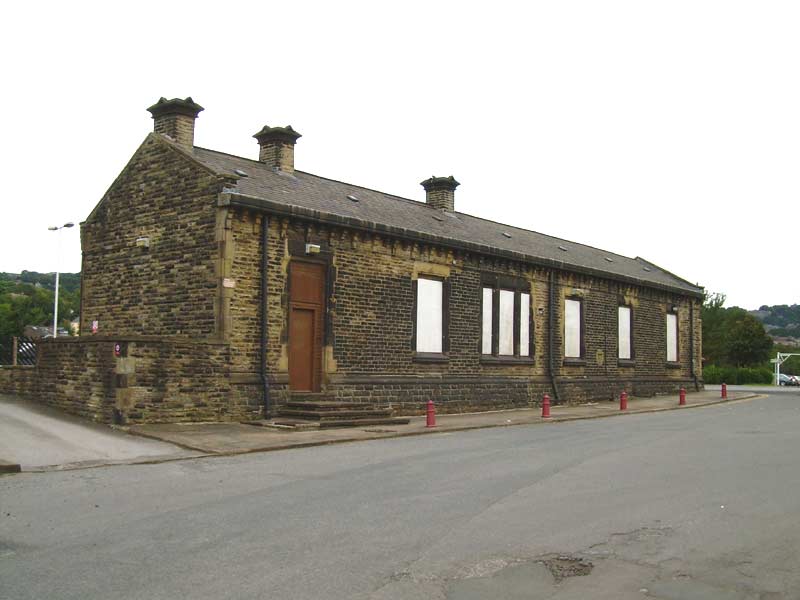
The Jubilee Refreshment Rooms, Sowerby Bridge, is in the old ticket office where Branwell Bronte, worked.
In 1840, Branwell was appointed assistant clerk at Sowerby Bridge’s recently opened railway station where he earned an annual wage of £75 working in a wooden and corrugated shack.


Luddenden Foot
After a brief time at Sowerby Bridge, Branwell was promoted to clerk in charge of Luddenden Foot station where he earned £130 a year.
However, he found the position more taxing and when he was not idling away the hours sketching and doing freehand portraits of local characters, he often took himself off to the Lord Nelson, the village’s main inn.
When the Manchester and Leeds Railway came to check its accounts for the year ending 1841, it discovered a discrepancy of more than £11 - a sizeable sum in those days - and he was subsequently dismissed for neglect of duty.
Brothers Andrew and Chris Wright
Railway enthusiasts and life members of the Campaign for Real Ale, had a dream. They wanted to open an old-style railway refreshment room with a new twist – the pub was to serve commuters, but it was also to be a mecca for railway and real ale aficionados.


The place they found had been a Victorian station, built in 1876, at Sowerby Bridge. Most of it had been demolished, but there remained part of the structure, the old booking and parcels office. It took 12 years of negotiations, but finally a deal was done and financial help appeared, from the Railway Heritage Trust.
Train operators call for disused railway lines to reopenTwo years of hard work followed. Problems included dry rot, wet rot, asbestos and even a panic about anthrax. Excavation revealed treasures, too. There were no clues, however, about Branwell Bronte, the brother of the famous sisters, who was Clerk in Charge here in 1840, when the line opened.
So here it is, up and running since July. The pub opens a window – "the whistle-stop café" – from 7.30-9.30am for drinks and snacks, then offer bigger breakfasts indoors –"the fireman's shovel" – from 9.30am to noon. From midday to 11pm, the bar is open, offering at least six different real ales, all sourced from microbreweries within a 50-mile radius.
The Wrights want the Jubilee to become a convivial meeting place. Local breweriana collectors, plus local Camra branches, have already been. Earlier this month, the Sowerby Bridge Rushcart procession, with scores of Morris dancers, arrived and drank the place dry.
vrijdag 30 juli 2010
Birthday Emily Bronte

is het
192 jaar geleden
dat Emily Bronte
werd geboren.
Emily Brontë was born at Thornton, Bradford, Yorkshire, and just after the birth of her sister Anne (20 April 1820), she moved with her family to Haworth, near Keighley, Yorkshire, where she spent most of her life. Today remembered chiefly as the author of the eighteenth-century romance Wuthering Heights (1847), set in her native Yorkshire.
Emily Brontë was born at Thornton, Bradford, Yorkshire, and just after the birth of her sister Anne (20 April 1820), she moved with her family to Haworth, near Keighley, Yorkshire, where she spent most of her life. Today remembered chiefly as the author of the eighteenth-century romance Wuthering Heights (1847), set in her native Yorkshire.
donderdag 29 juli 2010

Haworth was (and is) the first Fairtrade Village in the world.
READ MOREhaworthfairtrade
READ MOREhaworthtrust
Several annual events are held in Haworth, many of which include dressing up. Among the most popular is the 1940s weekend, held in early May.
There's also carnival in August, a Halloween weekend, bonfire night fireworks, "Scroggling the Holly" in November where the Holly Queen is crowned and villagers dress up in Victorian costume, "Pipes, Bows and Bells" in early December which celebrates the region's industrial heritage, and also in December, the "Torchlit Weekend" where a torch-lit procession walks through the village and up to the church for the traditional Carol service.
READ MOREhaworthtrust
Several annual events are held in Haworth, many of which include dressing up. Among the most popular is the 1940s weekend, held in early May.
There's also carnival in August, a Halloween weekend, bonfire night fireworks, "Scroggling the Holly" in November where the Holly Queen is crowned and villagers dress up in Victorian costume, "Pipes, Bows and Bells" in early December which celebrates the region's industrial heritage, and also in December, the "Torchlit Weekend" where a torch-lit procession walks through the village and up to the church for the traditional Carol service.
the Worth Valley from the Keighley terminus.

The steep gradient up the Worth Valley from the Keighley terminus has been a challenge for locomotives ever since the line opened on 15th April 1867. The sound of a steam engine tackling this climb echoes from the steep sides of the valley, while great clouds of steam and smoke add drama to the scene. Many of the woollen mills that once stood close to the line have been demolished, but a few remain as reminders that the textile industry was the reason why the line was built. Like the railway, the mills relied on coal, and the trains were able to bring hundreds of tons up the valley each week to keep the looms working by steam power. The five mile journey is a powerful reminder of our industrial heritage, as well as being a unique way of enjoying the beautiful countryside immortalised by Charlotte, Emily and Anne Brontë.
The Brontes unfortunately did not enjoy the benefits of this branch line in their own time (it was not ready until 1867 and had been hampered by the floods of 1866), so they must have endured many trudges to Keighley to catch trains to transport manuscripts to publishers! In fact we know from Charlotte Bronte's letters in Elizabeth Gaskell's 'The Life of Charlotte Bronte' (see p.422) that Charlotte was often met by friends at Keighley Station to then make the long trudge back to Haworth - this must have been horrendous in the middle of winter!
De Brontes konden helaas nog niet genieten van de voordelen van deze treinlijn. De aanleg was pas klaar in 1867, de aanleg werd belemmerd door de overstromingen van 1866), dus zij hebben veel moeite moeten doen om op reis te gaan. We weten uit de brieven van Charlotte Bronte aan Elizabeth Gaskell ; "The Life of Charlotte Bronte "(zie p.422), dat Charlotte vaak werd gehaald op Station Keighley, om daarna de lange weg terug te sjokken naar Haworth - dit moet in de verschrikkelijke winters vreselijk zijn geweest!
De Brontes konden helaas nog niet genieten van de voordelen van deze treinlijn. De aanleg was pas klaar in 1867, de aanleg werd belemmerd door de overstromingen van 1866), dus zij hebben veel moeite moeten doen om op reis te gaan. We weten uit de brieven van Charlotte Bronte aan Elizabeth Gaskell ; "The Life of Charlotte Bronte "(zie p.422), dat Charlotte vaak werd gehaald op Station Keighley, om daarna de lange weg terug te sjokken naar Haworth - dit moet in de verschrikkelijke winters vreselijk zijn geweest!
A Yorkshire Classic: Celebrate the Railway Children in the gorgeous setting of the original tear-jerker

Daddy, my daddy!' shouted Bobbie, as the steam cleared and her long-lost father walked along the platform towards her. It was a cinematic moment like none other, requiring a year's supply of man-size tissues.
The film adaptation of Edith Nesbit's heartwarming book was made here during the hot summer of 1970.
You can visit all of the well-loved sights, from Bents House, the iconic family home known in the film as the Three Chimneys, to Oakworth Station, where the tearjerking scenes of the father's homecoming were filmed.
The tourist board is going full steam ahead next month, with Railway Children tours and the chance for children to ' be Mr Perks' on selected dates until September. Children - or grownups, for that matter - can take on Mr Perks's stationmaster role on the steam railway, operating the signals and greeting trains.
But you probably won't have to rip off your red petticoat to wave a warning at a train approaching a landslip.
Even if you are not a fan, a wander around the pretty village set in the Pennines deep in Bronte country and backed by wild moorland will be entertainment enough. The views make you gasp, as do the cakes in tea shops up and down the cobbled streets.
Stay in The Old Registry, with its nine individually themed rooms, and sample famous breakfasts, with sausages from local butcher Lishman's - one of Rick Stein's 'food heroes'. For Railway Children fans, Haworth won't disappoint.
Start at the visitor information centre in West Lane, which acted as the butcher's shop in the film.
From here follow the Railway Children Walk, a five-mile round trip. You can call in at the Royal Oak where William Mervyn - alias 'the Old Gentleman' - reportedly retreated one afternoon, still in costume, to enjoy a few ales with fellow cast members.
Nearby is the Bronte Parsonage Museum, named after Charlotte and Emily who lived here in the mid-1800s, and which doubled as Dr Forrest's surgery. The cosy Fleece Inn on Main Street with its stone-flagged bar is an idyllic stop-off. Stills from the making of the film line the walls.
The rooms above served as the location office and landlord Nick Hindle insists that Jenny Agutter (Bobbie) still visits every year to lead a charity walk. He proclaimed her as 'lovely, down-to-earth and fond of a pint of Landlord'.

It was here the famous landslide was filmed. A glass-fibre tree was slid up and down the embankment while the children battled to save the train from disaster.
Whether you want a pilgrimage to the Railway Children's spiritual home or simply to explore a charming English village, Haworth is just the ticket.
woensdag 28 juli 2010
Per trein naar Haworth

How to Get to West Yorkshire
GNER (Great North Eastern Railway) runs train services from London’s Kings Cross station to Keighley many times a day with a change to the Northern Rail line. From there, a Keighley & District bus takes visitors on a scenic route right up to the top of Haworth, within a three minutes walk to Ashmount Guest House. The train services are easy to navigate and make renting a car unnecessary.
Another option from Keighley to Haworth is the popular Keighley and Worth Valley Railway. This steam engine service runs through gorgeous stations with its’ fleet of historic trains.
Another of Haworth's main attractions is the Keighley & Worth Valley Railway, a preserved steam railway which runs from Keighley station, via Haworth, to Oxenhope. The trains run every weekend, most days during the summer and also during school holidays, making it a fine olde-worlde way to arrive.
Haworth is no longer connected to the mainline rail network, and the only trains are those operated by the KWVR heritage railway. Their website has up-to-date details of train times. The nearest mainline station is Keighley on the Airedale Line, which has frequent connections to Leeds and Skipton. The modern station being adjacent to the heritage railway.
Arriving in Haworth by steam train, cross the footbridge and head uphill towards the upper part of the village. An alternative to walking up the cobbled street is to wander through the park area, which will bring you out on the main road. Cross at the pelican crossing, and proceed up the (very) steep cobbled road opposite, towards The Fleece pub.
Most of Haworth's bus services are provided by Keighley and District. Services 663, 664, 665 and 720 all serve Haworth, as does Firstbus service 500 which runs between Todmorden and Keighley (infrequent).
Service 665, also drops off on Rawdon Road, from where it is just a short walk up into the old village. This does away with the walk from the train station bus stop. On other routes, the best stop to get off at is Sun Street, opposite Weavers' Hill, as this also does away with the steep walk from the station area.
Visitors using Keighley & District's buses to travel to Keighley from further afield - eg from Leeds, Bradford, Skipton or Ilkley, and onward to Haworth, can take advantage of a "K-day" ticket which gives all day travel on all the company's bus services. This costs 2.50 for all-day travel (3.50 if purchased before 0930 Mon-Fri).
A further benefit for bus travellers interested in visiting East Riddlesden Hall, the KWVR, the Bront Parsonage Museum (Haworth) or the Museum of Rail Travel (Ingrow), should ask the driver for a "Heritage Voucher" which when presented with your valid Keighley & District ticket entitles you to discounted entry (special events excepted).
YORK and Scarborough IN THE 19th CENTURY
In 1801, at the time of the first census, York had a population of 16,846. By the standards of the time it was quite a large town but it declined in importance as the century drew on. The industrial revolution meant other Yorkshire towns boomed but York failed to industrialise. In the early 19th century it remained a market town with many craftsmen but no factories.
However the railway reached York in 1839. In 1842 a repair workshop opened. Soon afterwards York became famous for making railway carriages, largely through the efforts of known as the railway king. In the late 19th century confectionery and making cocoa also became a major industry in York. So did flour milling. Also in the late 19th century an industry of making optical instruments flourished.
In the 19th century the population of York grew rapidly and houses spread across the fields outside the walls. Part of the rise in population was due to an influx of Irish immigrants who arrived in the 1840s fleeing the potato famine. Many of the new houses were overcrowded and like all 19th century towns York was dirty and unsanitary. In 1832 and 1849 York suffered outbreaks of cholera. There was also an epidemic of typhus (a disease spread by lice) in 1847, which killed 403 people. However there were some improvements in the city during this century.
From 1824 the streets of York were lit by gas. In 1825 an Act of Parliament formed a body of men called the Improvement Commissioners who were responsible for paving, lighting and cleaning the streets. They were replaced by a Board of Health in 1850. In York some people were rich enough to afford a flushing lavatory connected to a sewer but until the end of the century the raw sewage was flushed into rivers. Most of the people in York used 'earth closets', which were really buckets that were emptied at night into carts by the 'night soil' men. The 'night soil' was sold as fertiliser. In 1890-95 the council built a proper sewage disposal system but it wasn't until the 1920s that all houses in York were connected.
Meanwhile the first modern police force in York was formed in 1836 and after 1880 horse drawn trams ran in the streets of York. York Art Gallery opened in 1892. The first public library in York opened in 1893.
SCARBOROUGH IN THE 19th CENTURY
In the 19th century Scarborough continued to be a genteel seaside resort. The fishing industry continued and Scarborough continued to be a busy port. However shipbuilding declined.
The population rose rapidly. In 1801 Scarborough had a population of about 6,000. To us it would seem tiny but by the standards of the time it was a respectably sized town. It grew rapidly during the 19th century. By 1851 the population of Scarborough was around 13,000. By the end of the 19th century the population more than doubled to over 30,000.
The 19th century saw a number of improvements to Scarborough. In 1805 an Act of Parliament formed a body of men called the Improvement Commissioners with powers to pave, clean and light the streets of Scarborough (with oil lamps).
The Rotunda Museum opened in 1829. A waterworks company was formed in Scarborough in 1844. A Market Hall was built in 1853 and the first cemetery opened in 1857. Meanwhile Cliff Bridge opened in 1827. Valley Bridge opened in 1865.
The railway reached Scarborough in 1845 which, of course, made it easier for visitors to reach the town and a hospital opened in Scarborough in 1893.
However the railway reached York in 1839. In 1842 a repair workshop opened. Soon afterwards York became famous for making railway carriages, largely through the efforts of known as the railway king. In the late 19th century confectionery and making cocoa also became a major industry in York. So did flour milling. Also in the late 19th century an industry of making optical instruments flourished.
In the 19th century the population of York grew rapidly and houses spread across the fields outside the walls. Part of the rise in population was due to an influx of Irish immigrants who arrived in the 1840s fleeing the potato famine. Many of the new houses were overcrowded and like all 19th century towns York was dirty and unsanitary. In 1832 and 1849 York suffered outbreaks of cholera. There was also an epidemic of typhus (a disease spread by lice) in 1847, which killed 403 people. However there were some improvements in the city during this century.
From 1824 the streets of York were lit by gas. In 1825 an Act of Parliament formed a body of men called the Improvement Commissioners who were responsible for paving, lighting and cleaning the streets. They were replaced by a Board of Health in 1850. In York some people were rich enough to afford a flushing lavatory connected to a sewer but until the end of the century the raw sewage was flushed into rivers. Most of the people in York used 'earth closets', which were really buckets that were emptied at night into carts by the 'night soil' men. The 'night soil' was sold as fertiliser. In 1890-95 the council built a proper sewage disposal system but it wasn't until the 1920s that all houses in York were connected.
Meanwhile the first modern police force in York was formed in 1836 and after 1880 horse drawn trams ran in the streets of York. York Art Gallery opened in 1892. The first public library in York opened in 1893.
SCARBOROUGH IN THE 19th CENTURY
In the 19th century Scarborough continued to be a genteel seaside resort. The fishing industry continued and Scarborough continued to be a busy port. However shipbuilding declined.
The population rose rapidly. In 1801 Scarborough had a population of about 6,000. To us it would seem tiny but by the standards of the time it was a respectably sized town. It grew rapidly during the 19th century. By 1851 the population of Scarborough was around 13,000. By the end of the 19th century the population more than doubled to over 30,000.
The 19th century saw a number of improvements to Scarborough. In 1805 an Act of Parliament formed a body of men called the Improvement Commissioners with powers to pave, clean and light the streets of Scarborough (with oil lamps).
The Rotunda Museum opened in 1829. A waterworks company was formed in Scarborough in 1844. A Market Hall was built in 1853 and the first cemetery opened in 1857. Meanwhile Cliff Bridge opened in 1827. Valley Bridge opened in 1865.
The railway reached Scarborough in 1845 which, of course, made it easier for visitors to reach the town and a hospital opened in Scarborough in 1893.
vrijdag 23 juli 2010
Anne Bronte and Scarlborough

This picture, which dates from about the turn of the century, shows the view down 'Westborough', the road that was, in Anne's time, named 'Falsgrave Walk'. On the right is the Scarborough Railway Station, and the large imposing building in the picture-centre is the Pavilion Hotel. This was built in 1870 and survived for just over a hundred years - being demolished in 1973. Just to the left of this, in the distance, can be seen the castle. The rail-line from York to Scarborough was opened in 1845; and it was here, in the early afternoon7n of Friday, 25th May 1849, that Anne, Charlotte, and Ellen Nussey arrived on the fateful visit. From here, they made their way, by horse drawn carriage, to Wood's Lodgings, situated about a quarter of a mile beyond the large buildings on the right (behind the railway tower).

Anne's collection of pebbles which she gathered from Scarborough's South Sands. These are currently housed in the Brontë Parsonage Museum, and are often on show to visitors.

The old sketch shows St. Nicholas Cliff around 1840. Above are Wood's Lodgings, beyond and behind which is Scarborough's South Bay. It was in these buildings where Anne stayed during her first few years at Scarborough with the Robinson family. The smaller buildings (in the centre of the block) were demolished in 1842, and a larger structure erected in their place (see 'Wood's Lodgings (2)' - link below). The photograph shows the same view today with the Grand Hotel standing on the site of Wood's Lodgings


This drawing is titled 'New Buildings, Cliff, Scarborough', and dated 1843.59 It shows Wood's Lodgings viewed from the sea, with its new 'central block' and 'down-the-cliff' extension - in the year of Anne's third visit to the resort.60n On the left is the Spa Bridge, and a number of bathing huts are in evidence along the beach.
Abonneren op:
Posts (Atom)
The Parlour

Parsonage


Top Withens in the snow.

LinkWithin
