I've dreamt in my life dreams that have stayed with me ever after, and changed my ideas: they've gone through and through me, like wine through water, and altered the color of my mind.
Emily Bronte
Wuthering Heights

dinsdag 26 juni 2012

On this day in 1817 Patrick Branwell Bronte fourth child of the Bronte family was born at Thornton.


As a young man, Branwell Brontë was trained as a portrait painter in Haworth, and worked as a portrait painter in Bradford in 1838 and 1839. His most famous portrait is of his three sisters: he seems to have painted himself out, though a legend holds that after an argument his father rubbed the image out with turpentine.
In 1840, Brontë became a tutor to a family of young boys in Broughton-in-Furness but was dismissed within six months. During this time he did a translation of Horace. He was then employed by the Manchester and Leeds Railway, initially as 'assistant clerk in charge' at their Sowerby Bridge station, being appointed to that post in August 1840, his salary being £75 per annum paid quarterly;[2] neither the station nor the line had opened – this event took place on 5 October 1840.[3] Brontë's salary was increased to £130 when he was transferred to Luddendenfoot railway station as 'clerk in charge' on 1 April 1841.[2] He was dismissed in 1842 due to a deficit of eleven pounds, one shilling and sevenpence in the accounts, probably stolen by Watson, the porter, who was left in charge when Brontë went drinking.[2] This was attributed to incompetence rather than theft, and the missing sum was deducted from Brontë's salary.[2] During his period of employment both as a tutor and on the railways he harboured literary ambitions and published poetry under various pseudonyms in the Yorkshire press. Read more: wiki/Branwell_Bronte-
--------------
On the whole, Branwell's critical reputation was cemented by Charlotte's exceedingly unfavorable judgment of him, revealed in a number of bitter letters sent to her publisher just after Branwell's death. According to Brontë scholar Robert G. Collins, Charlotte's assessment “was the sentence of death upon Branwell's reputation.” Charlotte had not spoken to Branwell for about two years before his death, and days after his funeral wrote: “I do not weep from a sense of bereavement … but for the wreck of talent, the ruin of promise, the untimely dreary extinction of what might have been a burning and a shining light. … There is such a bitterness of pity for his life and death, such a yearning for the emptiness of his whole existence as I cannot describe.” Elizabeth Gaskell, whose 1857 biography became the basis for subsequent Brontë studies, received most of her information about the family from Charlotte, who described the sad but welcome death of her brother. In 1886 Francis A. Leyland, a friend of Branwell's, attempted to restore Branwell's character with the publication of The Brontë Family, with Special Reference to Patrick Branwell Brontë. Claiming that Branwell had been unfairly characterized, Leyland attempted not to clear Branwell of his wrongs but to depict him as a man to be admired in spite of his flaws. Many critics found the book to be dull, however, and continued to maintain their earlier perception of Branwell.
The practice of condemning Branwell continued into the 1940s and 50s, with critics generally claiming that his work showed very little, if any, signs of genius. In 1960, the critical tide turned somewhat when Daphne Du Maurier, in her study The Infernal World of Branwell Brontë, argued that Branwell's reputation had been maligned. A year later Brontë scholar and biographer Winifred Gerin made a case for the need to study Branwell's works as a whole in order to understand his tortured and disappointing life and to comprehend the emotional outlook of the writer. The most recent scholarship echoes Gerin's argument, acknowledging the futility of trying to assess Branwell's overall purpose and qualifications when most editions of his works either include outdated or unreliable information, contain inaccuracies due to difficulties in dating or assigning authorship, or simply bring together fragments of his work. For a proper critical assessment of Branwell's merits as a writer, recent critics contend that a complete and accurate source of all of Branwell's known writings is needed.

maandag 25 juni 2012

Emily Bronte already has 57,842 'likes' on her Facebook page

 
Look at my wooden soldiers. I only have two, bought at the Haworth Brontë Parsonage Museum's shop. Everyone knows the famous story about the box of wooden soldiers. This photographe  and words of Georges Renaux,  I read on the Facebook page of Emily Bronte.

We may freak at the suggestion of chopping Tolstoy up into digestible megabytes, we may balk at the thought of Scrooge and Hamlet opening Twitter accounts and we may laugh at the thought of Mr Bumble teasing the reader with his very own Facebook page while Jamie Oliver offers a more tempting alternative to a bowl of gruel, but let's not forget Emily Bronte already has 57,842 'likes' on her Facebook page, and who's to say that Shakespeare would object to being the 'Blogging Bard' - if "all the world's a stage" as he says - I'm sure, if he were here today, that would include the laptop as well.
Read all:  Huffington Post

zondag 24 juni 2012

Patrick Brontë


The Brontë Parsonage Museum is partly manned by volunteers who did not disappoint in their dedication and friendliness. Predictably too, Haworth is packed with Bed and Breakfasts; ye OldeTeashops and so on. Nonetheless, a suggestion of tweeness is effectively counteracted by the weight of the history of Brontë family; and the magnificence of the moors. A wide variety of accommodation is on offer (in some cases at top prices) by the locals in the absence- thank goodness - of modern hotel chains. Great efforts are made to create an old world atmosphere in line with theBrontë story. Especially the standard of breakfasts and bakery is high (waist watchers be warned).................


Apart from the moors, Patrick Brontë remained a dominant – one has to say - presence. Over the weekend, one becomes quickly reacquainted with his strong personality; the many tragic aspects of his life; and his energetic commitment to carrying out his pastoral ministry including as Vicar of Haworth, against the background of the lively theological debates raging at the time. Some might   wonder then that the summing up accolade paid to him in the parish church in Haworth in the ceremony to celebrate the 200th anniversary of his marriage to Maria Branwell as well as his Faith, was that  Patrick Brontë was a great British hero - (Oh well; it is the Jubilee  Year!!)................................
Brussels Bronte

vrijdag 22 juni 2012

Bronte book lovers on the web


There is also a rather lovely small press miniature book:
Charlotte Bronte and Mary Taylor: Early Feminists by Suzanne Smith Pruchnicki. Illinois, The Brontë Press, 1999

 
Given my love for the Bronte sisters classics "Jane Eyre" and "Wuthering Heights", it was a no-brainer for me when I saw these little lovelies
 
Not to long ago I stubmbled upon this wonderful, in depth article about the Bronte Sisters and a lost (found and recently autctioned) book by Charlotte. 


maandag 18 juni 2012

Migrants to Haworth

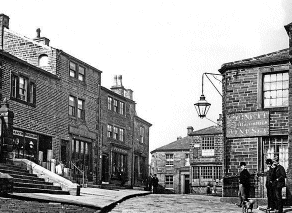
From John Hearfield (click) ( A period after the Bronte family was living in Haworth. But interesting to know what happened some years later. And a beautiful old picture of Haworth).
Haworth Main St

Because my oldest friend lives in Haworth, I have investigated the 19thC town in some detail, including making transcripts of the 1871, 1881 and 1891 censuses. Haworth is up on the moors above Keighley and is the West Riding mill town closest to the Yorkshire dales. Bleak and windswept, even now you can walk out of the town on to the moors, which would have given an illusion of familiarity to the migrants. The 1880s and 90s Heads of Households, often their wives, certainly their children, all worked at the many jobs which made up the textile trade, from washing, combing, carding and spinning the yarn, to weaving and finishing the fine worsted for which the town was famous.

Of the 51 Heads of Household who left Swaledale for the West Riding between 1881 and 1891, forty-four households - 323 people - came to Haworth. In 1881, the average age of those 323 people was just 16 - an awful lot of young children accompanied their parents and most of them were working in the mills by 1891.

zondag 17 juni 2012

Postmaster at Haworth

There is some confusion over which property on the Main St is the actual Post Office during the Brontes In the Trade Directory it states that between 1830-1857 William Hartley was Postmaster at Haworth, a  map of Haworth 1853 clearly shows the property in the photograph as the Post Office. 
In 1861 Edwin Feather became Postmaster, the post Office  located to another property, the Brontes were all dead by this time.
To confuse matters a book by Claude Meeker "Haworth home of the Brontes" (1895) claims a Samuel Feather as being the Postmaster. There is no known record of him as a Postmaster or living in Haworth. It has to be noted that at the time this book was published there was considerable interest in the Brontes and all sorts of claims were made. Haworth-village

Haworth

 
In the village, the old post office is now a general stationers run by Margaret Hartley, whose family have been in business in the village for more than 350 years.
 
'My great-great-great-grandad was the postmaster and served the Brontes,' says Margaret, 74. 'And this is the counter that the girls passed their manuscripts over.' 

'The girls' is how the people of Haworth refer to Anne, Charlotte and Emily Bronte, as if they were family.

Leaving behind the parsonage and the post office and heading along a steep footpath into the hills, the church bells (curate Bronte's old church, but rebuilt) and the steam engines running on the Keighley and Worth Valley railway are all I can hear.


The path is riddled with nettles - I imagine Emily's long skirts would have saved her from stings. As it winds around the hillside and narrows, the fields on the high side are replaced by rough moorland. Then slowly, the fields on the low side fade away too, and either side is no longer luxuriant green but browned, waist-high bracken, tough grass and blushing heather.
 
 
There's a single huge, upright grey stone, shaped like a throne, where Emily sat to gather her thoughts.


She took the natural features around her home and worked them into her novel, so every pile of stones holds a heavy meaning: the real-life Ponden Kirk became fictional Peniston Crag, where Cathy ponders her troubled life, and Ponden Hall became Thrushcross Grange, home of the Linton family that Cathy marries into, tearing her away from her true love.

Metal thieves strip lead from roof of historic church where Bronte sisters are buried

zaterdag 16 juni 2012

The Heaton family of Ponden Hall

Ponden Hall in the 1920s


Emily and her family were regular visitors to Ponden Hall and would walk across the moor to the Heaton family home. Branwell Brontë’s short story The Thurstons of Darkwell is based on it. The Heatons, who owned nearby Ponden Mill, also had what was reputed to be “the best library in the West Riding” and Emily certainly used it.


An influential though far from prosperous family in the Haworth area during the Brontës’ time. The large family included the elder Robert and his wife Alice, née Midgley and among their children the younger Robert (b. 1822), William, and John. The younger Robert has been linked romantically with Emily through a tenuous family tradition, and it has been noted that Hareton is an anagram of R. Heaton. The elder Robert was a church trustee at the time of the row over Patrick’s appointment to Haworth. Gerin (1971, p. 32) claims that the younger Brontës had access to the library at Ponden, but this has not been proved. During Ellen’s visit to Haworth in July 1844 she seems to record in her diary “fun and fatigue” with the Heaton family, but the entry is ambiguous. The Heatons’ fortune and position declined steadily in the later nineteenth century. blackwell reference


We know that Emily visited and read here, and scholarly studies have been made of the catalogue, working out what she might have read that could have influenced her work. It's highly likely that Anne, Charlotte and Branwell visited too, as the Heatons (together with the Taylors at the Manor House in Stanbury) were one of the foremost families in the area: for generations they acted as JPs and churchwardens at Haworth Church.
In the back garden are the withered remains of a now-dead pear tree, supposedly the gift of a lovesick teenage Heaton to an older, uninterested Emily.


There is another, important link between Wuthering Heights and Ponden Hall. In an account by William Davies (published in 1896) after a visit he made to Haworth in 1858, he tells how, after meeting Patrick Brontë ("a dignified gentleman of the old school"), he was taken on a tour of the area:
"On leaving the house we were taken across the moors to visit a waterfall which was a favourite haunt of the sisters… We then went on to an old manorial farm called 'Heaton's of Ponden', which we were told was the original model of Wuthering Heights, which indeed corresponded in some measure to the description given in Emily Brontë's romance."
wuthering-heights/locations/ponden-hal


A lot of photograph's Ponden Hall

donderdag 14 juni 2012

The former house of Cranford author Elizabeth Gaskell in Manchester is to be opened to the public after being awarded almost £2m for a restoration.


Gaskell moved to the villa on Plymouth Grove in 1850, three years before her novel Cranford was published. Visitors will be able to see the house as it would have looked during her time there, restored with the £1.85m grant from the Heritage Lottery Fund. It was damaged last year when metal thieves ripped off most of the roof. 


Gaskell's work enjoyed renewed popularity after Cranford was adapted for a BBC drama starring Dame Judi Dench, Dame Eileen Atkins and Michael Gambon in 2007.Other novels written by Gaskell while living at the house included North and South and Wives and Daughters.
Gaskell was visited in the house by great literary figures including Charles Dickens and Charlotte Bronte, and the author lived there until her death in 1865. 
 
Sara Hillton, head of Heritage Lottery Fund North West, said: "This building is hugely important to Manchester - both because of its association with Elizabeth Gaskell and as a rare remaining example of a Victorian suburban villa.
CranfordThe all-star TV adaptation of Cranford was a ratings hit
"Alongside the preservation of the house itself, the creation of displays and exhibitions will enhance people's understanding of the Gaskells within the context of the local area and Manchester at the time."
The Heritage Lottery Fund has awarded the grant to Manchester Historic Buildings Trust, which owns the building.
Rooms on the ground floor, including her husband William's study, the morning room and the drawing and dining rooms, still have some original fittings and are expected to be opened to the public. There will also be education and community facilities.bbc.co.uk/news

The first room we saw was the study of Elizabeth Gaskell's husband, William. This room is currently a used bookshop that helps raise money for the restoration of the house.


dinsdag 12 juni 2012

1834 Poor Law Amendment Act


When Patrick Brontë opposed the 1834 Poor Law Amendment Act little could he imagine that more than 170 years later his words would be so adequate for the current economical situation of his native Ireland. He wrote in 1837 to the Leeds Intelligencer.

Liberty or Bondage
To the Labourers, Mechanics, and Paupers or Slaves of England

(...) A law has lately been passed called the Poor Law Amendment Bill - a great misnomer I never read nor heard. It is a monster if iniquity, a horrid and cruel deformity, even in regard to what before was no very shapely or symmetrical representation. I know a comittee is sitting to amend the bill - but let me tell you, my dear friends, that it cannot be amended; it must be repealed altogether. (...)

We are told in the five books of Moses that the poor shall never cease from the land, and are exhorted to open our hands wide to relieve them. And the eternal God says multiply and replenish the earth. The blessed Saviour, also, follows up these injunctions with still more forcible admonitions. But a set of unfeeling, antiscriptural men, have lately arisen, who, being themselves only paupers on a larger scale, (as they are, in mnay instances supported by the country, and in a great measure, by the very men whom they wish to oppress) - who, nevertheless, teach doctrines in direct opposition to the law and to the gospel. What, then, my friends, are we to do under these circumstances? Why, verily, I see no plan better for us than that adopted by the Apostles, namely, to obey God, rather than man. (...) Then let me request you to do your duty - petition, remonstrate, and resist powerfully but legally, and God, the father and friend of the poor, will crown all your efforts with success. (Patrick Brontë to the Editor of the Leeds Intelligencer, 22 April 1837)

http://bronteblog.blogspot.com/

Patrick Bronte and Wethersfield, Hartshead and Woodhouse Grove School,

 
St Mary's, Wethersfield
 
Patrick Bronte served his first curacy in Wethersfield from 1806 to 1808. He lived in St George’s House, which still stands opposite the Church. He moved to Yorkshire where Branwell, Emily Aime and Charlotte were born.  stepneyrobarts/wethersfield-essex

The register of the parish church of St Mary Magdelene records his stay.  history detail 

Reverend Patrick Bronte (1777-1861)  was appointed curate at Wethersfield, Essex, where he was ordained a deacon of the Church of England, and ordained into the priesthood in 1807. In 1809 he became assistant curate at Wellington in Shropshire and in 1810 he published his first poem Winter Evening Thoughts in a local newspaper, followed in 1811 by a collection of moral verse, Cottage Poems. 


The following year (1812) he was appointed a school examiner at a Wesleyan academy, Woodhouse Grove School, near Guiseley. At Guisely Brontë met Maria Branwell (1783–1821), whom he married on 29 December 1812. wiki/John_Wesley

The first inspector at the Woodhouse Grove School was the Rev. Patrick Bronte, who examined the pupils at the end of the summer term. It is probable that the Rev. William Morgan knew that Patrick Bronte had been a successful teacher in County Down. His report on the school has never been quoted and research has failed to find it.  The Woodhouse Grove Academy, or school as it is now called, is on the north bank of the Aire, just below the bridge ; it is delightfully situated in its own grounds, and the governor's house adjoins the school. Whether Patrick Bronte had been to Woodhouse Grove Academy before he went as an examiner we are not told, but before August, 1812, was out, he was sending love letters to the Headmaster's niece, Maria Branwell daughter of Mr. Fennell's wife's brother. Evidently Mr. Bronte's warm-hearted Irish temperament would not allow him to remain a woman-hater for long. The engagement appears to have taken place in July, and the nine letters which have been published point to times of happiness and pleasure, referring to country walks to the historic spots around Apperley, to Calverley and to Kirkstall Abbey; the latter place inspired Patrick Bronte to write a poem on the old abbey. editor/target=post;post

zondag 10 juni 2012

Patrick Brontë and Mary Burder


St George's House, where Patrick Brontë met Mary Burder in 1807


A CHANCE encounter in a Wethersfield kitchen in 1807 almost changed the face of English literature. When Patrick Brontë, the poorly paid and poorly respected curate of St Mary Magdalene walked into the room in St George’s House where his landlady’s eligible young niece Mary Burder was preparing dinner he was instantly smitten. Had the course of true love run smooth perhaps the world would never have had “Jane Eyre”, “Wuthering Heights” or “The Tenant of Wildfell Hall” for Patrick might never have become the father of novelists Charlotte, Emily and Anne Brontë. As it was, the romance between the impecunious red-haired Irishman, already aged 30, who had gained his BA at St. John’s College Cambridge through hard graft and the help of some well-placed friends and the 18-year-old daughter of a prosperous local farming family, never ended in marriage. No-one is quite sure why. Not even perhaps the enamoured couple themselves. 


The Congregational Chapel where Mary Burder worshipped

 
The Congregational Chapel on the other side of Wethersfield village green to the church could have had a lot to do with it. Mary Burder’s father had died just before Patrick’s arrival in Wethersfield and the responsibility for her widowed mother and the four children in the family had been taken by her uncle who lived not some miles away in Great Yeldham. Mary’s father had been a churchman, though he shelled out a hundred pounds to help the case of the Congregational minister when he was arraigned, wrongly it transpired, for unmentionable crimes. Her uncle’s family were, however, non-conformists and didn’t look kindly on a match with an Anglican curate. That he was an Irishman didn’t help either. Mary, was whisked off to Great Yeldham.


St Mary's, Wethersfield where Patrick was curate


In fact a marriage to Mary Burder wouldn’t have been too great for Patrick Brontë either. Preferment in the Church of England for a man with a wife who did not share his beliefs would have been difficult to obtain. At any rate Patrick decided that nursing a broken heart in Wethersfield was less attractive than a busy life at a new church in Wellington in Shropshire. He continued to write to Mary for a couple of years but by the time she was 21 and therefore free to wed without her family’s permission, Mary became embittered as the prospect of marriage faded. Somehow Patrick’s letters, and his failure to return to Wethersfield to claim her hand, had turned her love to hatred and she saw herself as a jilted woman. Patrick for his part was coping with a far greater workload than ever the tiny parish of Wethersfield had imposed upon him, and, furthermore, no letters were forthcoming from Mary or her family. He began expressing his admiration of those ministers who could serve God without the distraction of unrequited earthly love. He admitted it was not easy for him but he doesn’t seem to have realised that Mary, too, might have found it hard to understand the situation. Eventually the matter was resolved by Patrick’s meeting, in his new Yorkshire parish of Hartshead, 29-year-old Maria Branwell the petite, though not particularly pretty, daughter of a prosperous Penzance grocer who had gone north to help in her aunt and uncle’s boarding school. Patrick and Maria were married in 1812 and over the next few years five girls and one boy were born to the couple. It was not to be a long marriage. Less than 10 years after the wedding Maria was found to have cancer; her death at 38 after a few months illness left Patrick with six small children aged between two and seven. 

He was in a sad predicament. Although he was now in a permanent benefice at Haworth on the Yorkshire moors he was not well off and no catch for a genteel woman of that period. He proposed to the godmother of some of his children but was brusquely turned down. His wife’s sister had been a tower of strength during his wife’s illness but there was no hope there – in those days marriage to the sister of a deceased wife was not permitted. A further proposal to a 
friend’s sister was also rejected. 
In desperation Patrick remembered Mary Burder. Was she married? Was there hope of a reconciliation? He wrote to Mary’s mother and received a reply from Mary herself. Yes, she was still single but she wanted nothing to do with a 47-year-old with a family of six to look after. She declined his suggestion of a meeting in Wethersfield.
Patrick, still hopeful, wrote again but there was no reply.


The Manse at Wethersfield where Mary went to live.
 
And Mary? A year or two later she married the minister at Wethersfield Congregational Church, Rev Peter Sibree who declared that in marrying her “he had found that blessing of which I can never sufficiently appreciate the importance – a prudent wife, which is from the Lord.”  They lived in the Manse by the chapel. Wethersfield/lovepages

The Parlour

The Parlour

Parsonage

Parsonage

Charlotte Bronte

Presently the door opened, and in came a superannuated mastiff, followed by an old gentleman very like Miss Bronte, who shook hands with us, and then went to call his daughter. A long interval, during which we coaxed the old dog, and looked at a picture of Miss Bronte, by Richmond, the solitary ornament of the room, looking strangely out of place on the bare walls, and at the books on the little shelves, most of them evidently the gift of the authors since Miss Bronte's celebrity. Presently she came in, and welcomed us very kindly, and took me upstairs to take off my bonnet, and herself brought me water and towels. The uncarpeted stone stairs and floors, the old drawers propped on wood, were all scrupulously clean and neat. When we went into the parlour again, we began talking very comfortably, when the door opened and Mr. Bronte looked in; seeing his daughter there, I suppose he thought it was all right, and he retreated to his study on the opposite side of the passage; presently emerging again to bring W---- a country newspaper. This was his last appearance till we went. Miss Bronte spoke with the greatest warmth of Miss Martineau, and of the good she had gained from her. Well! we talked about various things; the character of the people, - about her solitude, etc., till she left the room to help about dinner, I suppose, for she did not return for an age. The old dog had vanished; a fat curly-haired dog honoured us with his company for some time, but finally manifested a wish to get out, so we were left alone. At last she returned, followed by the maid and dinner, which made us all more comfortable; and we had some very pleasant conversation, in the midst of which time passed quicker than we supposed, for at last W---- found that it was half-past three, and we had fourteen or fifteen miles before us. So we hurried off, having obtained from her a promise to pay us a visit in the spring... ------------------- "She cannot see well, and does little beside knitting. The way she weakened her eyesight was this: When she was sixteen or seventeen, she wanted much to draw; and she copied nimini-pimini copper-plate engravings out of annuals, ('stippling,' don't the artists call it?) every little point put in, till at the end of six months she had produced an exquisitely faithful copy of the engraving. She wanted to learn to express her ideas by drawing. After she had tried to draw stories, and not succeeded, she took the better mode of writing; but in so small a hand, that it is almost impossible to decipher what she wrote at this time.

I asked her whether she had ever taken opium, as the description given of its effects in Villette was so exactly like what I had experienced, - vivid and exaggerated presence of objects, of which the outlines were indistinct, or lost in golden mist, etc. She replied, that she had never, to her knowledge, taken a grain of it in any shape, but that she had followed the process she always adopted when she had to describe anything which had not fallen within her own experience; she had thought intently on it for many and many a night before falling to sleep, - wondering what it was like, or how it would be, - till at length, sometimes after the progress of her story had been arrested at this one point for weeks, she wakened up in the morning with all clear before her, as if she had in reality gone through the experience, and then could describe it, word for word, as it had happened. I cannot account for this psychologically; I only am sure that it was so, because she said it. ----------------------She thought much of her duty, and had loftier and clearer notions of it than most people, and held fast to them with more success. It was done, it seems to me, with much more difficulty than people have of stronger nerves, and better fortunes. All her life was but labour and pain; and she never threw down the burden for the sake of present pleasure. I don't know what use you can make of all I have said. I have written it with the strong desire to obtain appreciation for her. Yet, what does it matter? She herself appealed to the world's judgement for her use of some of the faculties she had, - not the best, - but still the only ones she could turn to strangers' benefit. They heartily, greedily enjoyed the fruits of her labours, and then found out she was much to be blamed for possessing such faculties. Why ask for a judgement on her from such a world?" elizabeth gaskell/charlotte bronte


Poem: No coward soul is mine

No coward soul is mine,
No trembler in the worlds storm-troubled sphere:
I see Heavens glories shine,
And faith shines equal, arming me from fear.


O God within my breast.
Almighty, ever-present Deity!
Life -- that in me has rest,
As I -- Undying Life -- have power in Thee!


Vain are the thousand creeds
That move mens hearts: unutterably vain;
Worthless as withered weeds,
Or idlest froth amid the boundless main,


To waken doubt in one
Holding so fast by Thine infinity;
So surely anchored on
The steadfast Rock of immortality.


With wide-embracing love
Thy Spirit animates eternal years,
Pervades and broods above,
Changes, sustains, dissolves, creates, and rears.


Though earth and man were gone,
And suns and universes ceased to be,
And Thou wert left alone,
Every existence would exist in Thee.


There is not room for Death,
Nor atom that his might could render void:
Thou -- Thou art Being and Breath,
And what Thou art may never be destroyed.


--
Emily Bronte

Family tree

The Bronte Family

Grandparents - paternal
Hugh Brunty was born 1755 and died circa 1808. He married Eleanor McClory, known as Alice in 1776.

Grandparents - maternal
Thomas Branwell (born 1746 died 5th April 1808) was married in 1768 to Anne Carne (baptised 27th April 1744 and died 19th December 1809).

Parents
Father was Patrick Bronte, the eldest of 10 children born to Hugh Brunty and Eleanor (Alice) McClory. He was born 17th March 1777 and died on 7th June 1861. Mother was Maria Branwell, who was born on 15th April 1783 and died on 15th September 1821.

Maria had a sister, Elizabeth who was known as Aunt Branwell. She was born in 1776 and died on 29th October 1842.

Patrick Bronte married Maria Branwell on 29th December 1812.

The Bronte Children
Patrick and Maria Bronte had six children.
The first child was Maria, who was born in 1814 and died on 6th June 1825.
The second daughter, Elizabeth was born on 8th February 1815 and died shortly after Maria on 15th June 1825. Charlotte was the third daughter, born on 21st April 1816.

Charlotte married Arthur Bell Nicholls (born 1818) on 29th June 1854. Charlotte died on 31st March 1855. Arthur lived until 2nd December 1906.

The first and only son born to Patrick and Maria was Patrick Branwell, who was born on 26th June 1817 and died on 24th September 1848.

Emily Jane, the fourth daughter was born on 30th July 1818 and died on 19th December 1848.

The sixth and last child was Anne, born on 17th January 1820 who died on 28th May 1849.

Top Withens in the snow.

Top Withens in the snow.

Blogarchief

LinkWithin

Related Posts with Thumbnails