I've dreamt in my life dreams that have stayed with me ever after, and changed my ideas: they've gone through and through me, like wine through water, and altered the color of my mind.
Emily Bronte
Wuthering Heights

zondag 15 december 2013

A visit to the Parsonage Museum.... and the first photographes !!!!!

This article is from the weblog Helena Fairfax
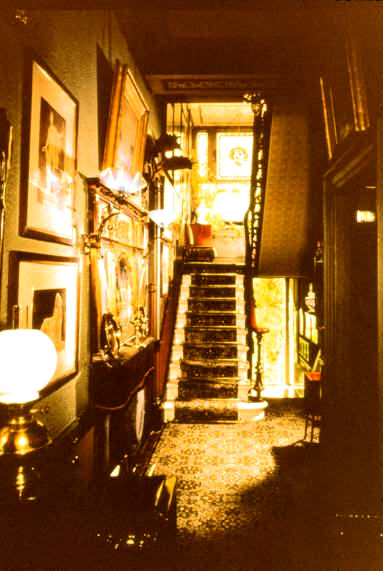
Look to the beautiful photographes  of the new decorated Parsonage.
 
I am so happy Helena made these pictures!!!!!!!!!!!!!!!!!!!!!!!!!
 
On this photographe I see  the removing of the portrait of Charlotte Bronte
Instead there is hanging an example of the Charlotte-Cory exposition
 
Last week I was lucky enough to attend a writers’ workshop at the Brontë Parsonage Museum in Haworth. The workshop was run by the Scots poet Jackie Kay. Jackie Kay is the writer in residence at the Parsonage (what a brilliant job that must be!)  She is also Professor of Creative Writing at Newcastle Uni, an MBE for her services to literature, and the author of several volumes of prose and poetry.  So, writing, the moors, Haworth and the Brontës – I was quite excited about the day! 
Jackie Kay talked about her research as writer in residence, and the areas which had particularly interested her. One of these was the life of the Brontë sisters’ father, Patrick Brontë. Patrick was Irish, but spent most of his adult life in England. He went to Cambridge, which was a massive achievement for the largely self-taught son of an agricultural labourer, who had been destined by his family to become a blacksmith. Jackie Kay wondered what type of man he had been, to come from such a background and be father to one of the most creative families in literature.  He survived his wife and all six of his children.


Another of the Haworth characters that interested Jackie was Tabitha, the family’s maid.  Jackie believes Tabitha was herself a phenomenal story teller, and would regale the children with tales that were far beyond their years. She served with the family for 31 years, and was much loved.
One of the discoveries I most enjoyed finding out about was a poignant list of the household’s goods, which Jackie came across during her research. The household goods were put up for auction after Patrick Brontë died, and include such items as “Sundry Books 5 s/3p” ; “Warming Pan 5s / ” ;  “Hair Trunk 12s/ “; and (somehow I found this the saddest): “2 silk umbrellas 10s / 6p”.
Finally, the writing exercise Jackie set us involved choosing one of the rooms in the Parsonage, plus an object we’d seen there, and maybe one of the members of the household. We also had to write down four words that summed up our main impressions of the morning. Then we had five minutes to write what we wanted.  (I’m not really explaining this as well as Jackie Kay did, but I’m sure you get my drift!)

Helena Fairfax, Haworth, Brontës, Jackie Kay

Anyway, I decided to put a scene together involving Patrick Brontë reading to the children when they were young.  I’m also intrigued by Aunt Branwell, so she, too, appeared in my five minute writing.  Aunt Branwell was Patrick’s sister-in-law, and moved from Plymouth to Haworth to look after the family when her sister died.  According to Mrs Gaskell, Aunt Branwell ran the household with clockwork precision.  I wonder what she made of the sisters and their frenzies of creativity, and of their brother Branwell, who became addicted to alcohol and opium.
 

zaterdag 14 december 2013

On this day in 1847

Emily and Anne received six published copies of their novels, Wuthering Heights and Agnes Grey from their publishers. haworth-village


donderdag 12 december 2013

Jane Eyre

Jane Eyre quiz

The Brontë Sisters and Their Work in Ankara

A Conference scheduled for today, December 12 completely devoted to the Brontës. In Ankara, Turkey:
12-13 December 2013 at Middle East Technical University
Ankara, Turkey
METU 2013: The Brontë Sisters and Their Work

is the theme for this year’s METU British Novelists Conference organized by the Department of Foreign Language Education in Middle East Technical University, Ankara, Turkey. The conference will explore various aspects of the work of Charlotte, Emily and Anne Brontë. There will also be papers approaching the work of the Brontë Sisters from the perspective of media and adaptation studies. Selected papers will be published in the conference proceedings.
Programme: Read The Brontë Sisters and Their Work in Ankara

woensdag 11 december 2013

December/Christmas 1893

The Yorkshire Post looks back on December/Christmas 1893. Among other things, this is what was happening:
December did bring some lighter news. On the 23rd, the Yorkshire Post reported that a Brontë Society had been formed following a meeting at Bradford Town Hall.
The Rev UH Keeling, headmaster of Bradford Grammar School, presided over the meeting, which had been called by the city’s mayor.  It was convened amid concerns that 38 years after Charlotte Brontë’s death, artefacts relating to both her and her sisters would end up being scattered away from Yorkshire. “The Brontës,” the chairman said, “represented and embodied the true Yorkshire spirit, though they themselves were not a Yorkshire family.” He praised their writing talent, adding: “In a word, they formed the strongest link between their county and the great world of literature.” (Chris Bond)
bronteblog

As we open Jane Eyre once more we cannot stifle the suspicion that we shall find her world of imagination as antiquated, mid-Victorian, and out of date as the parsonage on the moor, a place only to be visited by the curious, only preserved by the pious. So we open Jane Eyre; and in two pages every doubt is swept clean from our minds.

As Virgina Woolf wrote in 1916
Thank you Anne for sending


dinsdag 10 december 2013

Charlotte Brontë had found a way to mesmerise the reader through an intensely private communion with her audience.

 
The Guardian/The Observer has picked Jane Eyre as number 12 of the 100 best novels.
"There was no possibility of taking a walk that day."
From its haunting first line to its famous closer, "Reader, I married him", Charlotte Brontë takes her audience by the throat with a fierce narrative of great immediacy. Jane Eyre's voice on the page is almost hypnotic. The reader can hardly resist turning the next page, and the next…
In an extraordinary breakthrough for the English novel, borrowing the intimacy of the 18th-century epistolary tradition, Charlotte Brontë had found a way to mesmerise the reader through an intensely private communion with her audience. We, the author, and Jane Eyre become one. For this, she can be claimed as the forerunner of the novel of interior consciousness. Add to this a prose style of unvarnished simplicity and you have the Victorian novel that cast a spell over its generation. Even today, many readers will never forget the moment they first entered the strange, bleak world of this remarkable book.


The magic of Jane Eyre begins with Charlotte Brontë herself. She began to write her second novel
(The Professor had just been rejected) in August 1846. A year later it was done, much of it composed in a white heat. The reading public was spellbound. Thackeray's daughter says that the novel (which was dedicated to her father) "set all London talking, reading, speculating". She herself reports that she was "carried away by an undreamed-of and hitherto unimagined whirlwind".
There are three principal elements to Brontë's magic. First, the novel is cast, from the title page, as "an autobiography". This is a convention derived from Defoe's Robinson Crusoe (No 2 in this series). But the adventure offered by the author is an interior one. Jane Eyre portrays the urgent quest of its narrator for an identity. Jane, who cannot remember her parents, and as an orphan has no secure place in the world, is in search of her "self" as a young, downtrodden woman. (Robert McCrum) (Read more) bronteblog
 

maandag 9 december 2013

Queen Victoria's Book of Spells and more about gaslight in Victorian times.

I always love it very much when I have a reaction.  Roses and Vellum tells me:

Gaslamps are so beautiful. It is funny to think something so beautiful and nostalgic to us now was strange and futuristic back then. I have been reading recently, and there was a story (Smithfield by James P Blaylock) about the lighting of the gaslamps for the first time, it was quite fascinating to think about.

Thank you for your reaction. Yes, It is fascinating to think about the days that gaslight was new.  Your reaction also made me curious. I never heard about Queen Victoria's Book of Spells. So I was searching for it.  I found this nice weblog:  suzanne-johnson/drive-by-review-and-cntest-queen
 
ABOUT QUEEN VICTORIA’S BOOK OF SPELLS: “Gaslamp Fantasy,” or historical fantasy set in a magical version of the nineteenth century, has long been popular with readers and writers alike. A number of wonderful fantasy novels, including Stardust by Neil Gaiman, Jonathan Strange and Mr Norrell by Susanna Clarke, and The Prestige by Christopher Priest, owe their inspiration to works by nineteenth-century writers ranging from Jane Austen, the Brontës, and George Meredith to Charles Dickens, Anthony Trollope, and William Morris. And, of course, the entire steampunk genre and subculture owes more than a little to literature inspired by this period….Queen Victoria’s Book of Spells is an anthology for everyone who loves these works of neo-Victorian fiction, and wishes to explore the wide variety of ways that modern fantasists are using nineteenth-century settings, characters, and themes. These approaches stretch from steampunk fiction to the Austen-and-Trollope inspired works that some critics call Fantasy of Manners, all of which fit under the larger umbrella of Gaslamp Fantasy. The result is eighteen stories by experts from the fantasy, horror, mainstream, and young adult fields, including both bestselling writers and exciting new talents such as Elizabeth Bear, James Blaylock, Jeffrey Ford, Ellen Kushner, Tanith Lee, Gregory Maguire, Delia Sherman, and Catherynne M. Valente, who present a bewitching vision of a nineteenth century invested (or cursed!) with magic.
 
Wow, there really is a lot to read, I never heard from before.
 
On another website I found more about gaslight buildingconservation/lighting
 
At the start of the Victorian period most houses were lit by candles and oil lamps. Interior fittings included chandeliers (suspended from the ceiling) and sconces (fixed to the wall). However these were mainly used on special occasions, and most ordinary events after sunset took place using portable light sources such as candlesticks, candelabra (bracketed candlesticks) and oil lamps, and by the light of the fire. By the end of the period gas lighting was common in urban homes and electricity was being introduced in many. Gas lighting of buildings and streets began early in the 19th century, with most streets in London lit by gas as early as 1816. But for the first 50 years it was generally distrusted and few homes were lit. After gas fittings were introduced in the new Houses of Parliament in 1859 the tide turned. Fasionable town houses constructed in the 1860s often had a central pendant gas light (that is to say a gas light attached to the ceiling) in each of the principal rooms with a ventilation grille above, cunningly disguised in the deep recesses of the ceiling rose. Gas 'wall brackets' were used in place of the sconce, and some staircases were lit by newel lights attached to the newel post. The largest pendant fittings had several burners and were known as gasoliers.

 
Late 19th century paraffin lamp and gas wall brackets in the entrance hall of the Linley Sambourne House, London. (Victorian Society, Linley Sambourne House, London/Bridgeman Art Library)

Before the advent of the incandescent mantle, gas lighting relied on a simple open flame. By the mid 19th century the most common burners produced fan-shaped flames like the Batswing and Fish Tail burners. The Argand burner, which was successfully adapted for gas, was the principal exception with its circular flame.

All these gas light fittings and the early incandescent mantles had to point upwards directing the light towards the ceiling and away from where the light was needed most, and it was not until 1897 that the gas mantle was adapted to burn downwards - a useful event to remember when dating gas fittings.

 
Simple gas lights incorporated a plain brass, copper or iron gas supply tube with a tap for switching the gas on and off, terminating in a burner shielded from direct view by a shade or globe to diffuse the light. Some burners such as the Argand also incorporated a glass tube or chimney, and around which could be placed a larger shade of glass or silk. Pendant lights could consist of little more than a vertical rod turned at right angles at the end to support the up-turned burner, but they were rarely that simple in the Victorian period. Every element of the gas light offered an opportunity for embellishment. Early pendant fittings often incorporated two or more arms forming a loop, gracefully curving down around the glass lamp shade, with the lamp cradled below. In another design scrolling arms radiated from a central baluster, a design echoed by the scrolling arms of the wall brackets.

The shades provided another opportunity for embellishment. Most glass shades were translucent, either frosted or coloured and were often extremely ornate, with cut glass decoration or etched patterns. The most elaborate shapes appeared at the end of the 19th century when designs reached their most opulent in the Louis XV revival. As well as ornate silk shades on lamps with chimneys, a variety of other more delicate devices were introduced at different times, such as shades of glass beads.

By 1890 main stream taste had begun to change dramatically. Although William Morris, the father of the Arts and Crafts Movement, had established Morris and Co almost 40 years earlier, it was the second generation of craftsmen who started to manufacture products on a larger scale, often adopting the industrial processes reviled by Morris. One of the greatest and most prolific designers of the new style was W A S Benson who, with the encouragement of William Morris, had set up his own workshop making light fittings and other metalwork. His fittings, like those of many of his contemporaries, were mass-produced, selling through Liberty's in London in particular.

The Arts and Crafts style swept out the clutter from the Victorian interior, leaving them lighter and brighter in every sense. Richly decorated surfaces were replaced by plain ones relying on the warmth of natural materials
and simple craftsmanship for their interest. Those elements like the fireplaces and light fittings which remained as richly ornamented as ever before took on a new importance, focussing attention. Often the decoration of fittings can be described as 'Art Nouveau' for their graceful, flowing lines and lack of any clear historical influence, but revivalism remained common, and most homes at the turn of the 19th century borrowed heavily from the Tudor and Elizabethan periods in particular.

That the streets of Haworth be lighted with gas

06/12/1864
"Carried unanimously, that the streets of Haworth be lighted with gas and the number of lamps do not exceed 10 this winter. Also that the Clerk gets the estimates for the erection of those lamps as soon as possible that the streets may be lighted without delay."
Extract from Haworth Local Board of Health Minute Book
haworth-village.org.uk/history

By 1823, numerous towns and cities throughout Britain were lit by gas. Gaslight cost up to 75% less than oil lamps or candles, which helped to accelerate its development and deployment. By 1859, gas lighting was to be found all over Britain and about a thousand gas works had sprung up to meet the demand for the new fuel. The brighter lighting which gas provided allowed people to read more easily and for longer. This helped to stimulate literacy and learning, speeding up the second Industrial Revolution. wiki/Gas_lighting

Gaslight fixtures were ornate and decorative whether they were used outdoors or indoors. Echoing the design themes of the times, they integrated well into contemporary architecture. Strangely enough, even while the incandescent lamp was gaining ground, new developments in the gaslight continued.
lighting/history

zondag 8 december 2013

Christmas in Haworth

Haworth in Christmas
Keighley News gives some details about the Victorian Christmas Weekends in Haworth:
The clock is being turned back in Haworth as the village stages its annual Victorian Christmas Weekend.
Traders are donning period costume and a host of festive activities is taking place today and tomorrow.
Bands and choirs are among the attractions in Main Street.
And the Brontë Parsonage Museum is holding events, including a puppet theatre and carol singing. (Alistair Shand)

The Telegraph & Argus adds:
Next Sunday, as the sun sets, the famous Torchlight Procession begins in Haworth, when the band strikes up and the carollers begin the procession slowly up the Main Street, at 4.45pm. Also at the Brontë Parsonage next Saturday and Sunday is a Decoration and Stories weekend offering a chance to join the wreath making workshops, tuck into mince pies and mulled wine, and make some Christmas decorations at the drop in session from 10.30am to 1pm (booking essential) at Brontë Parsonage. (Sue Ward)The Haworth Victorian Christmas Facebook wall provides complete information and lots of pictures of the events taking place this month. bronteblog/haworth-in-christmas

vrijdag 6 december 2013

Dorothy Wordsworth: on a “dull, drizzly, Indian-inky day”.

The New Statesman lists the A-Z of northern fiction:
 
From the bonny beck to the kitchen sink and Heathcliff to the angry young men, Frances Wilson explores the personality of writing from the north of England, while Philip Maughan asks how the land lies today. (...)
I identify the north of my childhood reading with the heritage north catered for by the refurbished Brontë Parsonage Museum at Haworth and the dinky reconstruction of Wordsworth’s cottage in Grasmere. (...)
“We had the temerity to think we could write,” said Barstow, “but [with] no teachers and no models.” Heathcliff and Rochester had morphed into the daydreaming William Fisher in Waterhouse’s Billy Liar (1959), the upwardly mobile Joe Lampton in Braine’s Room at the Top (1957), Vic Brown in Barstow’s A Kind of Loving (1960) and the angry young Frank Machin, who leaves the pit to play league rugby in David Storey’s This Sporting Life(1960). (...)
Both Gaskell and Dickens set their stories in Manchester, which Dickens called Coketown and Gaskell called Milton. While Dickens wrote from the position of a Londoner, Mrs Gaskell, who now lived in the great Cottonopolis, understood, as Charlotte Brontë said, “the genius of the north”. (...)
Elizabeth Gaskell’s Life of Charlotte Brontë (1857), written as a homage to her friend after her death, fuelled the myth of the elemental northern writer. The book begins in wailing wind, with a description of the Leeds and Bradford railway running through “a deep valley of the Aire”; Gaskell arrives in Haworth on a “dull, drizzly, Indian-inky day”.
The Brontë family is described as carved out of the landscape – as Ted Hughes, raised on the Pennine moorland would also seem – and Charlotte’s story is told as though she were a character from one of her novels. Yet the Brontës had already constructed their own mythology.
In a letter to Wordsworth, Branwell Brontë had said that he, like the poet, lived in “wild
seclusion”, with only rocks and stones and trees for company. Haworth Parsonage was on the edge of the moor but it was not secluded; there was a village attached. Four miles away was Keighley, which, as Gaskell points out, with its “great worsted factories” and “rows of workmen’s houses”, could “hardly be called ‘country’”.
The Brontës’ model of the Romantic life came from the biographical sketches of Wordsworth and his sister Dorothy by Thomas De Quincey, a Mancunian – a scandalous series of articles written for Blackwood’s Magazine in 1837. Today, Wordsworth is largely presented as the asexual spokesman of leech-gatherers and idiot boys but De Quincey described the poet, who was bourgeois to his marrow, as barely civilised and semi-incestuous. With his teeth bared and his eyes flashing, Wordsworth was fuelled by “animal appetites”. Dorothy, who her brother would kiss on the mouth, was also “beyond any person I have known in this world . . . the creature of impulse”.
Emily Brontë, who read Blackwood’s Magazine, surely based her tale of barely civilised and semi-incestuous siblings on this account of the Wordsworths. When I read Wuthering Heights, I am reminded of Dorothy Wordsworth’s Grasmere journals, in which she describes the two and half years that she lived alone with her brother in Dove Cottage, before he married and was transformed from a wild, Heathcliff- like figure to a gentleman resembling the priggish Edgar Linton. The nature of Dorothy’s love for William, which is hard for us to understand, is replicated in Cathy’s well-known des cription of her love for Heathcliff. Less a pleasure than a necessity, it is like “the eternal rocks beneath”. (Frances Wilson) bronteblog

Dorothy Wordsworth Grasmere journals.

The delight of Dorothy's Grasmere journals, consigned to four notebooks between May 14, 1800, and January 16, 1803, is summed up in such passages as these.
The scenery she is observing is extraordinary enough; in this case, Nab Scar, between Grasmere and Ryedale in the Lakes. But the people she is observing it with are more extraordinary still: Samuel Taylor Coleridge and William Wordsworth, scrambling over the rocks and disputing about shade and sunlight, while in their minds lie the embryos of some of the deepest thought and finest poetry in English.
Infuriating, because Dorothy seems such a drudge, ironing, washing, planting, mending and baking, despite the headaches and bad bowels that send her early to bed; a woman who can translate German and snatches moments to read Shakespeare, who can catch the poetry in a scene before William, but whose life is bound up in cooking chops for him and soothing his hypochondria.
And disturbing, because her devotion to him goes further than a sister's usually does. How much further? That is the nub of Frances Wilson's sympathetic but intrusive study. Her account homes in on the three hectic, intense years covered by the journals, when Dorothy was at once her brother's servant, amanuensis, companion, eyes and ears. Within the journals Wilson's focus rests on two deleted sentences, describing what happened on the morning before William married Mary Hutchinson in October 1802: "I gave him the wedding ring - with how deep a blessing! I took it from my forefinger where I had worn it the whole of the night before - he slipped it again onto my finger and blessed me fervently." Those last few words might have read, "as I blessed the ring softly". As Frances Wilson says, the fervour is the same. Her book begins, and virtually ends, with this scene.
Other journal entries draw attention, too: Dorothy's admission that she "petted" William "on the carpet", her emotion when she sees his half-eaten apple core, her descriptions of his breathing, his shirts and his "cool & fresh" smell. Analysis of the relationship, with commentary from Freud and Camille Paglia, so dominates the book that poor Dorothy cannot admire the moon or the hawthorn blossom, or comment on the light or the rain, without revealing something about William and herself.
Walk-worn boots, mud-caked skirt and all, she is laid firmly on the couch.
Yet, thankfully, this is also a book informed by delicacy and common sense: the central chapter on incest is probably the best. Wilson's conclusion is that William and Dorothy were "finding and losing themselves in each other", in a devotion that was not sexual and which, in fact, survived William's marriage largely intact. It lasted through to Dorothy's half-mad old age, when her brother began, at last, to wait on her. telegraph/Dorothy-Wordsworth

donderdag 5 december 2013

On this day in 1809

 
Patrick Bronte began his curacy at Dewsbury
 
What brought Patrick Brontë to Dewsbury in the first place? Amateur local historian Graham Hardy explains that back in 1809 it seems that he was facing a choice between working in the West Riding or the much warmer climes of the West Indies. Perhaps surprisingly, Patrick chose Dewsbury! Why he made that decision to come here we'll perhaps never really know, but Graham believes it could be because Patrick and others believed it was fertile ground for 'spreading the word' of the Gospel: "They regarded Yorkshire - which was just going through the throes of the Industrial Revolution at that time - as The Promised Land, the land where they were going to save souls."

 
It wasn't long before Patrick Brontë made his mark on Dewsbury, according to Graham. He says there are many tales told about this young curate who certainly lived up to his reputation as "clever and good-hearted, but impetuous and hot-tempered" - as one Dewsbury lawyer described him at the time. Graham says: "There was the occasion when a drunk tried to stop a Sunday School procession and Patrick Brontë unceremoniously threw the drunk into the ditch at the side of the road. There was also another occasion when Patrick was doing his Sunday evening meditation in the old vicarage by the side of the Minster and the church bell ringers decided to have an extra practice. Patrick was so upset about this that he seized his shillelagh [a large stick], dashed up to the belfry and actually drove them out!" And Denis Ripley adds that as well as saving souls, Patrick also saved someone's life: "He was walking along the River Calder and he met a group who were acting silly. One boy pushed another into the river. Now, in spite of the fact that he couldn't swim, he jumped in and saved the boy. It was quite a famous incident."
"It was as a result of him coming here that the Yorkshire connection was launched and became famous worldwide!"
Denis Ripley on Patrick's legacy
Patrick Brontë was clearly no shrinking violet, but he was also - even in his early days in Dewsbury - a man of influence who wanted to right any wrongs which took place in the town. Graham explains: "There was a young man called William Nowell who was the victim of a miscarriage of justice. It was claimed by another young man that William had enlisted in the army at Lee Fair - a gathering just outside Dewsbury. William denied this...but he was hauled before the magistrates and flung into prison as a deserter. Patrick was very upset about this so he got together some of the prominent members of the town, credible witnesses, and he wrote to Lord Palmerston, who was Secretary of State for War but who Patrick had known at Cambridge. Palmerston intervened, as well as [social reformer and anti-slave trade supporter] William Wilberforce. Between them the case was reviewed, William Nowell was freed and the chap who'd given the false evidence was transported to the colonies!"
Graham Hardy says that as curate, Patrick Brontë was also well-known for travelling to all corners of his Dewsbury parish in an effort to spread the word on people's doorsteps: "He used to go around to people's houses and he used to preach there. In those days, of course, most churches in the outlying districts like Hanging Heaton, Dewsbury Moor and Batley Carr hadn't even been built. The Dewsbury parish was quite big so there were often important meetings held in people's houses."
It's obvious, then, that Patrick Brontë was an important figure in his own right - never mind the fact that his time in Dewsbury firmly established the roots of the Brontë family in West Yorkshire.
 

X-mas in Yorkshire


Victorian Christmas Weekend at Main Street, Haworth: Every year at Christmas time, Haworth is lit by twinkling fairy lights and festive shop windows. Each weekend in December the village hosts bands, choirs, carol singers and Father Christmas for visitors to enjoy with traders dressing in Victorian costume. The cobbled street is home to wonderful independant shops, tea rooms and public houses. yorkshire/christmas-markets

Keighley and Worth Valley Railway - Join the Santa Special at Oxenhope, Haworth or Keighley Stations for a ten-mile return journey on our steam train, lasting around an hour. Experience nostalgia and the magic of Christmas in our specially decorated coaches, with festive music to get you into the mood. Santa and his pixies visit each child during the journey, delivering presents and the grown-ups are served with a mince pie and seasonal drink: the perfect way for you and your family to start the Christmas season.

 
fairygobmother


The Apothecary Shop window on Haworth Main Street

voiceofthevalleys

vrijdag 29 november 2013

Gaskell and Unitarianism:

A reaction from Anne  It was Kelli B. Trujillo, in the original article that said

( Gaskell, who was a Unitarian, further skews Bronte’s beliefs as she interprets them through her own less-than-orthodox theological lens.)

I said
 
Few also seem to ponder if Mrs G 's attack on Patrick Bronte was in part an attack on the Established church itself...I think that has to be considered. People don't know how bitter the dispute between different groups was.
The reaction of Anne makes me wonder about Elisabeth Gaskell and Unitarisme.

Gaskell and Unitarianism:
During her formative years Gaskell had been brought up amongst Unitarians of a Priestleyan cast. These included Turner, Robberds, and her husband. These "old school" Unitarians believed in a deterministic—called by Priestley "necessarian"—universe in which human error inevitably led to suffering, and suffering infallibly brought about reconciliation with God. The plots of her more serious novels conform to the necessarian pattern, sometimes apparently compromising the logic of her social messages. In a crucial scene in North and South she depicts three people, an Anglican, a Dissenter, and an "infidel," kneeling together in mutual tolerance and reconciliation. According to scholar R. K. Webb, "Mrs. Gaskell's Unitarianism is not to be found in her characters but in the dynamics of her narratives and in her comments upon her characters' actions." Not wishing to be identified as a "Unitarian novelist" as this would severely limit her readership, Gaskell was careful not to tell her stories in explicitly Unitarian terms. In her personal letters, however, there are many clear expressions of her religious opinions and affinities. In a letter to her daughter Marianne she wrote, "one thing I am clear and sure about is this that Jesus Christ was not equal to His father." Gaskell preferred devotional to doctrinal preaching. About doctrines, she wrote to Charles Eliot Norton, "I am more and more certain we can never be certain in this world." She rejected "dogmatic hard Unitarianism, utilitarian to the backbone" and protested that she was not "(Unitarianly) orthodox!" See wrote a friend how she had tried to avoid seeing James Martineau, whom she did not like personally and whose "new school" Unitarian theology differed from her own. Gaskell frequently attended Church (Anglican services) as well as Chapel. She enjoyed the spiritual feeling of the high church service. "I wish our Puritan ancestors had not left out so much that they might have kept in of the beautiful and impressive Church service," she confided to Marianne. "But I always do feel as if the Litany—the beginning of it I mean,—and one or two other parts did so completely go against my belief that it would be wrong to deaden my sense of its serious error by hearing it too often." In Gaskell's estimation, true Christianity was not to be found in organized denominations nor in liturgy nor in theology. She believed and acted on a religion of works, "the real earnest Christianity which seeks to do as much and as extensive good as it can." Local action for change by those most intimately concerned, not government legislation, was her solution to social problems. Those who have should help those who have not. For her such charity began at or near home. She took her motto from Thomas Carlyle, "Do the duty that lies nearest to thee." Unitarian rationalist feminist journalist Frances Power Cobbe, after reading a story by Gaskell, wrote, "it came to me that Love is greater than knowledge—that it is more beautiful to serve our brothers freely and tenderly, than to hive up learning with each studious year." The originals of Elizabeth Gaskell's surviving correspondence are scattered in many collections throughout Britain and America. They have been gathered and issued in print, however, in J.A.V. Chapple and Arthur Pollard, editors, The Letters of Mrs Gaskell (1966). The Knutsford Edition, The Works of Mrs. Gaskell, edited by A.W. Ward (1906), 8 volumes, is the most complete edition of Gaskell's works. It does not, however, include The Life of Charlotte Brontë. Gaskell's novels and Charlotte Brontë are readily available in many editions, notably those issued by Penguin and Oxford University Press. Works not mentioned above include a set of serialized stories, My Lady Ludlow (1858); an historical novel, Sylvia's Lovers (1863), and a short novel, Cousin Phillis (1864). Among Gaskell's short stories are "The Poor Clare" (1856), "Lois the Witch" (1859), and "The Grey Woman" (1861). These and some others are collected in Laura Kranzler, editor, Gothic Tales (2000). The contemporary critical response to Gaskell has been compiled by Angus Easson in Elizabeth Gaskell: The Critical Heritage (1991). Two valuable recent biographies of Gaskell are Winifred Gérin, Elizabeth Gaskell, a Biography (1976) and Jenny Uglow, Elizabeth Gaskell: A Habit of Stories (1993). Coral Lansbury, Elizabeth Gaskell, the Novel of Social Crisis (1975) and Angus Easson, Elizabeth Gaskell (1979) are works of criticism with a strong biographical emphasis. Easson has a treatment of Gaskell's Unitarian background and beliefs. More theologically sophisticated, however, is Robert K. Webb, "The Gaskells as Unitarians," in Joanne Shattock, Dickens and Other Victorians (1988). There are shorter treatments of Gaskell in Concise Dictionary of British Literary Biography, Vol. 4: Victorian Writer, 1832-1890 and in Ruth Watts, Gender, Power and the Unitarians in England, 1760-1860 (1998). The fullest treatment of Gaskell's husband is Barbara Brill, William Gaskell, 1805-1884 (1984). The story of her relationship with Charles Dickens is briefly told by Sally Ledger in Paul Schlicke, editor, Oxford Reader's Companion to Dickens (1999).
elizabethgaskell
wiki/Unitarianism

The Parlour

The Parlour

Parsonage

Parsonage

Charlotte Bronte

Presently the door opened, and in came a superannuated mastiff, followed by an old gentleman very like Miss Bronte, who shook hands with us, and then went to call his daughter. A long interval, during which we coaxed the old dog, and looked at a picture of Miss Bronte, by Richmond, the solitary ornament of the room, looking strangely out of place on the bare walls, and at the books on the little shelves, most of them evidently the gift of the authors since Miss Bronte's celebrity. Presently she came in, and welcomed us very kindly, and took me upstairs to take off my bonnet, and herself brought me water and towels. The uncarpeted stone stairs and floors, the old drawers propped on wood, were all scrupulously clean and neat. When we went into the parlour again, we began talking very comfortably, when the door opened and Mr. Bronte looked in; seeing his daughter there, I suppose he thought it was all right, and he retreated to his study on the opposite side of the passage; presently emerging again to bring W---- a country newspaper. This was his last appearance till we went. Miss Bronte spoke with the greatest warmth of Miss Martineau, and of the good she had gained from her. Well! we talked about various things; the character of the people, - about her solitude, etc., till she left the room to help about dinner, I suppose, for she did not return for an age. The old dog had vanished; a fat curly-haired dog honoured us with his company for some time, but finally manifested a wish to get out, so we were left alone. At last she returned, followed by the maid and dinner, which made us all more comfortable; and we had some very pleasant conversation, in the midst of which time passed quicker than we supposed, for at last W---- found that it was half-past three, and we had fourteen or fifteen miles before us. So we hurried off, having obtained from her a promise to pay us a visit in the spring... ------------------- "She cannot see well, and does little beside knitting. The way she weakened her eyesight was this: When she was sixteen or seventeen, she wanted much to draw; and she copied nimini-pimini copper-plate engravings out of annuals, ('stippling,' don't the artists call it?) every little point put in, till at the end of six months she had produced an exquisitely faithful copy of the engraving. She wanted to learn to express her ideas by drawing. After she had tried to draw stories, and not succeeded, she took the better mode of writing; but in so small a hand, that it is almost impossible to decipher what she wrote at this time.

I asked her whether she had ever taken opium, as the description given of its effects in Villette was so exactly like what I had experienced, - vivid and exaggerated presence of objects, of which the outlines were indistinct, or lost in golden mist, etc. She replied, that she had never, to her knowledge, taken a grain of it in any shape, but that she had followed the process she always adopted when she had to describe anything which had not fallen within her own experience; she had thought intently on it for many and many a night before falling to sleep, - wondering what it was like, or how it would be, - till at length, sometimes after the progress of her story had been arrested at this one point for weeks, she wakened up in the morning with all clear before her, as if she had in reality gone through the experience, and then could describe it, word for word, as it had happened. I cannot account for this psychologically; I only am sure that it was so, because she said it. ----------------------She thought much of her duty, and had loftier and clearer notions of it than most people, and held fast to them with more success. It was done, it seems to me, with much more difficulty than people have of stronger nerves, and better fortunes. All her life was but labour and pain; and she never threw down the burden for the sake of present pleasure. I don't know what use you can make of all I have said. I have written it with the strong desire to obtain appreciation for her. Yet, what does it matter? She herself appealed to the world's judgement for her use of some of the faculties she had, - not the best, - but still the only ones she could turn to strangers' benefit. They heartily, greedily enjoyed the fruits of her labours, and then found out she was much to be blamed for possessing such faculties. Why ask for a judgement on her from such a world?" elizabeth gaskell/charlotte bronte


Poem: No coward soul is mine

No coward soul is mine,
No trembler in the worlds storm-troubled sphere:
I see Heavens glories shine,
And faith shines equal, arming me from fear.


O God within my breast.
Almighty, ever-present Deity!
Life -- that in me has rest,
As I -- Undying Life -- have power in Thee!


Vain are the thousand creeds
That move mens hearts: unutterably vain;
Worthless as withered weeds,
Or idlest froth amid the boundless main,


To waken doubt in one
Holding so fast by Thine infinity;
So surely anchored on
The steadfast Rock of immortality.


With wide-embracing love
Thy Spirit animates eternal years,
Pervades and broods above,
Changes, sustains, dissolves, creates, and rears.


Though earth and man were gone,
And suns and universes ceased to be,
And Thou wert left alone,
Every existence would exist in Thee.


There is not room for Death,
Nor atom that his might could render void:
Thou -- Thou art Being and Breath,
And what Thou art may never be destroyed.


--
Emily Bronte

Family tree

The Bronte Family

Grandparents - paternal
Hugh Brunty was born 1755 and died circa 1808. He married Eleanor McClory, known as Alice in 1776.

Grandparents - maternal
Thomas Branwell (born 1746 died 5th April 1808) was married in 1768 to Anne Carne (baptised 27th April 1744 and died 19th December 1809).

Parents
Father was Patrick Bronte, the eldest of 10 children born to Hugh Brunty and Eleanor (Alice) McClory. He was born 17th March 1777 and died on 7th June 1861. Mother was Maria Branwell, who was born on 15th April 1783 and died on 15th September 1821.

Maria had a sister, Elizabeth who was known as Aunt Branwell. She was born in 1776 and died on 29th October 1842.

Patrick Bronte married Maria Branwell on 29th December 1812.

The Bronte Children
Patrick and Maria Bronte had six children.
The first child was Maria, who was born in 1814 and died on 6th June 1825.
The second daughter, Elizabeth was born on 8th February 1815 and died shortly after Maria on 15th June 1825. Charlotte was the third daughter, born on 21st April 1816.

Charlotte married Arthur Bell Nicholls (born 1818) on 29th June 1854. Charlotte died on 31st March 1855. Arthur lived until 2nd December 1906.

The first and only son born to Patrick and Maria was Patrick Branwell, who was born on 26th June 1817 and died on 24th September 1848.

Emily Jane, the fourth daughter was born on 30th July 1818 and died on 19th December 1848.

The sixth and last child was Anne, born on 17th January 1820 who died on 28th May 1849.

Top Withens in the snow.

Top Withens in the snow.

Blogarchief

LinkWithin

Related Posts with Thumbnails