This event offers a unique opportunity to get up close to, and discover more about, these treasures and how they came back to the Parsonage.
Tickets are £25.
This is a blog about the Bronte Sisters, Charlotte, Emily and Anne. And their father Patrick, their mother Maria and their brother Branwell. About their pets, their friends, the parsonage (their house), Haworth the town in which they lived, the moors they loved so much, the Victorian era in which they lived.
Beautiful photographes on the Facebook page of Dave Zdanowicz.
Haworth at about 4:30am this morning. Rained just as I got there!
Nick Holland from the Anne Bronte Blog paid his first visit of 2022 to the Brontë Parsonage Museum in Haworth. Their latest exhibition is entitled ‘Defying Expectations’ and it takes a particular look at clothing and accessories used by the Brontë sisters, as well as showcasing some old favourite items from the museum’s extensive collections, and some items which are less frequently seen. Despite it’s title this exhibition very much lived up to my high expectations, so in today’s post I bring you five treasures from this year’s parsonage collection! Read all the story here: Anne Bronte
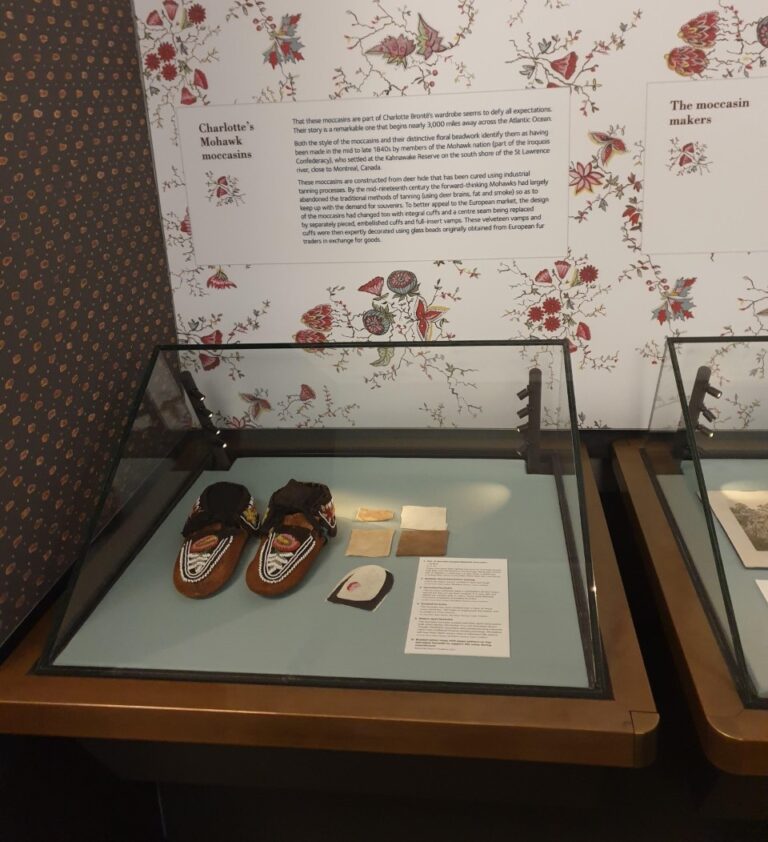
Mohawk Moccasin SlippersShawls
Nick Holland: The one on the right with the shiny silk inserts, is the very shawl that Charlotte Brontë wore on her wedding day in 1854.
Luxurious Dress
Nick Holland: Perhaps the greatest item of all, among many great items, in this year’s exhibition is this dress. Charlotte’s Room, as the museum hails it, always contains a Brontë dress within a carefully sealed glass case. They are always very moving, but this year the dress is particularly spectacular – and it really does defy general expectations around Charlotte Brontë’s apparel.
We often think of Charlotte Brontë as rather dowdy, and she may have been so by necessity throughout much of her life. The Brontës were not wealthy, and had to repair, improvise and recycle much of their clothing. By the end of Charlotte’s life, however, things had changed dramatically for her. The royalties she earned from her writing were far greater than anything she could have hoped to earn from careers as a teacher or governess, and the legacy she left in 1855 was worth more than a million pounds in today’s money.
This dress dates from this period of Charlotte’s life. It was one where she often had to mix in high society, difficult as that must have been for someone as shy as she was, and she dressed accordingly. This striped silk dress was one of three found holed up behind a wall during renovations at the parsonage in 1936. It has been a cause of speculation for some time, but the museum has finally proven that it did belong to Charlotte meaning that it can finally go on display. With floral adornments it’s an item of real beauty, and evidence of the elevation in status and wealth that Charlotte’s literary genius finally brought her. Also displayed her are an ornate fan, and a pair of black stockings worn by Charlotte Brontë.
Hair Brooch and Bracelet
On Facebook (Nick Holland | Facebook) I read: Sad to hear of the death of brilliant, versatile, groundbreaking artist Dame Paula Rego. A book of her 2002 artworks inspired by Jane Eyre is one of the favourite Bronte items I've ever been given.
I feel sad to hear this. I admired Paula Rego's illustrations as well.
Brontë and Paula Rego share an imaginative ardour that abolishes the veil between what takes place in fact and in fantasy. As storytellers, they really are kith and kin: Rego reproduces the psychological drama in the book through distortions of scale, cruel expressiveness of gesture, and disturbingly stark contrasts of light and welling shadows. The long, lugubrious, moralising face of Mr. Brocklehurst in The Inspection looms as large as the little girl’s whole upper body and twice its bulk: Jane standing on the stool, held by Bessie, becomes a tiny, breakable poppet.
In Paula Rego’s work, in her ‘artist’s dreamland’, the peculiar and the elfish twist and turn with a similar rebellious vitality. And they do so for reasons that Jane Eyre’s did, mirroring Charlotte Brontë’s, over a hundred and fifty years ago. Rego has explored, in a myriad different sequences of pictures, the conditions of her own upbringing in Portugal, her formation as a girl and a woman, and the oscillation between stifling social expectations and liberating female stratagems.
At one point Jane Eyre protests,
Women are supposed to be very calm generally: but women feel just as men feel; they need exercise for their faculties, and a field for their own efforts, as much as their brothers do; they suffer from too rigid a restraint, too absolute a stagnation, precisely as men would suffer; and it is narrow-minded in their more privileged fellowcreatures to say that they ought to confine themselves to making puddings and knitting stockings, to playing on the piano and embroidering bags.
Read all: tate/paula-rego
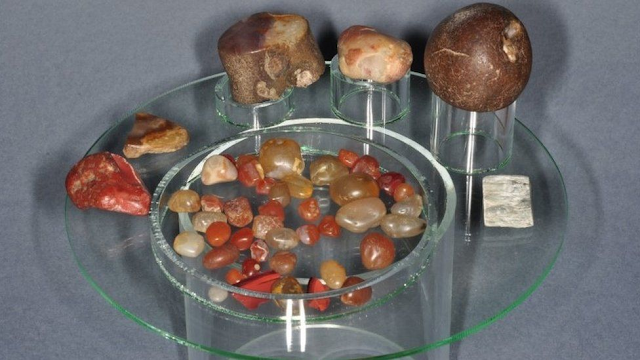
Anne Bronte was not only a talented writer but also a skilled rock collector interested in geology, researchers have revealed.
The youngest Bronte sister built up a collection of specimens before her death aged 29 in 1849.
It was thought she collected them for their aesthetic value, but research shared by Sally Jaspars has shown she was an informed geology fan.
Ms Jaspers is studying Bronte as part of a PhD at the University of Aberdeen.
She said: "Her interest in geology is mentioned in her literary works - indeed in The Tenant Of Wildfell Hall she references the science and a book by Sir Humphry Davy directly."
Experts from the University of Leeds and a specialist spectroscopy company were also involved, and they found she had carnelians and agates which she collected in Scarborough, where she worked as a governess.
She also had flowstone and a rare kind of red obsidian, which originated outside of the UK.
The Belgian capital barely acknowledges its link with the two most famous Brontë sisters, Charlotte and Emily. A plaque commemorates their stay here in 1842-43, at a girls’ boarding school called the Pensionnat Heger, which stood on the site now occupied by Bozar, the Centre for Fine Arts. However, it is placed high up near Bozar’s entrance: most concertgoers pouring through the doors are oblivious of it, as are most tourists.
It is a pity the city is so silent about its Brontë link. Visitors are unlikely to have heard about the connection before they come. Mention the Brontës and how many people picture the sisters strolling on the boulevards in Brussels?
Yet they did – and so do some of their fictional characters. Although it is not hard to see why the connection can be missed. Charlotte wrote two novels set in Brussels and based on her time in the city: her first, The Professor, which was not published until 1857, two years after her death; and her fourth and last, Villette (1853). But neither were bestsellers like Jane Eyre. Many literary pundits rate Villette as her most interesting book, but, sadly, no feature film has ever been made about its heroine Lucy Snowe, a sharply observant expat experiencing loneliness and frustration as a teacher at a pensionnat.
Margaret Gaskell, known as Meta, was born two and a half years after Marianne. In her diary for December 1837, Here the story of her life.
A book on Charlotte Brontë’s Irish honeymoon, “Charlotte Brontë – An Irish Odyssey”, read all: brusselsbronte/charlottes-irish-honeymoon-continued
For his recreation of the honeymoon, Michael O’Dowd also uses writings of literary friends and acquaintances who had visited the same places before Charlotte and Arthur’s honeymoon, including Harriet Martineau and William Makepeace Thackera, as well as well-known guidebooks on Ireland of the time (e.g. by Anna Maria and Samuel Hall).
Moreover, “An Irish Odyssey” is interspersed with extracts from poems and verse by well-known British and Irish poets (such as Thomas Moore, Sir Aubrey de Vere, Percy Bysshe Shelley, Sir Walter Scott and many more), which creates a very poetic atmosphere.
In all of these chapters, the author gives us a lot of information on the scenery that Charlotte and Arthur may have seen on their visits (based on travel and tourist guides of the time). He explores possible ways of travelling (by boat, train, coach, jaunting car, …) that Charlotte and Arthur may have used, as this is not always clear from the letters. He provides scientific facts on fauna and flora. He explores the historical and spiritual heritage of Banagher (where Arthur’s family lived) and its surroundings in great detail, but also historical facts about Ireland in general are shared with the reader.
I once was searching for information about the honeymoon of Charlotte and Arthur. I found a lot of information Brontesisters.blog/honeymoon
Another Saturday treasure from the wonderful Bronte Parsonage Museum. This lace collar was worn by Charlotte Bronte and was made for her by her little sister Anne Bronte:
Monthly sessions are being held at the Black Bull in Haworth, where in the 1830s Branwell Bronte entertained travellers and guests with stories and poems. Keighleynews/poetry-sessions-return-historic-haworth-pub
It was often called “consumption” because of how much weight those inflicted with tuberculosis lost. Another nickname was “the white plague” because of how pale people would become. And yet, its final nickname was “the romantic disease.” People became enamored with the physical effects of contracting the illness. Pale skin, thin waists, and flushed lips and cheeks from long-term fevers were seen as quite desirable. “Consumption, I am aware, is a flattering malady,” Charlotte Brontë wrote in a letter as she watched her sister fall ever sicker with the disease. Read more: everythinggp
Visit ‘Defying Expectations’ throughout the year at the Museum.
thetimes/mystery-of-brontes-mohawk-moccasins
Sitting in the Brontë Parsonage museum archives are a pair of native American beaded leather moccasins. Donated in 1983 by a Brontë enthusiast, the shoes arrived accompanied by a note claiming that they had once belonged to Charlotte Brontë and curators have been puzzled by this ever since. How could they have made their way into the hands of a plain parson’s daughter from Victorian Yorkshire?
| SR.5.7.Sym.1.42 | |
| Title | photographs of dresses worn by Charlotte Bronte |
| Description | printed page 22 showing two b/w images of a model wearing {103} pink frock and cape worn by Charlotte Bronte and {104} silk dress worn on her wedding tour by Charlotte Bronte [135mm l x 97mm w; fair;] [x 3 copies. (From the catalogue from the Bronte Parsonage) . |
This article is surprising me very much:
theguardian/charlotte-bronte-clothing-exhibition-sensual-side-parsonage-museum
A new side of Charlotte Brontë, showing the author of Jane Eyre’s unexpected penchant for colourful, fashionable, even “sensual” clothing, is revealed in a new exhibition at the Brontë Parsonage Museum.
“My personal favourite is her pink wrapper, which is a really, really strange garment,” said Dr Eleanor Houghton, a historian, writer and illustrator who has co-curated the exhibition. “It was a sort of house coat with a matching cape. It’s hideous, pink, with little flowers on it, very bold, very bright and huge – very voluminous. It’s absolutely the opposite of anything you would ever associate with Charlotte Brontë.”
It’s a sensual garment, it’s something that she would have been seen in in the house, and with Nicholls. So while it’s not exactly a negligee, it’s sort of a Victorian equivalent. It’s an intimate garment,” said Houghton.
"The expert quoted in the article seem to have an idea of Charlotte that she was some sort of austere, Quaker maid! Ha! Yes, CB cultivated that idea, but none should believe it. At heart she was a deeply sensual woman.
Charlotte LOVED all the extra bows and ruffles! Look at her wedding dress. She designed one frilly, extravagant, element after another. Charlotte was not plain in her dress once she had funds from her books. Her forays into fashion were not always sure, she still regularly called on her friend, Ellen Nussey, for advice, but they were determined. Particularly when she was visiting London, or on an important occasion, such as her marriage.
The article also portrays this garment as something like a kinky sex outfit, when it's simply a dressing gown and one that covered her up completely! People wore dressing gowns back then between their night gowns and their day clothes. I imagine Charlotte wore this gown at her dressing table to brush her hair. etc.
However, the 1927 catalogue calls this outfit a "frock", that is a dress, with a cape. So perhaps it was indeed a dress she wore during the day,( most likely in London, too dressy for Haworth! ) and so it is not a even dressing gown. Today our night dress and day clothes often look the same, like lounge wear, so it may be harder for us to tell!
I would also point out Charlotte would add large, even extravagant, elements when designing her outfits, like the balloon sleeves on the going away dress and extra padding on the outfit in question, to add bulk to her tiny figure."
In the summer of 1850, there was a frisson of excitement in London society. Charlotte Brontë, the recently revealed writer of the best-selling novel Jane Eyre, was in the capital, staying with her publisher, George Smith. The highlight of Charlotte’s trip was a large, formal dinner hosted by her literary hero, William Makepeace Thackeray. To this august event it has long been assumed that she wore a floral print, white and blue delaine skirt and bodice. Read all: tandfonline/Thackeray Dress
euppublishing/Unravelling the Mystery: Charlotte Brontë’s 1850 ‘Thackeray Dress’
At the heart of ‘Defying Expectations’ is a striped evening dress, which has never been exhibited before. The dress was proved to be Charlotte’s during an extensive period of research conducted over the last six years by Dr Eleanor Houghton, the first scholar ever to have studied the clothing in the Brontë Society's collection in detail.
The exhibition features more than twenty pieces of Charlotte’s clothing and accessories, and offers an intimate insight into both her domestic and literary lives. Bronte Parsonage/whats-on/1169/defying-expectations-inside-charlotte-brontes-wardrobe,