I've dreamt in my life dreams that have stayed with me ever after, and changed my ideas: they've gone through and through me, like wine through water, and altered the color of my mind.
Emily Bronte
Wuthering Heights

zaterdag 18 februari 2012

The Bronte Sisters - A True Likeness?


 Two 'alleged' portraits of Emily Bronte have recently been entered in auctions
News of a third ‘Bronte portrait’ in almost as many months is certain to be viewed with a touch of scepticism. But this find is different. It is not a painting, but a photograph, and it claims to depict not one, but all three Sisters. As no photos exist – apart from one of Charlotte - this would be the first true likeness of the Bronte Sisters. 

If this were proved right it would be a truly remarkable find.Despite distinct similarities to the Sisters, and many tantalising clues, the photo still lacks that final piece of hard evidence. Because of this it remains unauthenticated.


The research is presented here to give members of the Bronte Society and Bronte researchers the opportunity to judge whether this is a genuine photograph. 

They may be able to correct errors or help with information.Hopefully at some stage in the future it will be either authenticated or dismissed as an image of the Bronte Sisters.


Research set off to a bad start. The Bronte Museum had never seen the photo and with no photos of Emily or Anne to compare, they couldn’t authenticate it. Experts thought it unlikely to be a copy of an 1840s photo. It was a real conundrum. 
Gradually, over twelve months, the history behind this photograph has yielded some of its secrets. Most of the initial questions have been answered, but it has created dozens more and further research could carry on for years.This website brontesistersphoto 
has been created to list the findings to date. The history of the Bronte Sisters merges into the history of photography and the results are quite intriguing. 
 

dinsdag 14 februari 2012

On this day in 1840. 'Fair Ellen, Fair Ellen', 'Away fond Love' and 'Soul divine'.


In Feb 1840, about six months after his arrival, Ellen Nussey came to the Parsonage for a three weeks stay. Neither she, nor the Brontë girls had ever received a Valentine card; so it caused quite a stir on the morning of February 14th. when they each received one. 
Of course, the culprit was the scheming Weightman. In his usual mode of conduct, he had made a bold attempt to add a little sparkle to the girls' lives, and in a vain attempt to disguise his handiwork, had walked the ten miles to Bradford to post them. 
He had written verses in each of the Valentines; however, only the titles of three of them are known, but these give a general idea of their content:

 'Fair Ellen, Fair Ellen',
 'Away fond Love' 
 'Soul divine'

The girls were not to be fooled by the Bradford post-mark, and soon realised that the chirpy curate was the guilty party.

maandag 13 februari 2012

The Red House has a charming homely feel to it and is so authentic that visitors can easily imagine Charlotte Brontë mingling with the Taylor family whom she loved. She said it was a happy house, full of laughter.


The Spenborough Guardian publishes a letter from a reader who was outraged at the suggested closure of the Red House Museum:
In their “Vision and Strategic Objectives” outlined in the LDF Core Strategy, planners promised to retain the characteristics of Kirklees which make it attractive. This involved, among other issues, safeguarding the “distinctive and contrasting landscapes and legacy of historic buildings within and around Kirklees’ towns and villages.
So much for promises. The historic landscape from the Three Nuns to Hartshead and Roberttown has been earmarked for the biggest industrial development in West Yorkshire; totally ignoring its beauty and its close proximity to Robin Hood’s grave, the ruins of Kirklees Priory, the historic Armytage Estate, the Luddite heritage footpath, and Roe Head (now Hollybank school) the school to which all three Brontë sisters attended and at which Charlotte Brontë taught. And totally ignoring the seven presentations put forward last November to the extraordinary meeting of Kirklees Council.
And then we had the unbelievable threat to the only museum in the Spen Valley! The Red House Museum is a very precious and iconic building.
Built in 1660 by a typical entrepreneurial Spen clothier, William Taylor, it is now actually furnished in the style of the 1830’s when Joshua and Anne Taylor regularly enjoyed the company of their daughter Mary’s friend Charlotte Brontë. The house has a charming homely feel to it and is so authentic that visitors can easily imagine Charlotte Brontë mingling with the Taylor family whom she loved.
She said it was a happy house, full of laughter. And many visitors have felt this; almost 30,000 last year alone. They come to wander round the house and garden and the outbuildings which can absorb them for an afternoon. The cart-shed houses a unique history of the Spen Valley, painstakingly collected over many years. The barn has a wonderful exhibition dedicated to Charlotte Brontë’s book Shirley, based around the Luddite story.
Visitors come from schools, colleges and universities and from locally and far afield. It is well and truly on the Brontë trail for national and international enthusiasts. They all receive a warm welcome from the dedicated staff. What a tourist destination!
Most of all it is one of the most important buildings which make up the Spen Valley’s heritage. It doesn’t take a lot of imagination to work out that this solution to saving money was a no-brainer.
Charlotte Brontë had another lifelong friend whom she met at Roe Head school – Ellen Nussey who lived near Birstall Smithies crossroads. Her home was the inspiration for Thornfield Hall in Jane Eyre. This is now swamped by a paint manufacturer’s. We cannot go on losing our heritage. And why was North Kirklees being targeted in this way. 
 
Grotere kaart weergeven


zaterdag 11 februari 2012

Photography of Mark Davis


Mark makes his home in Haworth
 amidst the rugged landscape
 that inspired the Brontës
 and which continues
 to inspire him
 to deliver world-class photographs.

Mark-Davis-photography/yorkshire/haworth/
Ferndean manor/mark-davis.html

vrijdag 10 februari 2012

Nature around Haworth


February - an overview

February can be a cold unforgiving month with snow heavy rain and cold north winds, but it is also the month where the first signs that spring is not far away. Catkins sometimes called 'lambs tails' their golden tassels can be seen hanging from the branches of Hazel

Plants are beginning to show signs of life; the snowdrops are flowering, time-lapse of a snowdrop flowering here... Daffodils shoots are now above ground in readiness for flowering in March. Migrant
birds such as Redwing, Fieldfare and Waxwings which have spent the winter in Britain can still be seen. Later in the month Lapwings will return to moorland. Garden birds such as the Blackbird Blue Tit and Robin will still find food in short supply, putting out food for them will be help. This will encourage other birds such as Long Tailed Tits, Bullfinch and Goldcrests to visit. A period of fine weather and you will hear birds such as the Chaffinch singing. Frogs will move to breeding ponds to spawn.
Waxwing

woensdag 8 februari 2012

Red House: cabinet sees sense

Richard Wilcocks writes: 
Good news! At the cabinet meeting at Huddersfield Town Hall yesterday afternoon it was recommended that the Red House Museum should not close. All the friends and campaigners who have been so wonderfully active in the past couple of weeks can now breathe more easily for a while, hoping that Kirklees Council as a whole will do the right thing when it meets on 22 February. Thanks to everybody who has been in touch, especially to you, Gordon North - your local knowledge is impressively wide-ranging and your alacrity is admirable.

The cabinet made it clear that there should be a new business plan for all the museums in the authority which would include ways of making museums pay their way. This means admission charges, increasing visitor numbers and allowing weddings to take place. All of which is much better than a crassly simple closure plan.

English Heritage has been approached to get the ball rolling to make Red House into a Grade One listed building. It is a Grade Two at the moment. Grade One status could be awarded not because of the architecture but because of the history. Let us hope for this, because it means that new grants would be available. bronteparsonage/red-house-cabinet-sees-sense

maandag 6 februari 2012

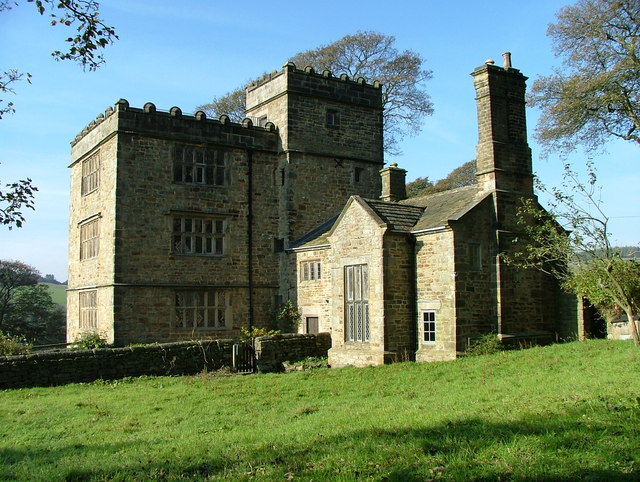
North Lees Hall

North Lees Hall is one of seven houses built by Sir Robert Eyre for his seven sons in and around the village of Hathersage.  It is said to have been the inspiration for Thornfield Hall in Jane Eyre after Charlotte Bronte visited it while staying at the vicarage.  


The road to North Lees Hall is described in Charlotte Bronte’s book :
 “the road ( to Thornfield Hall ) is a soft mantle of greens in spring and a blaze of gold in the Autumn, being gently sheltered by the thicket of foliage of the English summer days. Peace walks with he, who treads this way.


stubbs family history/the-eyres-north-lees-and-jane-eyre-also-little-john-buried-hathersage-church/

cathy-smith.suite101

-------------
Charlotte Bronte visited Hathersage in 1845 to stay with her old school friend Ellen Nussey at Hathersage Rectory, whose brother was the vicar of the village and it was while he was away on his honeymoon that Charlotte arrived to keep her friend company for a few weeks during the summer.  On Irish rovers  you see pictures how a Derbyshire  summer looks.

Distance Haworth/ Hathersage. It was three stories high . . . a gentleman’s manor-house . . . battlements around the top gave it a picturesque look’


Grotere kaart weergeven
peakdistrictinformation/towns/villages


In 1845 Charlotte Brontë stayed at Hathersage vicarage with her friend Ellen Nussey and regularly visited the locally important Eyre family at North Lees Hall.  Charlotte’s letters reveal Hathersage as the village Morton in Jane Eyre (published 1847). The landlord of the George Inn was a Mr Morton at the time Brontë stayed here and she borrowed the Eyre family name for her heroine.  There’s a reference in the novel to ‘Mr Oliver’s needle factory’ in Morton, and there were several needle mills in Hathersage then.

The novel’s crenellated Thornfield is clearly based on North Lees Hall. Robert Eyre is said to have built seven houses for seven sons and you can still see North Lees, an impressive Tudor manor just a short pleasant walk from the village.  It is rumoured there was indeed a ‘mad woman in the attic’ in its early history, just like Bertha Mason in Brontë’s novel. Agnes Ashurst was ‘reputed to have become demented and was confined to a room on the second floor where the walls were padded for her safety’. She later died in a fire.

‘Ladies, keep off, or I shall wax dangerous.’
And dangerous he looked:  his black eyes darted sparks.

the squeee/in-charlotte-brontes-footsteps
diane-heartshaped/hathersage-walk

zondag 5 februari 2012

Charlotte Bronte visiting Hathersage in Derbyshire.


Charlotte Bronte is usually associated with the village of Haworth in Yorkshire as this is where most of her novels are set. But possibly her most famous novel, Jane Eyre, seems to be set in the small village of  Hathersage in Derbyshire. In the summer of 1845 Charlotte visited this village in the heart of the Peak District. She was 29 and had come to stay with her old school friend Ellen Nussey at the Rectory. 
Charlotte arrived by stage coach which stopped at the George Inn. Local historians are keen to point out how she used her visit to great effect in collecting impressions for her famously passionate novel, published a couple of years later. In Chapter 11 we find Jane newly arrived and waiting nervously in The George to meet her new employer; the dashing Mr. R. 
" A new chapter in a novel is something like a new scene in a play; and when I draw up the curtain this time, reader, you must fancy you see a room in the George Inn at Millcote, with such large figured papering on the walls as inn rooms have; such a carpet, such furniture, such ornaments on the mantelpiece, such prints, including a portrait of George the Third, and another of the Prince of Wales, and a representation of the death of Wolfe. All this is visible to you by the light of an oil lamp hanging from the ceiling, and by that of an excellent fire, near which I sit in my cloak and bonnet; my muff and umbrella lie on the table, and I am warming away the numbness and chill contracted by sixteen hours’ exposure to the rawness of an October day… ": 
It was on one of the tombstones in the graveyard of St. Michael’s Church that Charlotte saw the local family name ’Eyre’ which she chose to adopt for her heroine. During her stay she took the opportunity to explore, walking on the moors and visiting many of the houses scattered around the area. One of these houses, the crenellated North Lees, is said to be the model for Thorn Field Hall, home of Mr. Rochester and the place where he and Jane fell in love. The George Inn which still stands on the main street has been welcoming travellers for over 500 years, first as an alehouse, and, since 1770, as an inn. homesteadbb.free-online.co.uk/derbys

www.george-hotel


zaterdag 4 februari 2012

Inspiration and imagination of Charlotte Bronte: determined to make her heroine plain, small, and unattractive


Anyone who has studied her writings,--whether in print or in her letters; any one who has enjoyed the rare privilege of listening to her talk, must have noticed her singular felicity in the choice of words. She herself, in writing her books, was solicitous on this point. One set of words was the truthful mirror of her thoughts; no others, however apparently identical in meaning, would do. She had that strong practical regard for the simple holy truth of expression, which Mr. Trench has enforced, as a duty too often neglected. She would wait patiently searching for the right term, until it presented itself to her. It might be provincial, it might be derived from the Latin; so that it accurately represented her idea, she did not mind whence it came; but this care makes her style present the finish of a piece of mosaic. Each component part, however small, has been dropped into the right place. She never wrote down a sentence until she clearly understood what she wanted to say, had deliberately chosen the words, and arranged them in their right order. Hence it comes that, in the scraps of paper covered with her pencil writing which I have seen, there will occasionally be a sentence scored out, but seldom, if ever, a word or an expression. She wrote on these bits of paper in a minute hand, holding each against a piece of board, such as is used in binding books, for a desk. This plan was necessary for one so short-sighted as she was; and, besides, it enabled her to use pencil and paper, as she sat near the fire in the twilight hours, or if (as was too often the case) she was wakeful for hours in the night. Her finished manuscripts were copied from these pencil scraps, in clear, legible, delicate traced writing, almost as easy to read as print.

The sisters retained the old habit, which was begun in their aunt's life-time, of putting away their work at nine o'clock, and beginning their study, pacing up and down the sitting room. At this time, they talked over the stories they were engaged upon, and described their plots. Once or twice a week, each read to the others what she had written, and heard what they had to say about it. Charlotte told me, that the remarks made had seldom any effect in inducing her to alter her work, so possessed was she with the feeling that she had described reality; but the readings were of great and stirring interest to all, taking them out of the gnawing pressure of daily-recurring cares, and setting them in a free place. It was on one of these occasions, that Charlotte determined to make her heroine plain, small, and unattractive, in defiance of the accepted canon.

She once told her sisters that they were wrong--even morally wrong--in making their heroines beautiful as a matter of course. They replied that it was impossible to make a heroine interesting on any other terms. Her answer was, 'I will prove to you that you are wrong; I will show you a heroine as plain and as small as myself, who shall be as interesting as any of yours.' Hence 'Jane Eyre,' said she in telling the anecdote: 'but she is not myself, any further than that.' As the work went on, the interest deepened to the writer. When she came to 'Thornfield' she could not stop. Being short-sighted to excess, she wrote in little square paper-books, held close to her eyes, and (the first copy) in pencil. On she went, writing incessantly for three weeks; by which time she had carried her heroine away from Thornfield, and was herself in a fever which compelled her to pause.


vrijdag 3 februari 2012

The relation between George Smith and Charlotte Bronte, Part 3


Villette was published on 28 January 1853. The date of the publisher's catalogue varies in different copies, from January 1853 to December 1854, according to Smith. The novel was difficult and slow to complete for the author, partly because of the circumstances of her own life, with the unresolved personal relationships with George Smith and James Taylor in the background colouring and mirroring the tale itself. "Experience was slowly eradicating the ancient fallacies of her romantic girlhood. She was gradually moving towards a complete realization of the truth of her particular destiny, and instantly transmuting it into another truth--the truth of art..." (Winifred Gérin, Charlotte Brontë.
The Evolution of Genius, p.508) sothebys.com/en/

donderdag 2 februari 2012

The relation between George Smith and Charlotte Bronte/ Part 2

The last lecture was one from Margaret Smith, who talked about George Smith and William Smith Williams and their connection with Charlotte Brontë. Smith was a very good friend, gave her advice on financial matters and was even an alleged love interest, although he wasn’t in the least attracted to Charlotte. William Smith Williams sent her books and advised her to write a three-part work (Jane Eyre) rather than another two-part work like The Professor. Charlotte dissolved their correspondence with a rather cold letter. 
brusselsbronte/ bronte-conference-in-york-2009

 
Transforming her loneliness and personal sorrow into a triumph of literary art, Charlotte pens her 1847 masterpiece, Jane Eyre. Charlotte’s novel becomes an overwhelming literary success, catapulting the shy and awkward young woman into the spotlight of London’s fashionable literary scene—and into the arms of her new publisher, George Smith, an irresistibly handsome young man whose interest in his fiercely intelligent and spirited new author seems to go beyond professional duty. But just as life begins to hold new promise, unspeakable tragedy descends on the Brontë household, throwing London and George into the background and leaving Charlotte to fear that the only romance she will ever find is at the tip of her pen Scandalous Woman

Disappearing history

Mary Taylor
BBC News covers the Red House story (don't forget to sign the petition if you haven't yet):
Joan Bellamy, author of a biography of Mary Taylor, said the sale of Red House would be a big loss to the history of the local area.
"It's a disaster. If it was sold then the history of the house would be in danger of disappearing," she said.
"The history of the area - the textiles, the Luddites and Charlotte Brontë's novel - all those elements represented by the house would disappear."
Kirklees Council said in its proposals for 2012 budget consideration that the possible closure of Red House at the end of September 2012 would mean a saving of £116,000 a year.
A council spokesman said: "Councillors have difficult decisions to make as there is a continuing need to achieve efficiencies from across the whole range of services in the three-year budget plan.
"The proposal to close Red House Museum is one of a large number of measures up for consideration which have been proposed to fill a very big gap in the council's budget and reduce expenditure."
The spokesman added that "no decision" had been made on the sale of Red House, and local residents were being invited to make their views known. documents/RedHouse-MaryTaylor
And the Yorkshire Evening Post has received a letter from a reader on the subject:
The Red House Museum is an integral part of the literary history of Yorkshire and of England.
Its value to the community and to the country is evidenced by the fact that it had 30,000 visitors from all over the world and is a place of learning and research.
In an age when much of Britain’s literary heritage is being lost, taking away such a valuable resource would be tantamount to permanantly removing a vital component of the literary history and traditions of a great people.
It also seems strange that when we are celebrating the 200th anniversay of Charles Dickens we should be considering closing a site of value to those other great literary giants – the Brontë sisters. It seems to me that Kirklees Council together with the Yorkshire Tourist Authority can make much more of the Museum and help, not only to increase its visitor numbers but to also use it as the Brontë sisters and the people of their times.
Judith Tampoe, by email  bronteblog/disappearing-history

woensdag 1 februari 2012

Brontë Parsonage Blog: Parsonage re-opens today

Brontë Parsonage Blog: Parsonage re-opens today: The Brontë Parsonage re-opens today following a hectic month of activity including maintenance work, cleaning, conservation and developme...

The Parlour

The Parlour

Parsonage

Parsonage

Charlotte Bronte

Presently the door opened, and in came a superannuated mastiff, followed by an old gentleman very like Miss Bronte, who shook hands with us, and then went to call his daughter. A long interval, during which we coaxed the old dog, and looked at a picture of Miss Bronte, by Richmond, the solitary ornament of the room, looking strangely out of place on the bare walls, and at the books on the little shelves, most of them evidently the gift of the authors since Miss Bronte's celebrity. Presently she came in, and welcomed us very kindly, and took me upstairs to take off my bonnet, and herself brought me water and towels. The uncarpeted stone stairs and floors, the old drawers propped on wood, were all scrupulously clean and neat. When we went into the parlour again, we began talking very comfortably, when the door opened and Mr. Bronte looked in; seeing his daughter there, I suppose he thought it was all right, and he retreated to his study on the opposite side of the passage; presently emerging again to bring W---- a country newspaper. This was his last appearance till we went. Miss Bronte spoke with the greatest warmth of Miss Martineau, and of the good she had gained from her. Well! we talked about various things; the character of the people, - about her solitude, etc., till she left the room to help about dinner, I suppose, for she did not return for an age. The old dog had vanished; a fat curly-haired dog honoured us with his company for some time, but finally manifested a wish to get out, so we were left alone. At last she returned, followed by the maid and dinner, which made us all more comfortable; and we had some very pleasant conversation, in the midst of which time passed quicker than we supposed, for at last W---- found that it was half-past three, and we had fourteen or fifteen miles before us. So we hurried off, having obtained from her a promise to pay us a visit in the spring... ------------------- "She cannot see well, and does little beside knitting. The way she weakened her eyesight was this: When she was sixteen or seventeen, she wanted much to draw; and she copied nimini-pimini copper-plate engravings out of annuals, ('stippling,' don't the artists call it?) every little point put in, till at the end of six months she had produced an exquisitely faithful copy of the engraving. She wanted to learn to express her ideas by drawing. After she had tried to draw stories, and not succeeded, she took the better mode of writing; but in so small a hand, that it is almost impossible to decipher what she wrote at this time.

I asked her whether she had ever taken opium, as the description given of its effects in Villette was so exactly like what I had experienced, - vivid and exaggerated presence of objects, of which the outlines were indistinct, or lost in golden mist, etc. She replied, that she had never, to her knowledge, taken a grain of it in any shape, but that she had followed the process she always adopted when she had to describe anything which had not fallen within her own experience; she had thought intently on it for many and many a night before falling to sleep, - wondering what it was like, or how it would be, - till at length, sometimes after the progress of her story had been arrested at this one point for weeks, she wakened up in the morning with all clear before her, as if she had in reality gone through the experience, and then could describe it, word for word, as it had happened. I cannot account for this psychologically; I only am sure that it was so, because she said it. ----------------------She thought much of her duty, and had loftier and clearer notions of it than most people, and held fast to them with more success. It was done, it seems to me, with much more difficulty than people have of stronger nerves, and better fortunes. All her life was but labour and pain; and she never threw down the burden for the sake of present pleasure. I don't know what use you can make of all I have said. I have written it with the strong desire to obtain appreciation for her. Yet, what does it matter? She herself appealed to the world's judgement for her use of some of the faculties she had, - not the best, - but still the only ones she could turn to strangers' benefit. They heartily, greedily enjoyed the fruits of her labours, and then found out she was much to be blamed for possessing such faculties. Why ask for a judgement on her from such a world?" elizabeth gaskell/charlotte bronte


Poem: No coward soul is mine

No coward soul is mine,
No trembler in the worlds storm-troubled sphere:
I see Heavens glories shine,
And faith shines equal, arming me from fear.


O God within my breast.
Almighty, ever-present Deity!
Life -- that in me has rest,
As I -- Undying Life -- have power in Thee!


Vain are the thousand creeds
That move mens hearts: unutterably vain;
Worthless as withered weeds,
Or idlest froth amid the boundless main,


To waken doubt in one
Holding so fast by Thine infinity;
So surely anchored on
The steadfast Rock of immortality.


With wide-embracing love
Thy Spirit animates eternal years,
Pervades and broods above,
Changes, sustains, dissolves, creates, and rears.


Though earth and man were gone,
And suns and universes ceased to be,
And Thou wert left alone,
Every existence would exist in Thee.


There is not room for Death,
Nor atom that his might could render void:
Thou -- Thou art Being and Breath,
And what Thou art may never be destroyed.


--
Emily Bronte

Family tree

The Bronte Family

Grandparents - paternal
Hugh Brunty was born 1755 and died circa 1808. He married Eleanor McClory, known as Alice in 1776.

Grandparents - maternal
Thomas Branwell (born 1746 died 5th April 1808) was married in 1768 to Anne Carne (baptised 27th April 1744 and died 19th December 1809).

Parents
Father was Patrick Bronte, the eldest of 10 children born to Hugh Brunty and Eleanor (Alice) McClory. He was born 17th March 1777 and died on 7th June 1861. Mother was Maria Branwell, who was born on 15th April 1783 and died on 15th September 1821.

Maria had a sister, Elizabeth who was known as Aunt Branwell. She was born in 1776 and died on 29th October 1842.

Patrick Bronte married Maria Branwell on 29th December 1812.

The Bronte Children
Patrick and Maria Bronte had six children.
The first child was Maria, who was born in 1814 and died on 6th June 1825.
The second daughter, Elizabeth was born on 8th February 1815 and died shortly after Maria on 15th June 1825. Charlotte was the third daughter, born on 21st April 1816.

Charlotte married Arthur Bell Nicholls (born 1818) on 29th June 1854. Charlotte died on 31st March 1855. Arthur lived until 2nd December 1906.

The first and only son born to Patrick and Maria was Patrick Branwell, who was born on 26th June 1817 and died on 24th September 1848.

Emily Jane, the fourth daughter was born on 30th July 1818 and died on 19th December 1848.

The sixth and last child was Anne, born on 17th January 1820 who died on 28th May 1849.

Top Withens in the snow.

Top Withens in the snow.

Blogarchief

LinkWithin

Related Posts with Thumbnails