I've dreamt in my life dreams that have stayed with me ever after, and changed my ideas: they've gone through and through me, like wine through water, and altered the color of my mind.
Emily Bronte
Wuthering Heights

zaterdag 2 maart 2013

On this day in 1841 Charlotte Bronte became a governess for the White family who lived at Upperwood House, Rawdon, near Bradford.

William Leavens (born 1747), whose name is preserved in the housing development on the former goods yard at Apperley Bridge, was a wealthy woolstapler, and had acquired it before Hird’s death in 1818. He left it to his nephew, John White (1790-1861), the employer of Charlotte Brontë. She was not particularly happy there but what Victorian parson’s daughter was happy as a governess, in limbo between upstairs and downstairs? Her letters to her friend Ellen Nussey include the remarks “the house is small but exceedingly comfortable and well regulated”. The children, Sarah Louisa (born 1832, later Mrs Atkinson) and Jasper Leavens (1837-67, died unmarried) were not particularly well behaved. She suggests that Mr and Mrs White were “of low extraction” and that Mrs White’s father was an Exciseman.4 She does not use the words nouveau riche, but the implication is there. The house was demolished in 1878 a-history-of-rawdon

 
The governess by Richard Redgrave

TO MISS ELLEN NUSSEY
‘Upperwood House, April 1st, 1841.
‘My dear Nell,—It is twelve o’clock at night, but I must just write to you a word before I go to bed. If you think I am going to refuse your invitation, or if you sent it me with that idea, you’re mistaken. As soon as I read your shabby little note, I gathered up my spirits directly, walked on the impulse of the moment into Mrs. White’s presence, popped the question, and for two minutes received no answer. Will she refuse me when I work so hard for her? thought I. “Ye-e-es” was said in a reluctant, cold tone. “Thank you, m’am,” said I, with extreme cordiality, and was marching from the room when she recalled me with: “You’d better go on Saturday afternoon then, when the children have holiday, and if you return in time for them to have all their lessons on Monday morning, I don’t see that much will be lost.” You are a genuine Turk, thought I, but again I assented. Saturday after next, then, is the day appointed—not next Saturday, mind. I do not quite know whether the offer about the gig is not entirely out of your own head or if George has given his consent to it—whether that consent has not been wrung from him by the most persevering and irresistible teasing on the part of a certain young person of my acquaintance. I make no manner of doubt that if he does send the conveyance (as Miss Wooler used to denominate all wheeled vehicles) it will be to his own extreme detriment and inconvenience, but for once in my life I’ll not mind this, or bother my head about it. I’ll come—God knows with a thankful and joyful heart—glad of a day’s reprieve from labour. If you don’t send the gig I’ll walk. Now mind, I am not coming to Brookroyd with the idea of dissuading Mary Taylor from going to New Zealand. I’ve said everything I mean to say on that subject, and she has a perfect right to decide for herself. I am coming to taste the pleasure of liberty, a bit of pleasant congenial talk, and a p. 86sight of two or three faces I like. God bless you. I want to see you again. Huzza for Saturday afternoon after next! Good-night, my lass.
‘C. Brontë.
‘Have you lit your pipe with Mr. Weightman’s valentine?’
---------------------------------------------------
Upperwood House, May 4th, 1841.
‘Dear Nell,—I have been a long time without writing to you; but I think, knowing as you do how I am situated in the matter of time, you will not be angry with me. Your brother George will have told you that he did not go into the house when we arrived at Rawdon, for which omission of his Mrs. White was very near blowing me up. She went quite red in the face with vexation when she heard that the gentleman had just driven within the gates and then back again, for she is very touchy in the matter of opinion. Mr. White also seemed to regret the circumstance from more hospitable and kindly motives. I assure you, if you were to come and see me you would have quite a fuss made over you. During the last three weeks that hideous operation called “a thorough clean” has been going on in the house. It is now nearly completed, for which I thank my stars, as during its progress I have fulfilled the twofold character of nurse and governess, while the nurse has been transmuted into cook and housemaid. That nurse, by-the-bye, is the prettiest lass you ever saw, and when dressed has much more the air of a lady than her mistress. Well can I believe that Mrs. White has been an exciseman’s daughter, and I am convinced also that Mr. White’s extraction is very low. Yet Mrs. White talks in an amusing strain of pomposity about his and her family and connections, and affects to look down with wondrous hauteur on the whole race of tradesfolk, as she terms men of business. I was beginning to think Mrs. White a good sort of body in spite of all her bouncing and boasting, her bad grammar and worse orthography, but I have had experience of one little trait in her character which condemns her a long way with me. After treating a person in the most familiar terms of equality for a long time, if any little thing goes wrong she does p. 87not scruple to give way to anger in a very coarse, unladylike manner. I think passion is the true test of vulgarity or refinement.
‘This place looks exquisitely beautiful just now. The grounds are certainly lovely, and all is as green as an emerald. I wish you would just come and look at it. Mrs. White would be as proud as Punch to show it you. Mr. White has been writing an urgent invitation to papa, entreating him to come and spend a week here. I don’t at all wish papa to come, it would be like incurring an obligation. Somehow, I have managed to get a good deal more control over the children lately—this makes my life a good deal easier; also, by dint of nursing the fat baby, it has got to know me and be fond of me. I suspect myself of growing rather fond of it. Exertion of any kind is always beneficial. Come and see me if you can in any way get, I want to see you. It seems Martha Taylor is fairly gone. Good-bye, my lassie.—Yours insufferably,
‘C. Brontë.’
---------------------------------------------------
‘Upperwood House, Rawdon,
‘May 9th, 1841.
‘Dear Sir,—I am about to employ part of a Sunday evening in answering your last letter. You will perhaps think this hardly right, and yet I do not feel that I am doing wrong. Sunday evening is almost my only time of leisure. No one would blame me if I were to spend this spare hour in a pleasant chat with a friend—is it worse to spend it in a friendly letter?
‘I have just seen my little noisy charges deposited snugly in their cribs, and I am sitting alone in the school-room with the quiet of a Sunday evening pervading the grounds and gardens outside my window. I owe you a letter—can I choose a better time than the present for paying my debt? Now, Mr. Nussey, you need not expect any gossip or news, I have none to tell you—even if I had I am not at present in the mood to communicate them. You will excuse an unconnected letter. If I had thought you critical or captious I would have declined the task of corresponding with you. When I reflect, indeed, it p. 88seems strange that I should sit down to write without a feeling of formality and restraint to an individual with whom I am personally so little acquainted as I am with yourself; but the fact is, I cannot be formal in a letter—if I write at all I must write as I think. It seems Ellen has told you that I am become a governess again. As you say, it is indeed a hard thing for flesh and blood to leave home, especially a good home—not a wealthy or splendid one. My home is humble and unattractive to strangers, but to me it contains what I shall find nowhere else in the world—the profound, the intense affection which brothers and sisters feel for each other when their minds are cast in the same mould, their ideas drawn from the same source—when they have clung to each other from childhood, and when disputes have never sprung up to divide them.
‘We are all separated now, and winning our bread amongst strangers as we can—my sister Anne is near York, my brother in a situation near Halifax, I am here. Emily is the only one left at home, where her usefulness and willingness make her indispensable. Under these circumstances should we repine? I think not—our mutual affection ought to comfort us under all difficulties. If the God on whom we must all depend will but vouchsafe us health and the power to continue in the strict line of duty, so as never under any temptation to swerve from it an inch, we shall have ample reason to be grateful and contented.
‘I do not pretend to say that I am always contented. A governess must often submit to have the heartache. My employers, Mr. and Mrs. White, are kind worthy people in their way, but the children are indulged. I have great difficulties to contend with sometimes. Perseverance will perhaps conquer them. And it has gratified me much to find that the parents are well satisfied with their children’s improvement in learning since I came. But I am dwelling too much upon my own concerns and feelings. It is true they are interesting to me, but it is wholly impossible they should be so to you, and, therefore, I hope you will skip the last page, for I repent having written it.
p. 89‘A fortnight since I had a letter from Ellen urging me to go to Brookroyd for a single day. I felt such a longing to have a respite from labour, and to get once more amongst “old familiar faces,” that I conquered diffidence and asked Mrs. White to let me go. She complied, and I went accordingly, and had a most delightful holiday. I saw your mother, your sisters Mercy, Ellen, and poor Sarah, and your brothers Richard and George—all were well. Ellen talked of endeavouring to get a situation somewhere. I did not encourage the idea much. I advised her rather to go to Earnley for a while. I think she wants a change, and I dare say you would be glad to have her as a companion for a few months.—I remain, yours respectfully,
‘C. Brontë.’
The above letter was written to Miss Nussey’s brother, whose attachment to Charlotte Brontë has already more than once been mentioned in the current biographies. The following letter to Miss Nussey is peculiarly interesting because of the reference to Ireland. It would have been strange if Charlotte Brontë had returned as a governess to her father’s native land. Speculation thereon is sufficiently foolish, and yet one is tempted to ask if Ireland might not have gained some of that local literary colour—one of its greatest needs—which always makes Scotland dear to the readers of Waverley, and Yorkshire classic ground to the admirers of Shirley.
Read more letters of this period on: Gutenberg

vrijdag 1 maart 2013

Pets of the Brontes


Keeper, a large mastiff, was an impressive dog, a match for Emily. A villager remembered Keeper as a “conglomerate, combining every species of English caninity from the turnspit to the sheepdog, with a strain of Haworth originality superadded” ( Smith, 1995, p. 332). Charlotte said that when Keeper stood silently, he was “like a devouring flame," and she noted in one letter, “Keeper is well, big—and grim as ever” (Smith, p. 259).
 
 
Keeper was capable of love and loyalty to a select few but vicious toward others. When Keeper fought another large dog, the local men stood around to watch the spectacle. Emily dove into the fight. She grabbed Keeper by the neck and dashed pepper into the faces of the furious beasts.
 
Under: Grasper From Life, pencil sketch by Emily Bronte, 1834

 The early pets are mainly known to us through pictures, and through Emily and Anne’s diary papers. They include Grasper (described in AOTB as an Irish terrier); Rainbow, Diamond, Snowflake (species unknown), and a pheasant called Jasper – possibly these were all wild birds who were fed regularly. Later the family acquired Keeper, the most famous and characterful of the Brontë pets (his fictional equivalent, Tartar in Shirley, is described in ch. 11 as “of a breed between mastiff and bull-dog”); Nero (often called Hero), a hawk, lost while Emily and Charlotte were in Brussels; Black Tom and Tiger (d. 1844), both cats; two geese, Victoria and Adelaide; and a cage bird, Little Dick, mentioned in Anne’s diary paper for 1845. Last of the major pets was Flossy, brought by Anne from Thorp Green in 1843 and painted by both her and Emily. Flossy sired a puppy, given to Ellen Nussey. In his last years Patrick acquired dogs called Cato and Plato. Charlotte’s comparative indifference to animals is evidenced by the lack of references to them in her early letters. In her last lonely years she was touched by the dogs’ display of affection, especially on her returns home.
 
In June 1843 Anne's charges at Thorp Green - the Robinson girls - gave her this spaniel dog as a gift. Anne named it 'Flossy', and brought it home to the Parsonage where it spent the rest of its life. The following summer Flossy had a pup, and this was given to Ellen Nussey as a gift: Ellen decided to name it 'Flossy' after its parent. This water-colour painting was produced in 1843 - soon after Flossy's arrival in the Brontë household: for many years it was attributed to Charlotte, but recent study into many aspects of the painting leave little doubt that it was actually by Emily. The dog outlived Anne by many years, dying in 1854 - 'without a pang . . . no dog ever had a happier life or an easier death'
reported Charlotte many years later. mick-armitage

 Under : Flossy, the dog of Anne.
 
" During Miss Bran well's reign at the parsonage, the love of animals had to be kept in due subjection. There was then but one dog, which was admitted to the parlour at stated times. Emily and Anne always gave him a portion of their breakfast, which was, by their own choice, the old north country diet of oatmeal porridge. Later on, there were three household pets the tawny, strong-limbed ' Keeper/ Emily's favourite: he was so completely under her control, she could quite easily

make him spring and roar like a lion. She taught him this kind of occasional play without any coercion. * Flossy long, silky-haired, black and white ' Flossy ' was Anne's favourite ; and black ' Tom/ the tabby, was everybody's favourite. It received such gentle treatment it seemed to
have lost cat's nature, and subsided into luxurious amiability and contentment. The Brontes' love of dumb creatures made them very sensitive of the treatment bestowed upon them. For anyone to offend in this respect was with them an infallible bad sign, and a blot on the disposition." infootstepsofthe Brontes
 
Ellen Nussey, Charlotte's friend and one of the few visitors to the Brontë home, recalled,

Keeper used to steal upstairs and sleep on the beds, which were covered in white counterpanes. This upset Emily, who was in charge of all of the housekeeping chores. One evening the servant Tabby came and told Emily that Keeper was sleeping on the bed again. Emily immediately went up after the dog while Tabby and Charlotte watched:
Down-stairs came Emily, dragging after the unwilling Keeper, his hind legs set in a heavy attitude of resistance, held by the "scruff of his neck" but growling low and savagely all the time…She let him go, planted in a dark corner at the bottom of the stairs...her bare clenched fist struck against his red fierce eyes, before he had time to make his spring...she “punished him” till his eyes were swelled up, and the half-blind, stupefied beast was led to his accustomed lair to have his swelled head fomented and cared for by the very Emily herself. The generous dog owed her no grudge; he loved her dearly ever after. (Gaskell, 1975, pp. 268-269) societyandanimalsforum
 

Under: A drawing from Emily

Ellen remembered evenings in the parsonage with Emily, “habitually kneeling on the hearth, reading a book, with her arm round Keeper” (Gerin, 1971, p.156). Ellen recalled that Emily and Keeper developed small, daily rituals that are an important part of the human-dog bond, “The two dogs, Keeper and Flossey were always in quiet waiting by the side of Emily and Anne during their breakfast of Scotch oatmeal and milk, and always had a share handed down to them at the close of the meal” (Shorter, 1896, p. 178).

Ellen found that the best approach to Emily, who was indifferent to friendly overtures, was through Keeper. Once Keeper tried to climb up on Emily's lap but could not quite fit, so he stretched out across Ellen's knees. She did not complain about his heaviness because she knew that “Emily's heart was won by [my] unresisting endurance” (Gerin, 1971, p.110).
societyandanimalsforum
 
“The evening before her death she insisted on feeding the dogs...as she had always done. As she stepped from the warmth of the kitchen into the cold air of the damp, stone-flagged passage, she staggered and almost fell against the wall” (p. 576).
 
Emily mentions Nero 'in his cage' in her diary paper of 30 July 1841. Christine Alexander suggests that the bird was probably acquired early in 1841. emily-brontes-hawk
 
Diary papers:

Emily and Anne Brontë's Diary Paper, November 24, 1834: I fed Rainbow, Diamond Snowflake Jasper pheasant (alias) this morning wuthering/diary_papers

Keeper and Flossey had become part of the family, somehow winning over Aunt Branwell who allowed previous dogs only into the parlor of the house and then only at stated times (Frank, 1990). The dogs' taken-for-granted presence in everyday life can be seen in the “diary papers” that Emily and Anne wrote for each other on their birthdays. On July 31,1845, Anne wrote, “Keeper and Flossey are I do not know where” and then added that Charlotte “has let Flossey in by the by and [s] he is now lying on the sofa” (Smith, 1995, p.410). In a diary paper dated 1841, Emily wrote, “ Victoria and Adelaide [the geese] are ensconced in the peat-house—Keeper is in the kitchen—We are all stout and healthy” (Barker, 1998, p. 95). societyandanimalsforum

Thursday, July 30, 1845. We have got Flossey, got and lost Tiger–lost the Hawk. Hero which with the geese was given away and is doubtless dead for when I came back from Brussels I enquired on all hands and could hear nothing of him–Tiger died early last year–Keeper and Flossey are well also the canary acquired 4 years since. diary_papers

Anne Brontë's Birthday Paper, July 30, 1841. We have got Keeper, got a sweet little cat and lost it, and also got a hawk. Got a wild goose which has flown away, and three tame ones, one of which has been killed. diary_papers

Anne Brontë's Diary Paper, Thursday July 31, 1845. Tabby and Martha are I think in the Kitchen Keeper and Flossy are I do not know where little Dick is hopping in his cage. diary_papers

One long ramble made in these early days was far away over the moors, to a spot familiar
to Emily and Anne, which they called 4 The Meeting of the Waters.' It was a small oasis of emerald green turf, broken here and there by small clear springs ; a few large stones served as resting-places ; seated here, we were hidden from all the world, nothing appearing in view but miles and miles of
heather, a glorious blue sky, and brightening sun. A fresh breeze wafted on us its exhilaiating influence ; we laughed and made mirth of each other, and settled we would call ourselves
the quartette. Emily, half reclining on a slab of stone, played like a young child with the tadpoles in the water, making them swim about, and then fell to moralising on the strong and the weak, the brave and the cowardly, as she chased them with her hand. infootsteps                     


donderdag 28 februari 2013

Birthplace of the Bronte Sisters

 
74, Market Street, Thornton
 
It was to St James' Church, Thornton that Patrick Bronte came as a curate in 1815 bringing with him a wife Maria and 1 daughter Maria. Here in Thornton were born the literary sisters Charlotte Bronte (1816–1855), Emily Bronte(1818–1848) and Anne Bronte (1820–1849), and their brother Patrick Branwell Bronte(1817–1848). These four children were born at the Bronte family home of 74, Market Street, Thornton and all were baptised in the Bell Chapel, Thornton
 
 
Charlotte, Emily and Anne Bronte's house in the village of Thornton near Bradford was sold for about 100,000 pounds last week to a private developer, who reportedly plans to turn the residence into a bistro.
There has been a long-running campaign to turn the four-bedroom property in west Yorkshire into a museum to celebrate the early years of Bronte sisters.
The house's literary legacy earned it a Grade II listing. The Bronte family lived in the residence for just five years before Rev Patrick Bronte moved them eight miles to the Parsonage in Haworth, where many of their great literary works were written.
The Bronte Birthplace Trust group have vowed to continue their campaign and will bide their time until the house comes on the market again, the Telegraph reported.
Earlier efforts to make the house into a heritage centre have failed; in 1996 the Heritage Lottery Fund rejected an application for a 500,000-pound grant.
Novelist Barbara Whitehead, bought and renovated the property in 1820s style, but visitor were low and her failing health forced her to sell it in 2007.
Today the house is unoccupied and is believed to have suffered from flooding.
 indianexpress/bronte-sisters-home-to-become-restaurant

Whitehead sold the house in 2007 when it was converted into flats.deccanherald/bronte-sisters-house-sold.html
.telegraph/Bronte-home-to-become-bistro-campaigners-fear

Look for more information and beautiful pictures on bancroftsfromyorkshire/old-bell-chapel-thornton
.Streetview Google whatwasthere


woensdag 27 februari 2013

On this day in 1837 Hall Green Baptist Chapel held a meeting calling for the abolition of church rates. Patrick & Branwell Bronte attended and disapproved of the resolution.

 
The Hall Green Baptists were active in the movement to abolish Church rates. Patrick attended a meeting there on the subject in February 1837, at which he and his companion “prudently contented themselves with holding up their hands against the resolution” ( Bradford Observer, 2 Mar 1837)
blackwellreference

dinsdag 26 februari 2013

A tiny poem is about to come to the market


A tiny poem, in Charlotte's distinctive minuscule handwriting, is about to come to the market on April 10 at Bonham's, London. Estimated to sell at between £40,000 - £45,000, it is a very early example of one of Charlotte's poems, dated 14 December 1829, and has, attached, the autograph note: 'from the Young Mans Intelligencer' (ie an edition of the the newspaper created by the Brontes for their toy soldiers). facebookpages/Bronte-Parsonage-Museum

Bear in mind when you read this, that Charlotte was just 13!
 
 I've been wandering in the greenwoods
And mid flowery smiling plains
I've been listening to the dark floods
To the thrushes thrilling strains

I have gathered the pale primrose
And the purple violet sweet
I've been where the Asphodel grows
And where lives the red deer fleet.

I've been to the distant mountain,
To the silver singing rill
By the crystal murmering mountain,
And the shady verdant hill.

I've been where the poplar is springing
From the fair inamelled ground
Where the nightingale is singing
With a solemn plaintive sound.
 

vrijdag 22 februari 2013

On this day in 1837/ Meeting held in the Sunday School rooms and chaired by Patrick Bronte to repeal the Poor Law Amendment Act of 1834.

The Poor Law Amendment Act 1834, sometimes abbreviated to PLAA,[1] was an Act of the Parliament of the United Kingdom passed by the Whig government of Lord Melbourne that reformed the country's poverty relief system (with the exception of Scotland, which reformed their poor law in 1845). It was an Amendment Act that completely replaced earlier legislation based on the Poor Law of 1601. With reference to this earlier Act the 1834 Act is also known as the New Poor Law.[2]
Read more on: wikipedia

Patrick Brontë (1777–1861)

Born into poverty in Ireland, he won a scholarship to St John’s College, Cambridge, and was ordained into the Church of England. He was perpetual curate of Haworth in Yorkshire for forty-one years, bringing up four children, founding a school and campaigning for a proper water supply.
Although often portrayed as a somewhat fobidding figure, he was an opponent of capital punishment and the Poor Law Amendment Act, a supporter of limited Catholic emancipation and a writer of poetry.
.kleurrijkbrontesisters/1834-poor-law-amendment-act

In February 1837 Patrick chaired a meeting in Haworth so large it eventually had to take place in the open, calling for the Act to be repealed. Two months later he wrote a powerful letter to the Leeds Intelligencer pleading that the Act could not be tinkered with but must be repealed:

“It is a monster of iniquity, a horrid and cruel deformity”

 he wrote, and followed Dickens in his indignation at the starvation diet prescribed for paupers:

 “ We will not live on their water gruel, and on their two ounces of cheese, and their fourteen ounces of bread per day”

 He imagined them saying. blackwellreference
 

donderdag 21 februari 2013

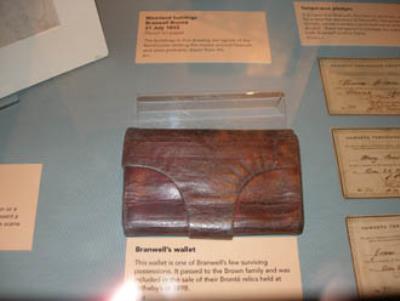
Branwell Bronte's wallet

Branwell Brontë's wallet

Short-sighted Decision Makers

 
Bronte birthplace, Thornton Village
In Market Street is the birthplace of the Bronte sisters (and their wayward brother). The datestone above the door reads 'A J S 1802'.
 
 (FROM): Bronte blog has received the following article from last night's Telegraph and Argus from the Brontë Birthplace Trust chairman, Steve Stanworth. It's appalling.
A Bradford councillor broke down in tears as she tried to respond to the news that Bradford Council has declined to save the Thornton birthplace of the Brontës.
Thornton& Allerton Conservative Councillor Valerie Binney wrote the original letter appealing to the Council for financial support to help Brontë Birthplace Trust buy the property and preserve it as part of Bradford's cultural heritage.
"I felt extreme disappointment.I could have cried. We worked so hard," she said and then did, briefly, break down in tears.
The Council said if it had made an offer for the doublefronted house in Market Street it might have jeopardised the Trust's bid for £239,000 of lottery cash.
Steve Stanworth, chairman of the Brontë Birthplace Trust said: "I received a phone call from Sheilagh O'Neill from the Council's regeneration department. The official line is they cannot justify lending or giving us the money for the Brontë Birthplace. This is due to a political decision.
"They say the property wouldn't be of interest to them and they don't believe it could be a going concern. I am extremely disappointed and frustrated, when we see the amount of wasted money on speed bumps, cycle races and events that are fleeting.
"This sums up the Council's attitude and goes against the Big Society the Government is trying to foster. We are now left in a bad position once again."
Coun Binney said: "The tourism department doesn't think a Brontë museum in Thornton is viable because everybody goes to Haworth. People we meet seem to think the Brontë sisters were born in Haworth.
"If I had the money I would buy the house myself. Somebody wants to buy it to turn it into a bistro. It used to be a restaurant and that didn't work."
The decision was taken by three executive committee members of the council: Council leader David Green, Councillor Susan Hinchcliffe and Councillor Andrew Thornton.
Coun Thornton, who holds the portfolio for environment, sport and sustainability, said: "We explored a number of ways in which we might offer assistance for the Brontë Birthplace Trust to make an offer for the property.
"However, as the Council has no interest in acquiring the building for itself we were not satisfied that this was a justifiable use of public money or a reasonable intervention for us to make in competition with any private individual seeking to purchase the property.
"Government cuts to the Council's budget together with a national and local contraction in public grant aid continues to put severe pressure on our existing cultural estate. Adding to those pressures with an open ended commitment to an unquantified scheme cannot be justified.
"We will continue to offer support to the Brontë Birthplace Trust as it pursues its Heritage Lottery Fund bid for its project."
The Trust, which meets tomorrow at the Blue Boar pub in Thornton, near St James's Church, at 7pm, will have to think again.
Mr Stanworth said: "Perhaps our best bet is to try to fast-track our Heritage Lottery Fund bid. This usually takes six months. "If we do get someone to buy the property, we have to be careful how this affects the funding status. I was hoping to bring good news to the meeting, but this puts a different light on it. We are back at square one." (Jim Greenhalf)
Steve asks readers to 'please feel free to vent your displeasure via the link to the letters page of the Telegraph and Argus'. And rightly so. We expect letters to the council, etc., would also be welcome. A pat on the back to these short-sighted decision-makers. Hopefully the members of the Trust will come up with something that allows them to save the birthplace.
 
WHAT HAPPENED IN THE TIME OF THE BRONTES IN THIS HOUSE?: 
Although, according to Miss Firth's diary, Mrs. Bronte 
appears to have had some social enjoyment and exchanged 
visits with her neighbours, in company with her husband and 
her sister, Miss Elizabeth Branwell, she must have had a very 
busy life with her young family. Her second child was only 
a few months old when she went to Thornton, and before she 
left, five years afterwards, the family had increased to six. 
There was not a room in the house that could well be spared 
for a nursery. Miss Branwell, who was with Mrs. Bronte 
when Charlotte was born, and for some months afterwards, 
needed accommodation, and, with the general servant and 
nursemaid, there was a household of eleven in this little 
parsonage. Mrs. Bronte must have been a very capable 
manager for her husband to be able to say that his happiest
days were spent at Thornton. 
 
It was during his stay here that he published a small volume
The Cottage in the Wood, 
or the Art of becoming rich and happy and he has also been 
credited with a story which formed another volume The 
Maid of Killarney, or Albion and Flora, a tale, in which are 
interwoven some cursory remarks on religion and politics. 
No author's name is attached to the book. Altogether Patrick 
Bronte could now claim to be the writer of four small volumes ; 
they were, however, such that literature would not have been 
much the poorer if he had never published them, but they 
show evidence of a thoughtful mind, and if too didactic they 
are artless and sincere. In a small house filled with children, 
with a husband busy with writing and preparing sermons, 
Mrs. Bronte's task must have been by no means an easy one. 
It is noticeable that Mr. Bronte did not publish any 
poems after he lived at Thornton ; the muse from this point 
appears to have left him. 

The old servants of the Thornton Vicarage Nancy and 
Sarah Garrs had nothing but kind remembrances of Mr. and 
Mrs. Bronte. Shortly after the family went to reside at 
Thornton, Mrs. Bronte felt it necessary to engage a second 
servant, and Mr. Bronte applied to the Bradford School of 
Industry. It was thus that Nancy Garrs became nurse in 
the Bronte family, and she was with Mrs. Bronte when Charlotte 
Emily Jane, Patrick Branwell, and Anne were born. 

Nancy Garrs married a Patrick Wainwright, and the old 
nurse was proud in after years to tell how Patrick Bronte 
entered the kitchen one day at Haworth, saying : " Nancy 
is it true, what I have heard, that you are going to marry a 
Pat?"" It is," replied Nancy,"and if he prove but a tenth 
part as kind a husband to me as you have been to Mrs. Bronte, 
I shall think myself very happy in having made a Pat my 
choice." 

In the footsteps of the Brontes. 
you 
can read more of this period 
 
Patrick Bronte called
" My happiest days were spent there." 

The Lion, The Spectacles and the Bracelet

 
What can three simple objects tell us about the Brontës? Education Officer Sue Newby shows three very different objects from the Brontë collection, then leads a short walk to the churchyard, to discover a little about life and death in Haworth in the Brontës' day. Read more on: the-lion-the-spectacles-and-the-bracelet

dinsdag 19 februari 2013

Bronte heritage put before green energy in key wind turbine ruling

 
These turbines at Ovenden Moor Wind Farm in Yorkshire are due to be replaced by ones twice the height of Nelson's Column Photo: ALAMY
 
The brooding West Yorkshire countryside that inspired classics such as Wuthering Heights has been protected from plans for more turbines because of the importance of the famous sister writers.

It is believed to be the first time the literary significance of an area has been put before the need for green energy.

It comes as the High Court will this week hear a separate case brought by leading heritage groups hoping to protect historic sites from wind farm development.

Bradford Council has rejected plans for a 15m turbine at Hardnaze Farm, Oxenhope, Keighley, less than two miles from Haworth, where Emily, Charlotte and Anne Bronte grew up.

Councillors ruled the scheme would do little to boost renewable energy – while creating a blot on Bronte Country. Read more on: .telegraph/Bronte-heritage-put-before-green-energy-in-key-wind-turbine-ruling  /Moors-inspired-Wuthering-Heights-saved-wind-turbines-planners-consideration-literary-significance-area

zondag 17 februari 2013

On this day in 1855 Tabitha Aykroyd "Tabby" faithful servant of the Bronte family died aged 85.


Almost nothing is known of Tabitha's life before she entered the Parsonage in 1824 aged 53. She was almost certainly a native of Haworth, and we know of two sisters; Rose, who married a Bingley man called Bower, and Susannah, who married a Haworth man called Wood. Tabitha never married, and while there is no record of her life before she entered the Parsonage, it is thought that she had worked in domestic service and on farms.

Living at the Parsonage 'Tabby' was the Cook/Housekeeper and for the first 15 of her 31 years at the Parsonage, she was the only servant living in, although the Brontë sisters themselves also cooked, cleaned and washed clothes. In December 1836 Tabby slipped on ice in Haworth's main street, badly breaking her leg. Aunt Branwell suggested that she leave the Parsonage to be nursed by her sister Susannah, but the Brontë children objected, even going on hunger strike, and Tabby stayed in the Parsonage nursed by the children. The leg never fully healed however, and over the next 3 years many of Tabby's duties were taken up by Emily.

In 1839 Tabby seems to have retired temporarily, moving into a house in Newell Hill that she had bought with her now-widowed sister Susannah. Mr. Brontë engaged Martha Brown, the 11 year old daughter of his Sexton, John Brown, but the greater part of the skilled and the heavy work fell upon the Brontë girls, with Emily becoming Housekeeper. In 1842, Tabby moved back into the Parsonage where she stayed, sharing the little servants' bedroom with young Martha, for the next 13 years. Tabby died in February 1855 and she is buried with her sister Susannah, and a George Aykroyd who may be a brother, just over the wall from the Parsonage garden.

Personality; Influence
According to Mrs. Gaskell, Tabby "abounded in strong practical sense and shrewdness. Her words were far from flattery; but she would spare no deeds in the cause of those whom she kindly regarded"(The Life of Charlotte Brontë 1857). Mrs. Brontë had been dead for 3 years when Tabby came to the Parsonage and the children were looked after by their mother's sister, Elizabeth Branwell. A year after Tabby's arrival, the two eldest children, Maria and Elizabeth, died of consumption. Charlotte and Emily were only nine and seven years old at the time, and as they at least had only a formal relationship with their Aunt Branwell, they found physical and emotional warmth in the kitchen. Tabby was fond of her "childers" and they were fond of her. As Charlotte later wrote, "she was like one of our own family". Tabby took the girls for their walks on the moors, and, with her old-fashioned ways and broad Haworth accent, she was sometimes the butt of their boisterous games.


Tabby was a great storyteller. She knew all the local families, all their complex inter-relationships and disputes, and, despite her belief in the Christian teachings of divine reward and retribution, she held also to the ancient anthropomorphic traditions of the countryside, claiming (according to Mrs. Gaskell) to have known people who had seen the fairies. Emily, who spent more time working in the kitchen than either of her sisters, was particularly close to Tabby, and Tabby's influence permeates the landscape of Wuthering Heights. Tabby has also been identified as the model for Nelly Dean in Wuthering Heights, and for the housekeeper Martha in Charlotte's novel Shirley.
bronteparsonage/tabitha-aykroyd

Ellen “Nelly” Dean

Ellen, or Nelly Dean, is the housekeeper of Thrushcross Grange as the novel begins and is the servant of both Catherines. Intelligent and compassionate, she is often more of a friend or relative to the characters in the book than a servant. Consequently, she knows more of the story than anyone else so is able to fill Mr Lockwood in on events.
wuthering-heights.

Quotes
(Childhood) … I was almost always at Wuthering Heights; because my mother had nursed Mr. Hindley Earnshaw … and I got used to playing with the children: I ran errands too, and helped to make hay, and hung about the farm ready for anything that anybody would set me to.
(1801, aged 43) At this diabolical violence I [Ellen] rushed on him furiously. 'You villain!' I began to cry, 'you villain!' A touch on the chest silenced me: I am stout, and soon put out of breath; and, what with that and the rage, I staggered dizzily back and felt ready to suffocate, or to burst a blood-vessel.
(1801, aged 44) ' … you [Ellen], my good friend, are a striking evidence against that assertion. Excepting a few provincialisms of slight consequence, you have no marks of the manners which I am habituated to consider as peculiar to your class. I am sure you have thought a great deal more than the generality of servants think. You have been compelled to cultivate your reflective faculties for want of occasions for frittering your life away in silly trifles.'
' … but I [said Ellen] have undergone sharp discipline, which has taught me wisdom; and then, I have read more than you would fancy, Mr. Lockwood. You could not open a book in this library that I have not looked into, and got something out of also … '’

 
Sarah Lancashire who plays Nelly Dean

Sarah, 44, describes Nelly as the go-between for Cathy and Heathcliff. “She feels terribly protective of them. What we don’t see in our adaptation, but is written in the book, is that Nelly grew up with Cathy. It was Nelly’s mother who was in service at Wuthering Heights, so the two of them almost have a sibling relationship separated by their status.
“Nelly also raised Heathcliff so she has maternal feelings towards them both. Nelly’s life is undoubtedly Cathy, because she herself has never married or had children of her own. She’s very much a woman in service bound to the family.”
Despite her role as carer, Sarah says Nelly is helpless when it comes to Cathy and Heathcliff’s relationship.
“I don’t think Nelly has any influence or control over how they feel for each other,” she says. “Brutally bound by her status in life, Nelly is incapable of intervening to prevent their relationship. All she can do is stand back from it all.”
Wuthering Heights was filmed last year in areas of West Yorkshire, on vast areas of moorland and stone-built manor houses including East Riddlesden Hall, near Keighley, and Oakwell Hall at Birstall. Did the rugged Yorkshire landscape help Sarah identify with the story?
bronteblog/wuthering-heights


donderdag 14 februari 2013

Elizabeth Gaskell's Manchester home to get £2.5m restoration

Heritage Lottery Fund grant will help restore villa where Cranford and North & South were written back to its Victorian splendour.
The Manchester home of Elizabeth Gaskell, the Victorian novelist and short story writer, is to be restored thanks to a Heritage Lottery Fund grant of £1.85m. The house, which dates from the 1830s, had stood empty for several years and was on English Heritage's register of buildings at risk.

Although little original furniture belonging to the Gaskells remains, the Gaskell Society has carried out extensive research into what the family owned, and will be filling the house with appropriate Victorian pieces, and authentic wallpaper and decorations. As well as being open to the public, the building will also be used for concerts, and available for corporate hospitality to help pay for the running costs.

The house was occupied by the Gaskell family from 1850 until the death of Meta Gaskell, Elizabeth's second daughter, in 1913.


In 1850, in a letter to her friend Eliza Fox, Elizabeth Gaskell wrote:
We've got a house. Yes! We really have. And if I had neither conscience nor prudence I should be delighted, for it certainly is a beauty... You must come and see us in it, dearest Tottie, and make me see 'the wrong the better cause' and that it is right to spend so much ourselves on so purely a selfish thing as a house is, while so many are wanting.
The house's seven bedrooms may have explained the relatively high rent of £150 a year – at the time her husband William Gaskell's income as a priest was £300 a year. Elizabeth joked that the expense of the house would bankrupt them:
My dear! It's £150 a year, and I dare say we shall be ruined; and I've already asked after the ventilation of the new Borough Gaol. . guardian/elizabeth-gaskell-manchester-house-restored

Valentine Day

 
I wrote to the facebook page of the Bronte Parsonage museum and asked about photographes of the new decorated Museum. The answer is: ""We're having some new pix shot shortly, then they'll be going up"". I really am surprised that there is not a big marketing campaign, with beautiful photo- and video material of the new situation. The re-opening was such a good moment to show ""the world"" what is going on.  
Because I don't have new material  I use a photograph of the old situation. I was looking for some Valentine material and came across this page:
 
Above is the room in Haworth Parsonage where the Bronte sisters lived and wrote. Friend of Charlotte Bronte and fellow novelist Elizabeth Gaskell, described the room as “…the perfection of warmth, snugness and comfort, crimson predominating in the furniture.” With Valentine’s Day fast approaching I could think nothing more appropriate than to take inspiration from the room where Jane Eyre, Wuthering Heights, Villette and other love stories were penned, cozy and crimson by the fire.
 
Look on this page for more CRIMSON colours, the colour Charlotte loved so much: Decorwrite.
 
The beautiful story of William Weightman and his Valentine Card.
In Feb 1840, about six months after his arrival, Ellen Nussey came to the Parsonage for a three weeks stay. Neither she, nor the Brontë girls had ever received a Valentine card; so it caused quite a stir on the morning of February 14th. when they each received one. Of course, the culprit was the scheming Weightman. In his usual mode of conduct, he had made a bold attempt to add a little sparkle to the girls' lives, and in a vain attempt to disguise his handiwork, had walked the ten miles to Bradford to post them.
He had written verses in each of the Valentines; however, only the titles of three of them are known, but these give a general idea of their content:
 
 
The girls were not to be fooled by the Bradford post-mark, and soon realised that the chirpy curate was the guilty party.
 

'I have stings of Conscience, visitings of remorse, glimpses of holy

There's an article in the 'Antiques Trade Gazette' dated Feb 3 which describes the six letters recently discovered tipped into a first edition of Elizabeth Gaskell's 'Life of Charlotte Bronte' as 'the best Bronte lot of the year'. The same ...lot we were hugely privileged to be able to win at auction, with help from the National Heritage Memorial Fund.
Written to her friend Ellen Nussey during a time of terrible stress in Charlotte's life while utterly miserable and working at Roe Head School, they describe how she tried so hard to find a little comfort in her life by turning to God, of inexpressible things which formerly I used to be a stranger to - it may all die away and I may be in utter midnight but I implore a merciful Redeemer that if this be the real dawn of the Gospel it may still brighten to perfect day.'
We are delighted to report the letters are now on display in the the corner case of Charlotte's room. If you can, come and see them! facebook/Bronte-Parsonage-Museum

The Parlour

The Parlour

Parsonage

Parsonage

Charlotte Bronte

Presently the door opened, and in came a superannuated mastiff, followed by an old gentleman very like Miss Bronte, who shook hands with us, and then went to call his daughter. A long interval, during which we coaxed the old dog, and looked at a picture of Miss Bronte, by Richmond, the solitary ornament of the room, looking strangely out of place on the bare walls, and at the books on the little shelves, most of them evidently the gift of the authors since Miss Bronte's celebrity. Presently she came in, and welcomed us very kindly, and took me upstairs to take off my bonnet, and herself brought me water and towels. The uncarpeted stone stairs and floors, the old drawers propped on wood, were all scrupulously clean and neat. When we went into the parlour again, we began talking very comfortably, when the door opened and Mr. Bronte looked in; seeing his daughter there, I suppose he thought it was all right, and he retreated to his study on the opposite side of the passage; presently emerging again to bring W---- a country newspaper. This was his last appearance till we went. Miss Bronte spoke with the greatest warmth of Miss Martineau, and of the good she had gained from her. Well! we talked about various things; the character of the people, - about her solitude, etc., till she left the room to help about dinner, I suppose, for she did not return for an age. The old dog had vanished; a fat curly-haired dog honoured us with his company for some time, but finally manifested a wish to get out, so we were left alone. At last she returned, followed by the maid and dinner, which made us all more comfortable; and we had some very pleasant conversation, in the midst of which time passed quicker than we supposed, for at last W---- found that it was half-past three, and we had fourteen or fifteen miles before us. So we hurried off, having obtained from her a promise to pay us a visit in the spring... ------------------- "She cannot see well, and does little beside knitting. The way she weakened her eyesight was this: When she was sixteen or seventeen, she wanted much to draw; and she copied nimini-pimini copper-plate engravings out of annuals, ('stippling,' don't the artists call it?) every little point put in, till at the end of six months she had produced an exquisitely faithful copy of the engraving. She wanted to learn to express her ideas by drawing. After she had tried to draw stories, and not succeeded, she took the better mode of writing; but in so small a hand, that it is almost impossible to decipher what she wrote at this time.

I asked her whether she had ever taken opium, as the description given of its effects in Villette was so exactly like what I had experienced, - vivid and exaggerated presence of objects, of which the outlines were indistinct, or lost in golden mist, etc. She replied, that she had never, to her knowledge, taken a grain of it in any shape, but that she had followed the process she always adopted when she had to describe anything which had not fallen within her own experience; she had thought intently on it for many and many a night before falling to sleep, - wondering what it was like, or how it would be, - till at length, sometimes after the progress of her story had been arrested at this one point for weeks, she wakened up in the morning with all clear before her, as if she had in reality gone through the experience, and then could describe it, word for word, as it had happened. I cannot account for this psychologically; I only am sure that it was so, because she said it. ----------------------She thought much of her duty, and had loftier and clearer notions of it than most people, and held fast to them with more success. It was done, it seems to me, with much more difficulty than people have of stronger nerves, and better fortunes. All her life was but labour and pain; and she never threw down the burden for the sake of present pleasure. I don't know what use you can make of all I have said. I have written it with the strong desire to obtain appreciation for her. Yet, what does it matter? She herself appealed to the world's judgement for her use of some of the faculties she had, - not the best, - but still the only ones she could turn to strangers' benefit. They heartily, greedily enjoyed the fruits of her labours, and then found out she was much to be blamed for possessing such faculties. Why ask for a judgement on her from such a world?" elizabeth gaskell/charlotte bronte


Poem: No coward soul is mine

No coward soul is mine,
No trembler in the worlds storm-troubled sphere:
I see Heavens glories shine,
And faith shines equal, arming me from fear.


O God within my breast.
Almighty, ever-present Deity!
Life -- that in me has rest,
As I -- Undying Life -- have power in Thee!


Vain are the thousand creeds
That move mens hearts: unutterably vain;
Worthless as withered weeds,
Or idlest froth amid the boundless main,


To waken doubt in one
Holding so fast by Thine infinity;
So surely anchored on
The steadfast Rock of immortality.


With wide-embracing love
Thy Spirit animates eternal years,
Pervades and broods above,
Changes, sustains, dissolves, creates, and rears.


Though earth and man were gone,
And suns and universes ceased to be,
And Thou wert left alone,
Every existence would exist in Thee.


There is not room for Death,
Nor atom that his might could render void:
Thou -- Thou art Being and Breath,
And what Thou art may never be destroyed.


--
Emily Bronte

Family tree

The Bronte Family

Grandparents - paternal
Hugh Brunty was born 1755 and died circa 1808. He married Eleanor McClory, known as Alice in 1776.

Grandparents - maternal
Thomas Branwell (born 1746 died 5th April 1808) was married in 1768 to Anne Carne (baptised 27th April 1744 and died 19th December 1809).

Parents
Father was Patrick Bronte, the eldest of 10 children born to Hugh Brunty and Eleanor (Alice) McClory. He was born 17th March 1777 and died on 7th June 1861. Mother was Maria Branwell, who was born on 15th April 1783 and died on 15th September 1821.

Maria had a sister, Elizabeth who was known as Aunt Branwell. She was born in 1776 and died on 29th October 1842.

Patrick Bronte married Maria Branwell on 29th December 1812.

The Bronte Children
Patrick and Maria Bronte had six children.
The first child was Maria, who was born in 1814 and died on 6th June 1825.
The second daughter, Elizabeth was born on 8th February 1815 and died shortly after Maria on 15th June 1825. Charlotte was the third daughter, born on 21st April 1816.

Charlotte married Arthur Bell Nicholls (born 1818) on 29th June 1854. Charlotte died on 31st March 1855. Arthur lived until 2nd December 1906.

The first and only son born to Patrick and Maria was Patrick Branwell, who was born on 26th June 1817 and died on 24th September 1848.

Emily Jane, the fourth daughter was born on 30th July 1818 and died on 19th December 1848.

The sixth and last child was Anne, born on 17th January 1820 who died on 28th May 1849.

Top Withens in the snow.

Top Withens in the snow.

Blogarchief

LinkWithin

Related Posts with Thumbnails